






Definition and Purpose of 2014 IRS Form 8965
The 2014 IRS Form 8965 is used by taxpayers to claim exemptions from the health coverage requirement outlined in the Affordable Care Act. This form allows individuals and households to report exemptions when filing federal tax returns. These exemptions can be granted by the Health Insurance Marketplace or claimed directly on the form for situations such as income below the filing threshold or other specific hardships. It is essential for taxpayers to attach Form 8965 to their Form 1040, 1040A, or 1040EZ to ensure accurate processing of their tax return.
How to Use the 2014 IRS Form 8965
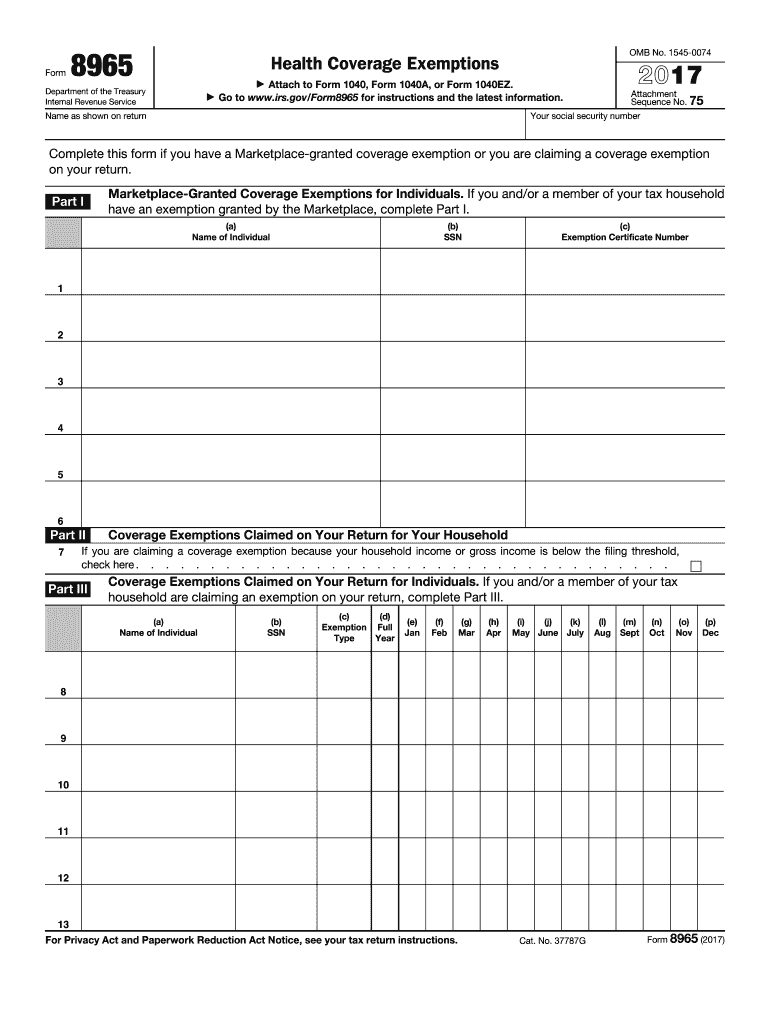
Form 8965 is utilized primarily for reporting health coverage exemptions. Taxpayers need to determine if they qualify for any exemptions and fill out the form accordingly. The form is divided into several parts, each corresponding to different types of exemptions. For example, Part I covers Marketplace-granted exemptions, while Part II is for claiming exemptions based directly on the IRS rules.
- Part I: Exemptions Granted by Marketplace - Use this section if you received an exemption certificate number (ECN) from the Marketplace.
- Part II: Coverage Exemptions for Your Household - Here, list exemptions that apply to individuals in your household.
- Part III: Coverage Exemptions for Yourself - Claim personal exemptions not covered by the previous sections.
Careful attention must be paid to each section to ensure all applicable exemptions are declared.
Steps to Complete the 2014 IRS Form 8965
- Identify Exemptions: Review IRS guidelines and your circumstances to identify which exemptions you qualify for.
- Gather Required Documentation: Collect supporting documents, such as exemption certificate numbers or proof of eligibility for certain exemptions.
- Fill Out the Form: Enter your details and exemption information in the appropriate sections of Form 8965.
- Attach to Tax Return: Ensure that Form 8965 is correctly attached to your main tax return (Form 1040, 1040A, or 1040EZ).
- Review and Submit: Double-check all entries for accuracy and submit them with your completed tax return.
Important Terms Related to 2014 IRS Form 8965
Understanding the terminology used in Form 8965 is crucial for accurate completion. Important terms include:
- Exemption Certificate Number (ECN): A unique identifier provided by the Health Insurance Marketplace for certain exemptions.
- Filing Threshold: The minimum income level at which a person is required to file a federal tax return.
- Household Income: The combined gross income of all members of a household.
Comprehending these terms aids in accurate form completion and exemption claims.
IRS Guidelines for 2014 IRS Form 8965
The IRS provides specific guidelines that outline who must file Form 8965 and under what circumstances exemptions can be claimed. These guidelines include criteria for individual and household exemption claims, acceptable documentation, and submission protocols. The IRS stresses the importance of accuracy in reporting and timely filing to avoid penalties and ensure eligibility for the exemptions claimed.
Required Documents for Completing Form 8965
Certain documents are crucial when completing Form 8965. These may include:
- Exemption Certificate Numbers: Necessary if you received exemptions from the Marketplace.
- Proof of Income: Documentation like W-2s, 1099s, and other income statements.
- Household Size Verification: Documents such as birth certificates or Social Security cards for household members.
Having these documents on hand ensures a smooth form completion process.
Filing Deadlines and Important Dates
The deadline for filing Form 8965 coincides with the general tax filing deadline, typically April 15th. It's essential to submit the form along with your tax return by this date to avoid issues. Extensions on the tax return filing do allow additional time to file Form 8965, but it's pivotal to verify specific conditions with the IRS or consult a tax professional to avoid penalties.
Penalties for Non-Compliance
Failing to file Form 8965 when required or incorrect filing can result in penalties under the Affordable Care Act's individual mandate provision. Non-compliance may lead to fines, which are based on a percentage of household income or a fixed dollar amount, whichever is higher. Accurate filing and exemption reporting are essential to avoid any unintended penalties or legal complications.
Examples of Using the 2014 IRS Form 8965
Various scenarios illustrate the necessity and application of Form 8965.
- Case Study 1: An individual with a financial hardship that made it impossible to acquire coverage must claim an income-related exemption.
- Case Study 2: A family with a Marketplace-granted exemption certificate must report this exemption using Part I of the form.
- Case Study 3: A self-employed person with income below the filing threshold can claim this as an exemption on their tax return using Form 8965.
These examples demonstrate how different situations determine the necessity of Form 8965 when filing taxes.