
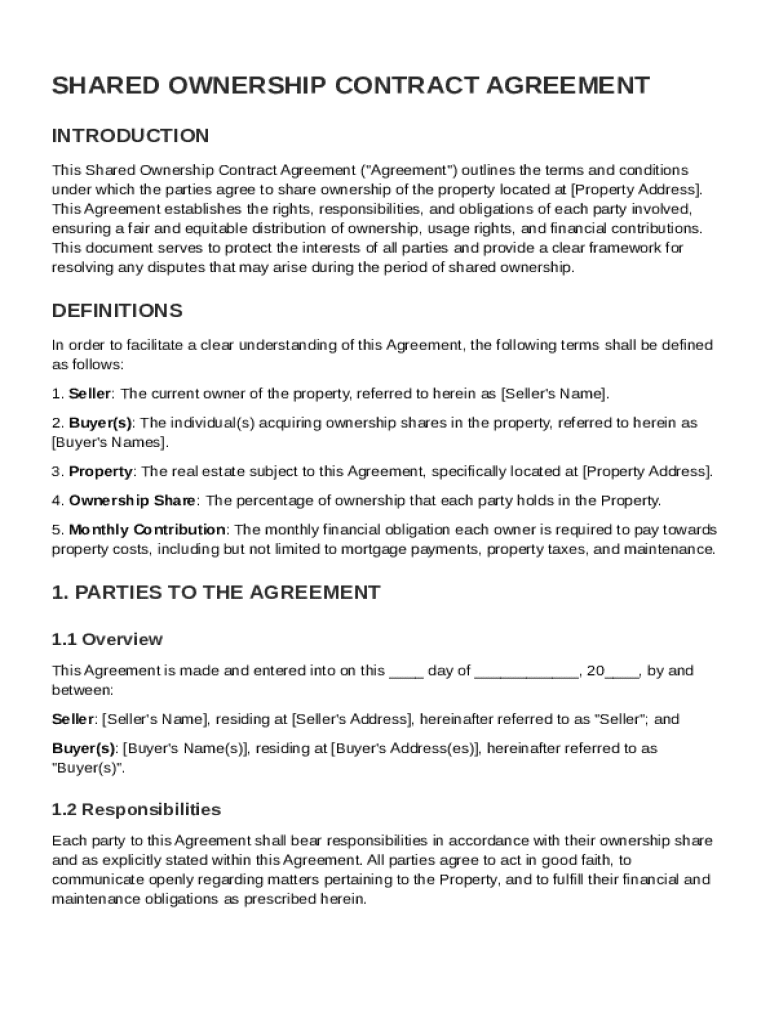




Understanding the Shared Ownership Contract Agreement
The Shared Ownership Contract Agreement is essential for defining the terms of joint property ownership. It sets out the rights, responsibilities, and financial obligations between parties. This document serves as a protective measure ensuring fair management and protecting each party's interests.
- Rights and Responsibilities: The agreement outlines usage rights, management decisions, and each party's roles.
- Financial Obligations: Clearly defines how costs like mortgage payments, taxes, and maintenance will be divided.
- Dispute Resolution: Procedures for resolving disagreements to maintain harmony among owners.
Utilizing the Shared Ownership Contract Template
Using the template simplifies the creation of a comprehensive agreement. It provides pre-formulated sections that guide users through the necessary inclusions without overlooking critical components.
- Customization: Adjust the sections to fit specific needs, adding or removing clauses as necessary.
- Clarity: Follow the structure to ensure no aspect of ownership is left ambiguous.
- Efficiency: Save time by using the template's built-in format rather than starting from scratch.
How to Access the Shared Ownership Contract Template
Accessing the Shared Ownership Contract Template involves choosing a reliable source and method for obtaining the most current version.
- Online Platforms: Many platforms provide templates, ensuring they are up-to-date with legal standards.
- Legal Advisors: Consulting with legal professionals to obtain customized templates.
- Cloud Services: Use services like DocHub to easily download and edit the template on any device.
Completing the Shared Ownership Contract Template
Filling out the Shared Ownership Contract Template requires careful attention to detail to ensure completeness and accuracy.
- Fill Basic Information: Include names, addresses, and contact details of all parties.
- Define Ownership Shares: Clearly state the percentage of ownership each party holds.
- Outline Financial Responsibilities: Itemize financial contributions and obligations.
- Detail Usage Rights: Specify rights concerning the property's use and access.
- Signatures: Ensure all parties sign the document for it to be legally binding.
Key Components of the Shared Ownership Contract Template
Several essential elements must be present to ensure the agreement fully covers shared ownership aspects.
- Title and Introduction: Clearly labeled and descriptive to set the context.
- Party Details: Specific information about each involved party.
- Property Description: Exact legal description of the property involved.
- Financial Arrangements: Terms for ongoing costs and contingencies.
- Termination Clause: Conditions under which the agreement can be dissolved.
Legal Implications of the Shared Ownership Contract
Understanding the legal context of a shared ownership agreement is crucial to its enforceability and effectiveness.
- Compliance: Ensure local and federal legal standards are met.
- Binding Agreement: Considered a legally enforceable contract once signed by all parties.
- Modification Conditions: Procedures for amending the agreement if ownership or circumstances change.
Variations and Alternatives to the Shared Ownership Contract Template
While the Shared Ownership Contract is standard, there are variations and alternatives depending on unique needs or circumstances.
- Joint Tenancy: An alternative where ownership is split equally and includes rights of survivorship.
- Tenancy in Common: Allows more flexibility in ownership shares and is common for unrelated parties.
- Co-Ownership Agreements: Tailored documents that might incorporate other responsibilities not typically covered by standard contracts.
Examples and Practical Scenarios
Real-world examples provide insight into how shared ownership contracts function in practice and may inform potential users.
- Family Arrangements: Often used among family members purchasing property together.
- Co-Investment Ventures: Useful for business partners investing in real estate for shared profit.
- Vacation Homes: Enables multiple families to share investment and access to a secondary residence.
Gathering Necessary Documents for the Shared Ownership Agreement
Compiling the right documents beforehand makes completing the template smoother and ensures all relevant data is available for reference.
- Identity Documentation: Prove identity using government-issued IDs for all parties involved.
- Property Deeds/Descriptions: Verify property details with official documents.
- Financial Statements: Clarify the financial status and obligations of each party.
Digital vs. Paper Versions of the Shared Ownership Contract Template
Choosing between digital or paper formats depends on convenience, legal requirements, and personal preference.
- Digital Format: Allows for easy editing and sharing; services like DocHub facilitate electronic signatures.
- Paper Version: Traditional, sometimes preferred for formal settings or where physical signatures are required.
- Hybrid Approach: Initial drafts might be digital, while final versions are printed and signed in person.
Important Terms in the Shared Ownership Agreement
Familiarize with key legal and financial terms to fully understand and utilize the agreement:
- Tenancy Types: Different forms of co-ownership arrangements.
- Capital Contributions: Initial financial input from parties for acquiring the property.
- Property Tax Liabilities: Each party's responsibility in state and local taxes related to the property.
Considerations for State-Specific Rules
Regulations can vary by state, affecting elements like property taxes, zoning laws, and registration processes.
- State Laws: Understanding your state's property laws ensures compliance.
- Zoning Regulations: Recognize limits on property use or alterations.
- Registration Processes: Procedures for registering the ownership agreement with state or local authorities.