







Definition and Meaning
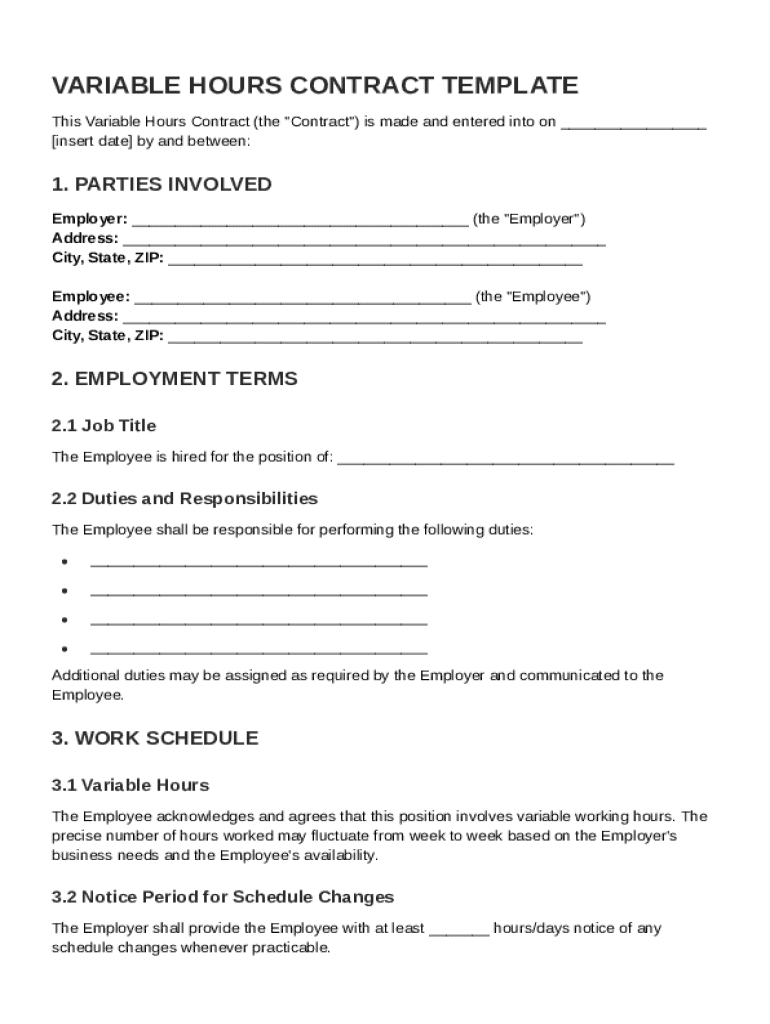
A Variable Hours Contract Template is a legally binding document designed to outline the terms and conditions between an employer and an employee whose working hours may vary depending on the business's needs. This type of contract is especially relevant in industries with fluctuating workloads, such as retail or hospitality. It ensures that both parties clearly understand the terms regarding work schedules, compensation, and other employment conditions. The contract highlights flexible working conditions and defines obligations and rights, which can help avoid disputes and misunderstandings.
Key Elements of the Variable Hours Contract Template
The template includes several critical components that ensure comprehensive coverage of the employment relationship:
-
Parties Involved: Clearly identifies the employer and employee, establishing their legal relationship.
-
Employment Terms: Specifies the duration of employment and conditions under which the employee works, with an emphasis on flexibility in scheduling.
-
Work Schedule: Details how and when the employee will be notified of their working hours, offering mechanisms for scheduling changes, which is crucial for variable hour roles.
-
Compensation and Benefits: Defines how payment is calculated, including hourly rates, overtime rates, and any additional benefits such as healthcare or bonuses.
-
Confidentiality Agreement: Establishes confidentiality obligations for the employee, preserving business interests.
-
Governing Law: Indicates which state’s legal framework governs the contract, affecting interpretation and enforcement.
-
Termination Conditions: Outlines scenarios under which the contract can be terminated, including notice periods and specific conditions prompting termination.
Steps to Complete the Variable Hours Contract Template
Completing this template involves several steps to ensure accuracy and compliance:
-
Enter Party Details: Fill in the employer and employee information, including names and contact details.
-
Define Work Schedule: Clearly articulate the nature of the variable schedule and how shifts will be communicated to the employee.
-
Specify Compensation Details: List hourly wages, pay periods, and any variable pay clauses, ensuring alignment with industry standards and legal requirements.
-
Detail Transportation and Amendments: Note any provisions for variations in contract terms, including the correct procedure for amendments.
-
Review Confidentiality Clauses: Ensure the confidentiality agreement is tailored to the business’s needs and the employee’s role.
-
Establish Termination Procedures: Confirm all conditions under which the contract may be terminated are explicit, minimising conflicts.
-
Legal Compliance Check: Ensure the contract complies with applicable federal and state labor laws.
Why Use a Variable Hours Contract Template
Variable hours contracts offer several advantages that are particularly useful in dynamic work environments:
-
Flexibility: Companies can adjust employee hours based on demand, reducing labor costs during slow periods.
-
Risk Mitigation: Clearly defined terms regarding work hours reduce the likelihood of disputes over work expectations and conditions.
-
Resource Optimization: Helps organizations efficiently manage their workforce, allowing for adjustments according to business cycles.
-
Employee Clarity: Employees understand what to expect in terms of work schedule flexibility, potential changes, and compensation, fostering a positive work environment and reducing turnover.
Legal Use of the Variable Hours Contract Template
Legally, a variable hours contract must adhere to relevant employment laws:
-
Fair Labor Standards Act (FLSA): Ensures compliance with federal regulations regarding minimum wage and overtime.
-
State Employment Laws: Variations in state laws regarding employee rights necessitate reviewing the contract to reflect local requirements.
-
At-Will Employment Clauses: When included, these clauses must be in accordance with state norms, allowing employers to adapt staffing as business needs change.
-
Anti-Discrimination Laws: Contract terms must abide by laws prohibiting discrimination based on race, gender, age, etc.
Important Terms Related to Variable Hours Contract Template
Understanding associated terminology helps clarify the contract’s scope and application:
-
Zero-Hour Contracts: Similar but distinct from variable hours, these contracts offer no guaranteed work hours, unlike variable contracts which may guarantee minimum hours.
-
Part-Time Employment: Variable hours differ from traditional part-time roles where hours are more consistently scheduled.
-
Flex-Time: Although sometimes confused, flex-time typically allows employees to choose their start and end times rather than having hours dictated by the employer's needs.
Examples of Using the Variable Hours Contract Template
Practical scenarios where this template is effective:
-
Seasonal Businesses: Retailers adjusting staffing for holiday seasons can utilize variable hours contracts to handle increased customer volume without committing to permanent hours.
-
Hospitality Industry: Restaurants often require variable staffing to match customer flow, employing such contracts to scale personnel efficiently.
-
Healthcare Services: Facilities may use variable hours contracts to ensure adequate staffing during peak patient volume times or emergencies.
Software Compatibility with Variable Hours Contract Template
The creation, editing, and storage of Variable Hours Contract Templates can be managed using various digital tools:
-
DocHub: Leverage its comprehensive editing and signing capabilities to create customizable, legally binding contracts without needing specialized software installation.
-
Microsoft Office Suite (Word, Excel): Offers tools for drafting and managing templates, though lacking in detailed signing functionalities without add-ons.
-
Google Workspace: Integrated seamlessly through platforms like DocHub, facilitating quick edits and sharing directly through Google Drive.
Employing these software solutions helps streamline the contracting process, ensuring precision, compliance, and ease of access across digital platforms.




