




01. Edit your form online
Type text, add images, blackout confidential details, add comments, highlights and more.

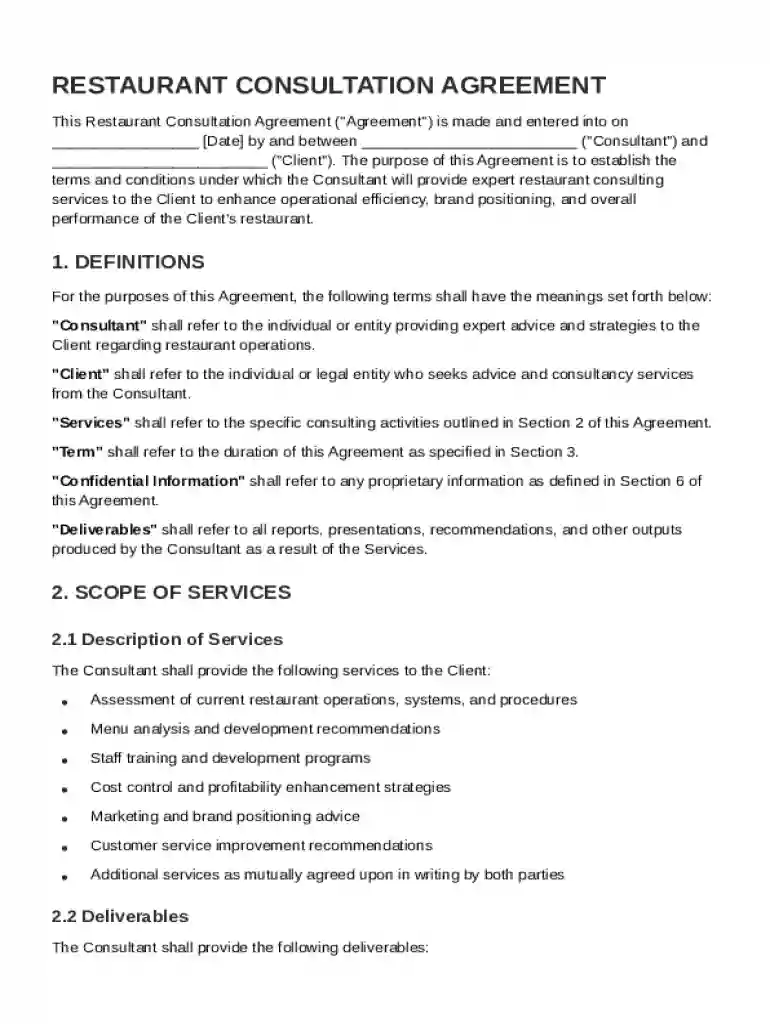
Type text, add images, blackout confidential details, add comments, highlights and more.

Draw your signature, type it, upload its image, or use your mobile device as a signature pad.

Send it via email, link, or fax. You can also download it, export it or print it out.
The Restaurant Consultation Agreement is a comprehensive document that outlines the terms and conditions under which a consultant offers expert services to a restaurant client. These services generally aim to enhance restaurant operations, improve brand positioning, and boost overall performance. The agreement serves as a formal contract, detailing each party's responsibilities and the scope of consulting services. Additionally, it addresses various critical components, such as compensation structure, confidentiality measures, and intellectual property rights. The agreement establishes a clear framework, ensuring a mutually understood and legally binding relationship between the consultant and the client.
When crafting a Restaurant Consultation Agreement, several key elements must be included to ensure a comprehensive understanding between the consultant and the client:
Creating a thorough Restaurant Consultation Agreement involves several critical steps:
The Restaurant Consultation Agreement is a legally binding document valid in the United States. It outlines the contractual relationship between the consultant and the client in the restaurant industry, ensuring legal protection for both parties. The agreement specifies applicable laws such as the governing law that dictates the jurisdiction under which any disputes will be resolved. It also includes enforceable clauses on confidentiality, liability, and compensation, making it essential for delineating legal use and responsibilities. Compliance with legal standards ensures that the consultancy engagement adheres to applicable state and federal regulations.
Understanding the terminology used in a Restaurant Consultation Agreement is crucial for both parties:
The primary users of the Restaurant Consultation Agreement are restaurant owners and consultancy professionals. This contract is valuable for establishments seeking expert guidance to optimize various aspects of their business, such as improving efficiency, implementing marketing strategies, or repositioning brands in the market. Consultants with specific experience in the restaurant industry use this agreement to formalize their engagements with clients, ensuring that both the services rendered and expectations set are clearly documented. The agreement is particularly beneficial for new restaurant owners aiming to gain competitive advantage and seasoned restaurateurs looking to revitalize their operations.


Restaurant Consultation Agreements may be subject to state-specific regulations that influence their enforceability. These rules can include differences in contract law, professional licensing requirements for consultants, and specific disclosure requirements necessary for legal compliance. For instance, some states may have unique stipulations for confidentiality agreements or intellectual property rights that must be incorporated into the contract. Consultants and clients should be aware of these variations to ensure that their agreements comply with all state laws relevant to their jurisdiction, minimizing potential legal disputes.
The Restaurant Consultation Agreement can be composed and managed using various software tools compatible with DocHub and beyond. Digital tools like Word processors (Microsoft Word, Google Docs) and PDF editors (Adobe Acrobat, DocHub) help create, edit, and share the agreement efficiently. These platforms often support seamless integration with cloud storage services like Google Drive, Dropbox, and OneDrive, facilitating collaboration and version control. Software compatibility ensures that the agreement can be accessed, updated, and signed electronically, streamlining the workflow for both consultants and clients.
At DocHub, your data security is our priority. We follow HIPAA, SOC2, GDPR, and other standards, so you can work on your documents with confidence.





Mar 24, 2022 Discover the essential components of a robust consulting agreement. Learn how to create a solid contract with these 12 key elements.
For unincorporated consultants: Consultant shall be responsible for her, his, or its own health, accident, vehicle and other insurance. [ADD THE FOLLOWING TEXT


