Definition & Meaning
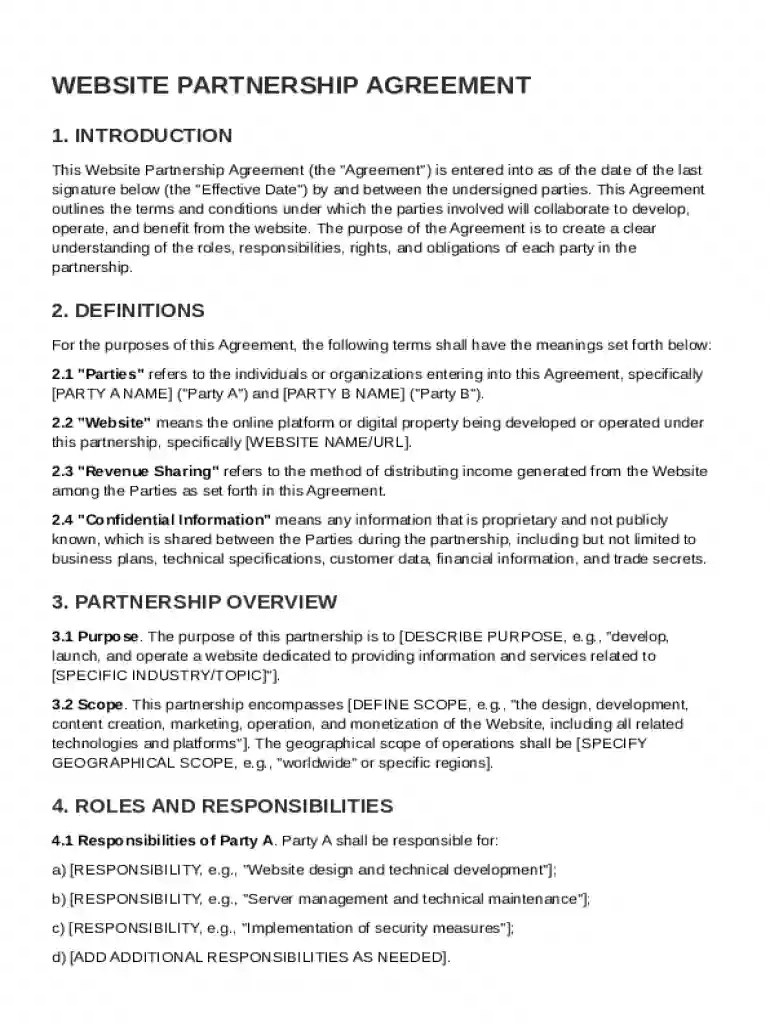
A Website Partnership Agreement Template is a specialized legal document that establishes the foundational terms for a partnership between two parties, typically referred to as Party A and Party B. This template outlines how both parties will collaborate, define their roles, share responsibilities, and cooperate in the development and operation of a website. It ensures a mutual understanding of financial arrangements, intellectual property rights, confidentiality obligations, and dispute resolution processes, ensuring all parties benefit equitably from the partnership.
Key Elements of the Website Partnership Agreement Template
The Website Partnership Agreement Template is composed of several critical elements to ensure clarity and protect the interests of all parties involved:
- Roles and Responsibilities: Clearly outlines each party's role in the collaboration, including specific tasks and obligations.
- Revenue Sharing Models: Details how profits will be distributed between the parties, ensuring transparent financial arrangements.
- Intellectual Property Rights: Specifies ownership and usage rights of any content, design, or technology developed as part of the partnership.
- Confidentiality Obligations: Sets forth the requirements to protect sensitive information exchanged between the parties.
- Dispute Resolution: Includes provisions for how disputes will be handled, such as mediation or arbitration processes.
Steps to Complete the Website Partnership Agreement Template
Completing the Website Partnership Agreement Template involves several methodical steps to ensure accuracy and comprehension:
- Identify the Parties: Begin by naming Party A and Party B, including any relevant company or organizational details.
- Define Purpose: Clearly articulate the purpose of the partnership and the website's intended aim or function.
- Specify Roles: Assign specific roles and responsibilities to each party, detailing what each will contribute to the project.
- Outline Financial Details: Establish the revenue sharing model, including any profit splits or financial contributions.
- Address Ownership and IP Rights: Clearly define who holds the ownership of any developed content or technology.
- Include Legal Protections: Add clauses related to confidentiality, liability, and insurance where applicable.
- Set Term Length and Termination Conditions: Decide on the duration of the agreement and conditions under which it can be terminated.
- Review and Finalize: Each party should review the completed agreement before formally signing.
Legal Use of the Website Partnership Agreement Template
The legal applicability of the Website Partnership Agreement Template ensures compliance with relevant laws and regulations:
- Compliance with ESIGN Act: For electronic signatures, the template adheres to the standards established by the ESIGN Act, making digitally signed agreements legally binding.
- Intellectual Property Laws: Ensures that all parties comply with intellectual property laws, protecting any created content or assets.
- Contract Law: Operates within the boundaries of general contract law, making it an enforceable document in court if necessary.
Who Typically Uses the Website Partnership Agreement Template
Various entities and individuals may find the Website Partnership Agreement Template valuable:

- Business Partnerships: Companies collaborating to launch or manage a website together.
- Freelancers and Consultants: Independent professionals joining forces to offer joint services through a website platform.
- Non-profits and Charitable Organizations: Groups looking to co-develop online platforms for mutual benefit.
- Educational Institutions: Schools and universities partnering with other educational entities to create a shared digital space.
Important Terms Related to Website Partnership Agreement Template
Understanding the terminology used within the Website Partnership Agreement Template is crucial:
- Partnership: A legal relationship in which two or more parties agree to operate a business together.
- Revenue Share: The agreed percentage of profits distributed among the partners.
- Liability: The legal responsibility each party has in the partnership.
- Arbitration: A method of dispute resolution where an independent third party makes a binding decision.
Benefits of Using a Website Partnership Agreement Template
Utilizing a Website Partnership Agreement Template provides several advantages:
- Clarity: Provides a clear understanding of each party's roles and expectations.
- Protection: Offers legal safeguards for both parties, reducing risks associated with business collaborations.
- Efficiency: Streamlines the negotiation process by providing a structured format.
- Encourages Fairness: Established terms mitigate potential conflicts, fostering a more harmonious partnership.
Examples of Using the Website Partnership Agreement Template
Real-world scenarios illustrate the utility of the Website Partnership Agreement Template:
- Tech Startups: Two tech firms collaborate to build a joint web application focused on healthcare services.
- Content Creators: Influencers co-develop a lifestyle blog, sharing the workload and profits.
- eCommerce Ventures: Two businesses join forces to launch an online marketplace, combining resources and expertise.
State-Specific Rules for the Website Partnership Agreement Template
Although the template is generally applicable, specific state laws may influence its provisions:
- California: Requires explicit privacy terms to comply with the California Consumer Privacy Act (CCPA).
- New York: New York State contract laws may impose additional requirements on liability and indemnity terms.
- Texas: May necessitate particular considerations for sales tax implications in eCommerce partnerships.