






Definition and Meaning
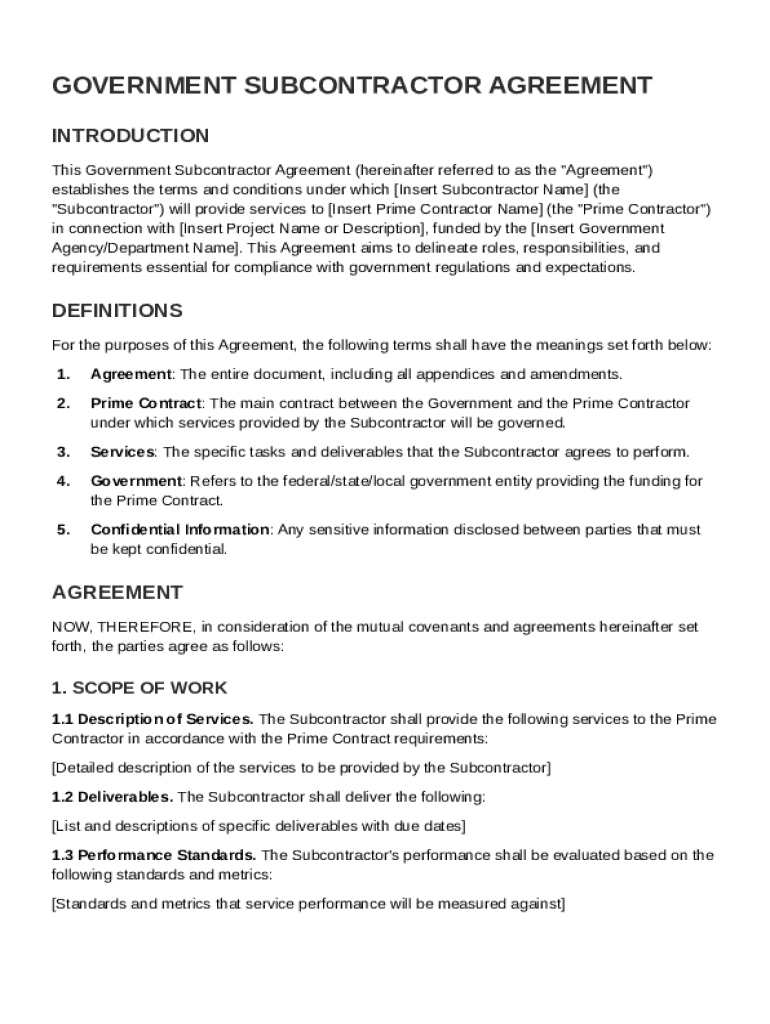
The "Government Subcontractor Agreement Template" is a document used to establish the terms and conditions under which a subcontractor will provide services or products to a prime contractor for a government-funded project. This template outlines critical areas such as the scope of work, compensation, compliance with laws and regulations, and dispute resolution procedures. The agreement ensures that both parties meet government standards and fulfill their contractual obligations with integrity and professionalism. It is essential for maintaining clarity and transparency in subcontractor dealings.
How to Use the Government Subcontractor Agreement Template
When using the Government Subcontractor Agreement Template, it's important to follow structured steps to ensure all critical aspects are addressed:
- Identify Parties Involved: Clearly state the names and contact information of the prime contractor and subcontractor.
- Define Scope of Work: Specify the tasks and responsibilities of the subcontractor in the project.
- Outline Payment Terms: Detail compensation schedules, payment methods, and invoice requirements.
- Compliance and Regulations: Include clauses ensuring that all activities conform to applicable federal, state, and local laws.
- Confidentiality Agreements: Develop terms related to safeguarding proprietary and sensitive information.
- Dispute Resolution: Establish procedures for handling disagreements or breaches of contract.
- Review and Revise: Have legal professionals review the document for accuracy and completeness.
Key Elements of the Government Subcontractor Agreement Template
A comprehensive Government Subcontractor Agreement should contain several key components:
- Identification of Parties: A detailed listing of the parties involved, including any third parties if applicable.
- Scope of Services: A precise definition of work, timelines, and deliverables expected from the subcontractor.
- Payment Structures: Clarification on how, when, and under what conditions payments will be disbursed.
- Compliance Obligations: Assurance sections for adhering to all relevant government regulations and standards.
- Intellectual Property Rights: Agreement on the ownership of work produced and any rights of use.
- Confidentiality Clauses: Protection for any shared confidential information.
- Termination Terms: Conditions under which the agreement may be canceled or revised.
Important Terms Related to the Government Subcontractor Agreement Template
Understanding terminology within the Government Subcontractor Agreement Template is essential:
- Prime Contractor: The primary entity receiving the government contract, responsible for overall project delivery.
- Subcontractor: An individual or company contracted to perform part of the work for the prime contractor.
- Compliance: Adherence to laws, regulations, and standards set by governing authorities.
- Dispute Resolution: Processes applied in settling disagreements between parties.
- Confidentiality: Obligations regarding the non-disclosure of sensitive information.
- Scope of Work (SOW): Detailed outline of work tasks and responsibilities.
Legal Use of the Government Subcontractor Agreement Template
The legal use of the Government Subcontractor Agreement Template is pivotal:
- Regulatory Compliance: The agreement must align with local, state, and federal regulations, ensuring all activities conform to legal standards.
- Binding Contracts: The template serves as a legally binding document, enforceable in courts if disputes arise.
- Electronic Signatures: Utilizing legally recognized digital signatures to streamline approval and keep legality intact per the ESIGN Act.
- Review and Amendments: Legal assistance is recommended to tailor the template to specific project needs, ensuring legal robustness.
State-Specific Rules for the Government Subcontractor Agreement Template
State-specific nuances can affect the application of the Government Subcontractor Agreement Template:
- Variation in Laws: Differences in compliance requirements, tax obligations, and labor laws.
- Licensing Requirements: Certain states may impose specific licensing needs for contractors.
- Reporting Obligations: Varying levels of required reporting related to subcontractor performance and payment.
- Dispute Regulations: Procedures for resolving disputes may differ widely by state.
Examples of Using the Government Subcontractor Agreement Template
There are several scenarios where the Government Subcontractor Agreement Template is applied:
Example 1: An IT company subcontracting a software tool development to a smaller firm to meet a government agency's new system requirements.
Example 2: A construction firm needing specialized electrical services for a federally funded infrastructure project may engage an expert subcontractor through this agreement.
Example 3: Defense contractors often use subcontractor agreements to appoint niche experts providing technology research, meeting stringent government protocols.
Who Typically Uses the Government Subcontractor Agreement Template
Various entities and professionals find utility in the Government Subcontractor Agreement Template:
- Large Corporations: Particularly those involved in defense, technology, and infrastructure sectors engaging with government projects.
- Small and Medium Enterprises (SMEs): Companies offering specialized services like consulting or engineering.
- Legal Teams and Consultants: Advising on compliance, negotiation, and drafting specialized agreements.
- Government Agencies: Utilizing templates when interfacing with prime contractors to ensure compliance and consistency.


Penalties for Non-Compliance
Subcontracting without adherence to a Government Subcontractor Agreement can lead to severe penalties:
- Financial Penalties: Imposed through fines or reduced compensation.
- Legal Action: Resulting from breach of contractual obligations, including potential lawsuits.
- Loss of Contract: Termination of the agreement and potential bans from future government contracting opportunities.
- Reputational Damage: Negative impact on both the subcontractor's and prime contractor's reputation, affecting future business prospects.
By adhering to agreements, ensuring legal compliance, and maintaining transparency, parties involved in subcontracting for government projects can mitigate risks and uphold successful business relationships.