
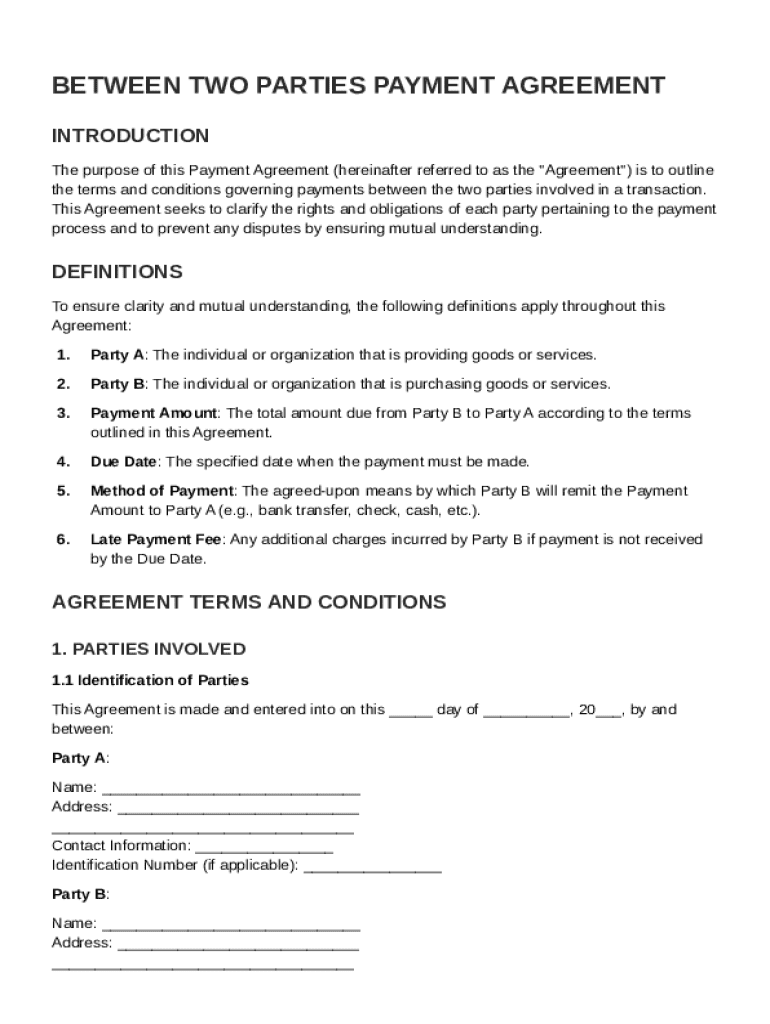







Definition and Purpose
A Between Two Parties Payment Agreement Template serves as a structured document that outlines the terms and conditions under which payments are to be made between two entities. Typically used in transactions involving goods or services, the agreement specifies the identities of the involved parties, often referred to as Party A (the service provider) and Party B (the purchaser). It establishes clear terms regarding payment amounts, due dates, methods of payment, late fees, and processes for dispute resolution. The primary aim of this template is to prevent misunderstandings and disputes by clearly delineating the rights and obligations of each party involved.
How to Use the Payment Agreement Template
Using the Between Two Parties Payment Agreement Template involves several steps to ensure all necessary details and clauses are accurately filled out:
-
Identify the Parties: Clearly state the names and roles of each party involved, identifying who provides the goods or services and who makes the payment.
-
Detail Payment Terms: Outline the agreed payment amount, due dates, and the method by which payments will be made. Specify whether payments are to be made in installments or as a lump sum.
-
Specify Late Fees and Penalties: Include clauses detailing any penalties applicable in the event of late payments to make implications clear to both parties.
-
Dispute Resolution Process: Describe the steps that will be taken to resolve disputes, should they arise, ensuring both parties agree to the specified process.
-
Review and Sign: Once details are finalized, both parties should review the document thoroughly and sign it, either manually or using legally binding electronic signatures.
Steps to Complete the Payment Agreement
Completing the Between Two Parties Payment Agreement Template requires careful attention to detail:
-
Draft Agreement: Begin by entering the basic information such as the names and addresses of both parties.
-
Define Transaction Details: Clearly spell out what goods or services are being exchanged, including precise descriptions and quantities if applicable.
-
Establish Financial Terms: Fill out sections related to monetary amounts, payment schedules, and preferred methods of payment, ensuring consistency throughout.
-
Incorporate Additional Clauses: Include any additional terms like confidentiality agreements or non-compete clauses relevant to the transaction.
-
Verification and Approval: Once completed, both parties should verify the entered information. Legal advice may be sought to ensure compliance with relevant laws. Obtain necessary signatures to validate the agreement.
Key Elements of the Agreement
The Between Two Parties Payment Agreement Template typically includes several key elements that serve to protect the interests of both parties:
- Identity of Parties: Clearly lists both parties involved in the transaction.
- Description of Goods or Services: Detailed description of what is being exchanged.
- Payment Terms: Detailed explanation of payment amount, method, due dates, and late penalties.
- Dispute Resolution: Predefined method for handling disagreements, reducing risk of conflict escalation.
- Governing Law: State the jurisdiction under whose laws the agreement is enforceable, often pertinent if parties are in different states.
Important Terms Related to the Template
Several essential terms frequently appear in a payment agreement:
- Consideration: The compensation agreed upon by both parties, often monetary, in exchange for goods or services.
- Breach of Contract: Occurs when one party fails to fulfill their obligations as outlined in the agreement.
- Indemnification: Protects a party from legal liability for damages or losses.
- Force Majeure: Clauses that relieve parties from obligations due to extraordinary events beyond their control, like natural disasters.
Legal Use of the Payment Agreement Template
Legal considerations for using the Between Two Parties Payment Agreement Template include:
- Compliance with State and Federal Laws: Ensure the agreement is compliant with applicable laws and regulations in the relevant jurisdiction.
- Legal Capacity and Authority: Both parties must have the legal capacity to enter into the agreement, meaning they are recognized as legally competent.
- Signatures: Both parties must sign the document for it to be legally binding; electronic signatures are increasingly recognized under the ESIGN Act.
State-Specific Rules for Agreements
Payment agreements may be subject to different regulations depending on the state:
- Usury Laws: State laws that establish maximum interest rates that can be charged.
- Consumer Protection Laws: Varying regulations designed to protect consumers from unfair business practices.
- Notarization Requirements: Some states may require notarization to validate a document’s authenticity.
Examples of Using the Payment Agreement
Real-world applications of the Between Two Parties Payment Agreement Template offer insights:
- Freelance Services: Freelancers providing services to a company can use the template to outline payment schedules and terms.
- Goods Transactions: A supplier may use the agreement to ensure that payment terms for goods delivered to a retailer are adhered to.
- Installment Plans: For large purchases requiring installment payments, such as machinery or vehicles, buyers and sellers can outline schedules and penalties for defaults.
These examples illustrate the diverse applications of the payment agreement, protecting both parties' interests across various fields and industries.




