




01. Edit your avid cornell notes template online
Type text, add images, blackout confidential details, add comments, highlights and more.

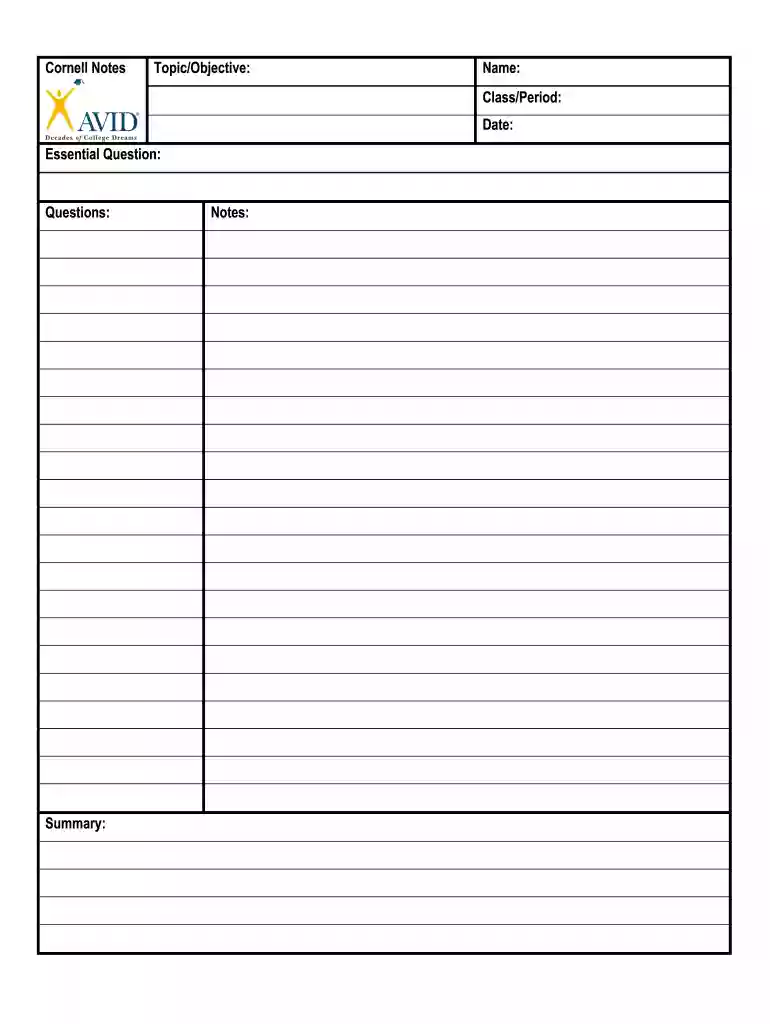
Type text, add images, blackout confidential details, add comments, highlights and more.

Draw your signature, type it, upload its image, or use your mobile device as a signature pad.

Send cornell notes via email, link, or fax. You can also download it, export it or print it out.
Cornell Notes is a systematic method for organizing and reviewing notes from lectures or reading materials. This technique, developed at Cornell University by Walter Pauk, consists of a specific template that encourages active learning and effective retention of information. The format divides the page into three main sections: the right-hand column for detailed notes, the left-hand column for keywords and questions, and a bottom section reserved for summarizing the content. This organized structure promotes awareness of essential concepts, enhances recall, and fosters a deeper understanding of the material.
The core purpose of Cornell Notes is to facilitate engagement with the content. It encourages users to identify main ideas and supporting details as they listen or read, creating a visual representation that aids memory. The systematic approach, alongside reflective summarization at the end, helps learners internalize information more efficiently.
The Cornell Notes system serves a diverse range of educational contexts, empowering students at all levels to retain information more effectively.
Utilizing Cornell Notes is straightforward but requires attention to detail and consistency for maximum effectiveness. The following steps outline how to use the system effectively:
Set Up Your Page: Divide your paper (or digital document) into three sections according to the Cornell method—right-hand side for notes, left-hand side for cues, and a summary section at the bottom.
Take Notes During Lectures or Reading: In the right column, jot down main ideas, explanations, and important details as you engage with the content. Use bullet points for clarity and structure.
Add Cues After the Session: Once the lecture or reading is complete, reflect on the notes taken and write keywords or questions in the left column that relate to the information distilled in the right column.
Summarize the Information: At the bottom of the page, write a brief summary that encapsulates the overall concepts and key points from the material. This section consolidates your understanding and serves as a quick reference.
Review and Revise: Regularly revisit the notes, using the keywords in the left column to prompt recollection of the details in the right column. This practice reinforces learning over time.
Using this method not only helps capture information but also promotes comprehensive review, facilitating long-term retention of knowledge.
The effectiveness of Cornell Notes can be illustrated through various learning scenarios:
Classroom Lectures: In a biology class discussing cellular processes, a student can note down key terms and definitions in the main section while preparing questions regarding specific mechanisms in the left column. A summary of processes like osmosis and diffusion can then be crafted at the end.
Reading Assignments: During a literature review, students can capture major themes and character developments while jotting down significant quotes or potential discussion points on the left. The summary can highlight overarching messages or lessons learned from the text.
Group Study Sessions: When collaborating with peers, one student can take notes using the Cornell method while others can contribute insights. This approach helps compile varied perspectives into a single, organized note structure.
These examples demonstrate that Cornell Notes are adaptable across different subjects and contexts, making them an invaluable tool for numerous academic situations.
The Cornell Notes system offers several advantages that enhance educational experiences:
The combination of these benefits makes Cornell Notes an essential strategy for learners aiming to optimize their study habits and performance.
Different adaptations of the Cornell Notes system cater to specific learning styles or preferences:
These variants ensure that learners can utilize the Cornell method in a way that best suits their individual needs and preferences. Each version retains the core principles of the Cornell technique while allowing for customization that maximizes effectiveness in diverse contexts.
At DocHub, your data security is our priority. We follow HIPAA, SOC2, GDPR, and other standards, so you can work on your documents with confidence.



This page and our Canvas module will teach you about different note-taking systems and styles and help you determine what will work best for your situation.Read more
How to Prepare for Cornell Note-taking: 1. Prepare the Page: Divide your paper into three sections and label each section. 2. Take Notes: While readingRead more


