






Definition & Meaning
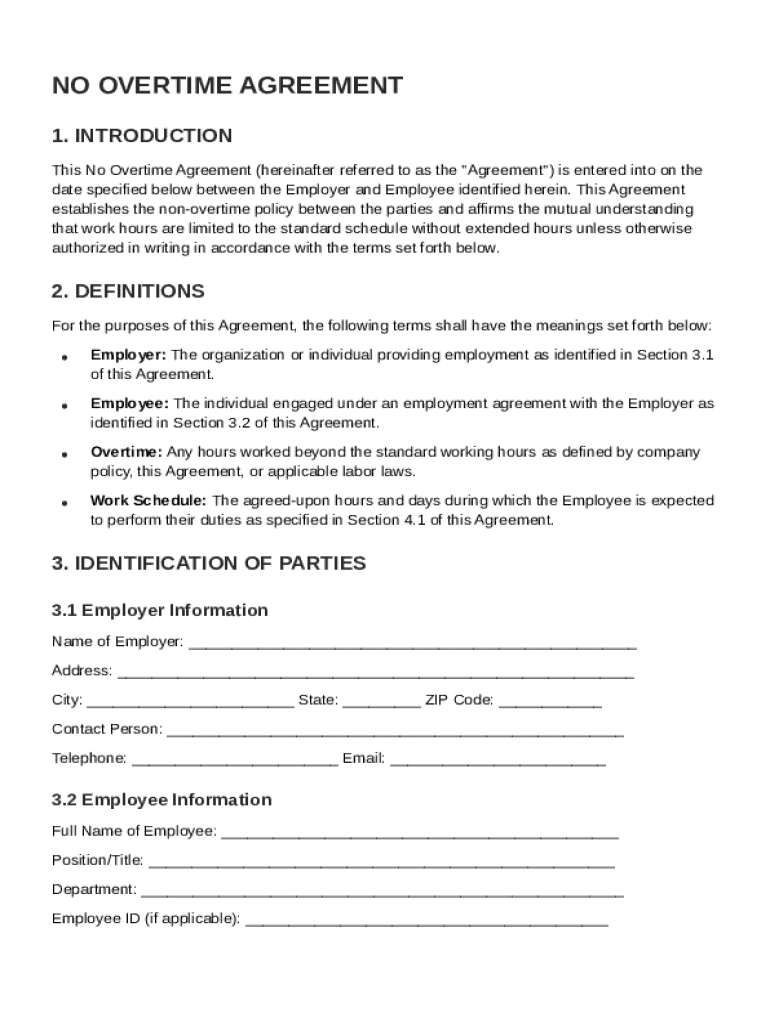
A No Overtime Agreement Template is a legal document designed to formalize the conditions under which an employee consents to work only standard hours without accruing overtime. This agreement is critical in defining the expectations between an employer and an employee concerning working hours. By signing this document, employees acknowledge their understanding that overtime requires prior written authorization from their employer. Such agreements typically include terms that outline the employer’s policy on overtime, any exceptions for emergencies, and the potential consequences for unauthorized overtime. The agreement serves to protect both parties by clearly delineating duties and responsibilities.
Key Elements of the No Overtime Agreement Template
Several fundamental components are crucial to a comprehensive No Overtime Agreement Template:
- Standard Working Hours: Clearly define the regular working hours expected.
- Overtime Authorization: Specify the need for written consent before any overtime is worked.
- Consequences for Non-Compliance: Clarify disciplinary measures if unauthorized overtime occurs.
- Exceptions Clause: Detail situations under which deviations from the no-overtime policy might occur, such as emergencies or critical tasks.
- Modification Procedures: Outline the method for amending the agreement if required.
These elements ensure both clarity and enforceability, serving to prevent misunderstandings regarding working hours and compensation.
Steps to Complete the No Overtime Agreement Template
- Enter Basic Information: Start by filling in the employee's and employer's names, company name, and date.
- Define Standard Hours: Clearly state the regular working hours and days.
- Detail the Overtime Policy: Explain the requirement for prior written approval for overtime work.
- Specify Exceptions: List any permissible exceptions where overtime might be allowed without prior approval.
- Acknowledge Consequences: Describe potential actions for unauthorized overtime work.
- Finalize with Signatures: Both parties should sign and date the document to confirm their understanding and agreement.
Comprehensively completing these steps ensures that the agreement is thorough and legally binding.
Legal Use of the No Overtime Agreement Template
The legal enforceability of a No Overtime Agreement Template hinges on clear articulation of terms and mutual consent. In the United States, such agreements must comply with federal and state labor laws to ensure they are valid and enforceable. Employers must verify that the terms do not contravene labor standards established by the Fair Labor Standards Act (FLSA), which governs overtime pay. Employers and employees should consult legal experts or labor attorneys to ensure their specific context is adequately addressed within the agreement.
Important Terms Related to No Overtime Agreement Template
- Overtime: Work performed beyond the official working hours.
- Standard Hours: Regular work hours agreed upon by both parties without additional pay.
- Authorization: Required prior approval for working extra hours.
- Emergency: An unforeseen situation that may necessitate overtime.
- Disciplinary Action: Possible consequences for violating the agreement.
Understanding these terms is essential for effectively using and interpreting the template.
How to Use the No Overtime Agreement Template
The No Overtime Agreement Template can be adapted to suit various business needs. Begin by customizing it to reflect your organization's specific working hour policies and exceptions. The document can then be presented to employees as part of an onboarding package or distributed to existing staff to clarify company policies on work hours. Regular review and updates may be necessary to address changes in policy or labor laws, ensuring continued compliance and relevance.
Examples of Using the No Overtime Agreement Template
- Corporate Environment: A company establishes a policy prohibiting overtime unless critical deadlines demand it, ensuring projects remain within budget.
- Retail Sector: A store manager uses the agreement to regulate part-time staff schedules, maintaining profitability through controlled labor costs.
- Healthcare Facilities: An agreement prevents unauthorized overtime among nurses, optimizing shift coverage and managing institutional costs.
These examples illustrate the template’s adaptability to different business environments.
Who Typically Uses the No Overtime Agreement Template
The No Overtime Agreement Template is widely utilized by employers in various sectors where regulating work hours is crucial. Businesses such as retail chains, manufacturing plants, and service providers frequently employ these agreements to manage labor costs and maintain scheduling consistency. It is equally useful in industries requiring stringent budget controls, like non-profits and start-ups. Additionally, the template is valuable in sectors with fluctuating workloads that demand clear communication regarding permissible overtime.