






Definition & Meaning
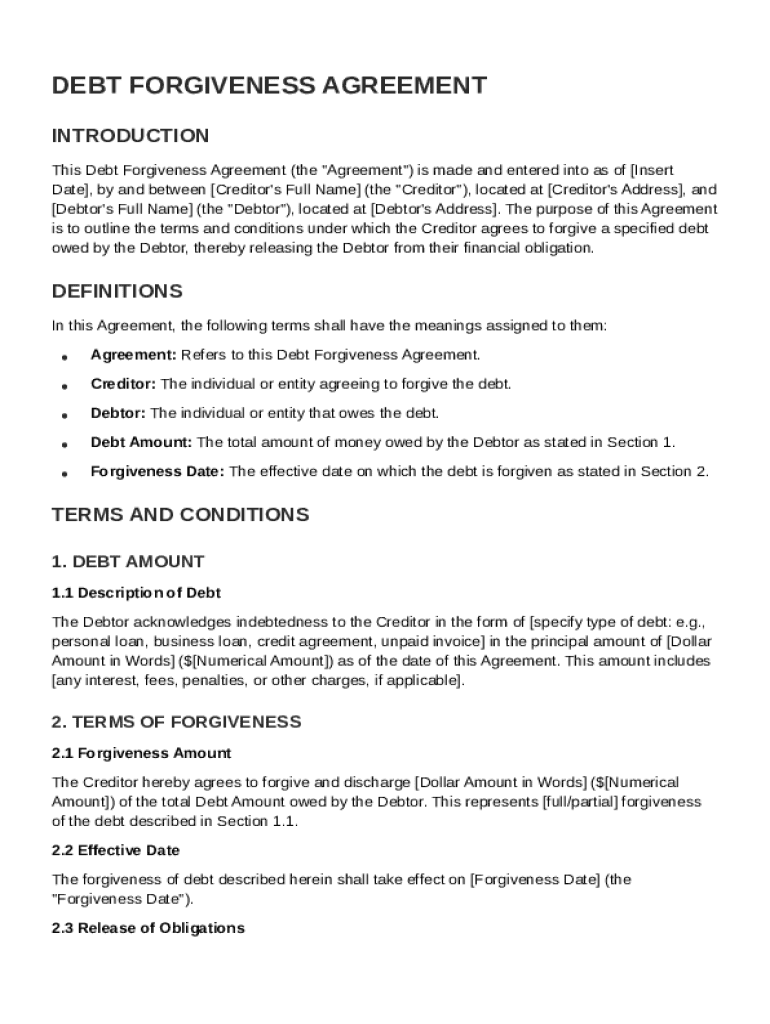
A Debt Forgiveness Agreement Template is a structured document that outlines the terms and conditions under which a creditor agrees to forgive a specified debt owed by a debtor. The agreement typically includes definitions of essential terms, the exact amount of debt being forgiven, and the conditions that must be met for the forgiveness to be valid. This document serves as a legal framework providing clarity and protection for both the creditor and debtor, ensuring that the forgiveness of debt is executed under mutually agreed-upon terms.
Key Components
- Debt Amount: Specifies the total sum being forgiven.
- Conditions for Forgiveness: Outlines what the debtor must fulfill to qualify for the forgiveness.
- Representations and Warranties: Statements made by both parties about their capacity to enter the agreement.
- Indemnification Clause: Protects parties from specific liabilities or risks associated with the agreement.
How to Use the Debt Forgiveness Agreement Template
Using a Debt Forgiveness Agreement Template involves customizing the document to reflect the specific details of the forgiveness arrangement between the creditor and the debtor. It is essential to populate all relevant fields accurately to ensure the agreement is enforceable.
Steps to Utilize the Template:
- Identification of Parties: Fill in the names and contact information of both the creditor and debtor.
- Debt Details: Enter detailed information about the original debt, such as the principal amount, interest owed, and any fees.
- Terms & Conditions: Specify the terms under which the debt will be forgiven, including any preconditions the debtor must satisfy.
- Signatures: Ensure both parties sign and date the agreement to confirm their acceptance of its terms.
Practical Example:
Consider a scenario where a student loan lender agrees to forgive a portion of a borrower's outstanding debt after completion of a certain number of public service years. The template would cover the service requirements and forgiveness terms.
Key Elements of the Debt Forgiveness Agreement Template
The Debt Forgiveness Agreement Template consists of several critical elements ensuring clarity and legal compliance.
Essential Sections:
- Governing Law: Specifies the jurisdiction under which the agreement will be interpreted.
- Amendments and Severability: Details how amendments to the agreement should be handled and which portions remain effective if parts of it are invalidated.
- Effective Date: States when the agreement goes into effect and when the debt is considered forgiven.
Detailed Breakdown:
- For amendments, include procedures such as mutual written consent to cement their validity.
- The governing law section might reference state-specific legal statutes appropriate to the agreement.
Legal Use of the Debt Forgiveness Agreement Template
The use of a Debt Forgiveness Agreement Template must comply with applicable federal and state laws to ensure its enforceability. Legal precision is vital to avoid potential disputes or legal challenges.
Legal Considerations:
- ESIGN Act Compliance: Ensure electronic signatures used in the agreement are legally binding.
- State Variability: Acknowledge that state laws may significantly influence the agreement's enforceability. For example, certain states might require additional disclosures about tax ramifications.
Real-World Scenario:
A nonprofit organization using such agreements to forgive loans granted to small businesses may incorporate IRS guidelines to address potential tax implications for the forgiven party.
State-Specific Rules for the Debt Forgiveness Agreement Template
Given the diverse legal landscape across the United States, the specifics of a Debt Forgiveness Agreement can vary significantly by state. Understanding these differences ensures adherence to local legislation.
State-Specific Elements:
- California: May require specific disclosures about the implications of forgiveness on debtor’s taxable income.
- New York: Could have additional consumer protection laws affecting debt forgiveness agreements.
Practical Application:
If a lender operates in multiple states, they must adjust the template to align with each state's laws, possibly resulting in multiple versions tailored for compliance appropriate to each jurisdiction.
Eligibility Criteria
Determining the eligibility for debt forgiveness is crucial as it ensures only qualified parties receive such financial relief. The criteria should be clear and detailed in the agreement.


Typical Eligibility Requirements:
- Debtor’s Financial Hardship: Documented proof of inability to maintain regular payments due to unforeseen circumstances.
- Timing Criteria: For instance, maintaining a specified period of timely payments before the debt forgiveness initiative applies.
Case Study:
A veteran suffering from medical discharge might qualify for student loan forgiveness through specific military service criteria outlined in the agreement.
Examples of Using the Debt Forgiveness Agreement Template
This template is versatile, applicable across various industries and scenarios. Each use case illustrates the template's adaptability to meet specific needs.
Varied Applications:
- Educational Loans: Schools may offer loan forgiveness to educators after a certain service period.
- Corporate Relocation Loans: Businesses might forgive loans granted to employees who relocate for job requirements after a specified tenure.
In-Depth Example:
Consider a healthcare professional working in underserved areas. A medical institution could use the template to offer loan forgiveness to encourage service in rural locations.
Differences Between Digital and Paper Versions
With advancements in technology, debt forgiveness agreements now often have both digital and paper formats. Each version has distinct attributes beneficial in different contexts.
Comparative Attributes:
- Digital Version: Offers convenience and quick distribution. Allows easy storage and retrieval through platforms like DocHub.
- Paper Version: Preferred for environments where digital tools are impractical. Provides a tangible document easily archived in traditional settings.
Comparative Insight:
For a tech-savvy organization, the digital version's advantages in speed and efficiency are unmatched, whereas non-digital settings might find the paper version more accessible and reliable for routine documentation.