




01. Edit your form online
Type text, add images, blackout confidential details, add comments, highlights and more.

Type text, add images, blackout confidential details, add comments, highlights and more.

Draw your signature, type it, upload its image, or use your mobile device as a signature pad.

Send it via email, link, or fax. You can also download it, export it or print it out.
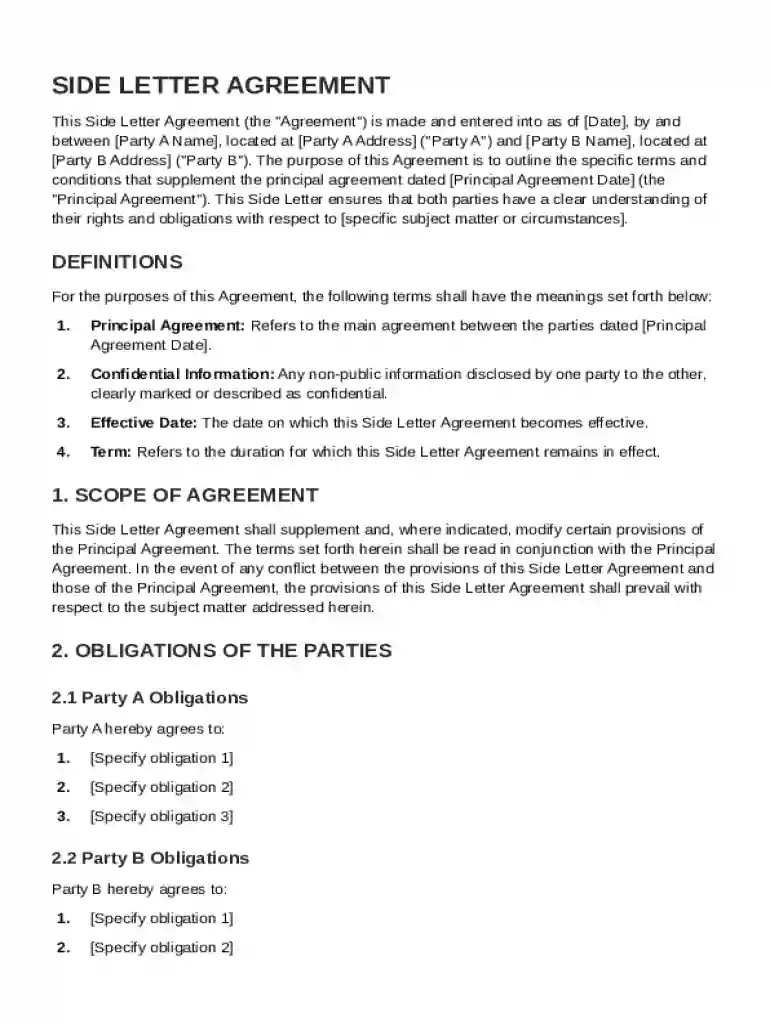
A Side Letter Agreement Template is a legal document used to supplement an existing principal agreement between two parties, often known as Party A and Party B. Its purpose is to outline specific terms and conditions, providing clarity on rights and obligations that are supplementary to the main agreement. These agreements serve to address issues that require confidentiality, specify adjustments, or make provisions that are not covered adequately in the primary contract. They often include essential definitions, detailed obligations of both parties, confidentiality clauses, termination conditions, and methods for dispute resolution. The primary intent of a side letter is to ensure mutual understanding and compliance, addressing any potential conflicts that might arise with the main agreement.
Using a Side Letter Agreement Template involves a series of steps to ensure that it appropriately complements the primary contract. First, identify the needs that merit a side letter, such as clarifications, special incentives, or conditions that may not have been anticipated in the main agreement. Then, draft clear terms within the template that address these specifics. Each term should logically correspond to the primary agreement, preventing any contradictions. After drafting, both parties should review the side letter thoroughly to ensure that the rights and responsibilities are clearly defined and mutually agreed upon. Finally, the side letter must be signed by both parties to make it legally binding.
Side letter agreements are legally permissible as long as they do not contradict the main agreement or violate public policy. They must be crafted with precision to avoid any ambiguity that could be used to undermine their enforceability. These agreements must also be consistent with the laws of the jurisdiction specified in their governing law clause. Proper drafting, coupled with the signatures from authorized representatives of both parties, ensures that side letters retain legal standing as enforceable contracts.
Side Letter Agreement Templates are primarily used by business entities such as corporations, joint ventures, and partnerships. They are also prevalent in industries where complex transactions frequently occur, such as real estate, entertainment, and finance. Legal professionals and contract managers regularly utilize these agreements to fine-tune terms without revisiting the primary contract, adding agility and specificity to business arrangements.


Consider a software development firm entering a contract to deliver a product with specific milestones. They might use a side letter to specify additional support services or software updates that are dependent on future developments, thus providing added value without amending the principal agreement. Similarly, in real estate, side letters might clarify aspects of tenant obligations for improvements or maintenance beyond standard lease terms, accommodating negotiated benefits without altering the primary lease agreement.
At DocHub, your data security is our priority. We follow HIPAA, SOC2, GDPR, and other standards, so you can work on your documents with confidence.




LexCheck integrates directly into Microsoft Word, allowing legal teams to review and negotiate contracts without changing their existing document workflows. TheRead more
Jun 27, 2023 We hand-coded the material terms of each side letter in the sample, identifying more than eighty substantively distinct side letter provisions.Read more


