




01. Edit your form 2290 2013 online
Type text, add images, blackout confidential details, add comments, highlights and more.

Type text, add images, blackout confidential details, add comments, highlights and more.

Draw your signature, type it, upload its image, or use your mobile device as a signature pad.

Send 2290 2013 via email, link, or fax. You can also download it, export it or print it out.
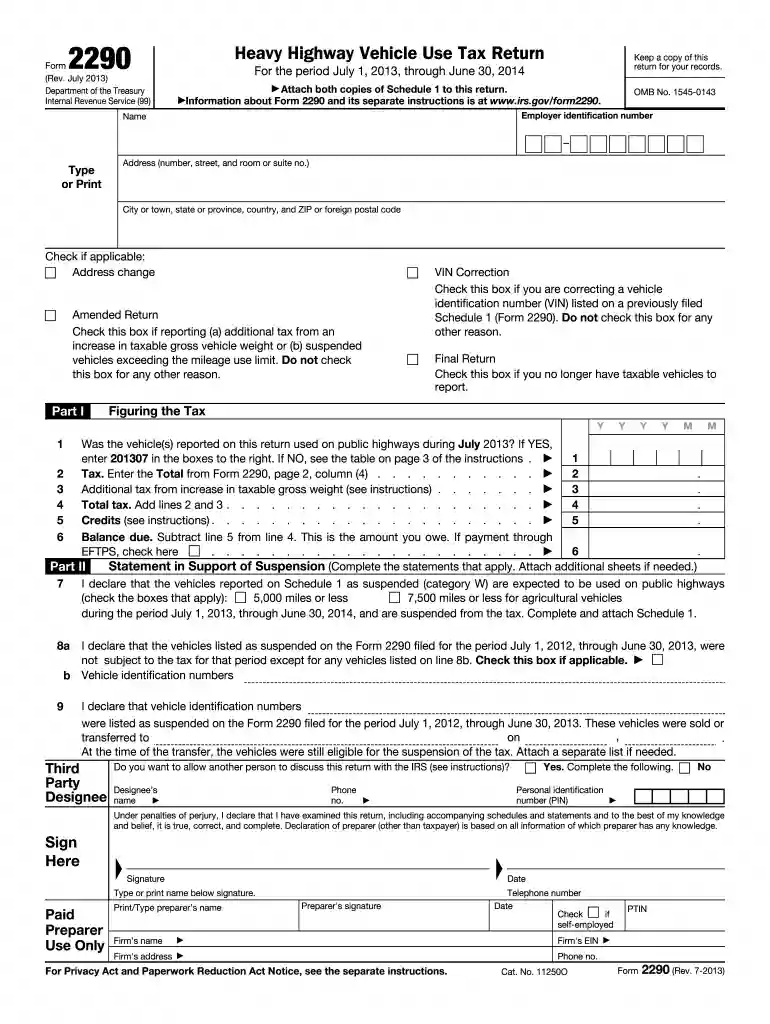
The IRS Form 2290, known as the Heavy Highway Vehicle Use Tax Return, is a crucial document for truckers and owners of heavy highway vehicles operating on public roads in the United States. For the 2013 tax period, which spans from July 1, 2013, to June 30, 2014, this form is used to report and pay taxes on vehicles that weigh 55,000 pounds or more. This tax helps fund highway infrastructure projects and maintain roads across the country.
Vehicle Identification: Begin by listing the Vehicle Identification Numbers (VIN) for each vehicle. Accuracy is essential to avoid discrepancies.
Tax Calculation: Calculate the tax based on the gross weight of the vehicle. Use the tax rates provided by the IRS for the 2013 tax year to determine the amount due.
Schedule 1 Filing: Complete Schedule 1, a part of Form 2290, which is necessary for demonstrating proof of payment. This is key for renewing vehicle registration with state motor vehicle departments.
Amended Returns: If adjustments to initial filings are necessary due to an error or changes in vehicle usage, prepare an amended return. Follow IRS guidelines to ensure compliance.
Payment Voucher (Form 2290-V): Include Form 2290-V if you are submitting a payment by check or money order. This voucher helps the IRS process your payment efficiently.
Gross Taxable Weight: This is the combined weight of the vehicle when fully equipped for service, consisting of the unloaded weight of the vehicle, unloaded weight of trailers, and the maximum load usually carried.
Taxable Gross Weight Category: This term categorizes vehicles by weight ranges, impacting the tax rate applicable.
Suspended Vehicles: Vehicles expected to be under the mileage use limit of 5,000 miles (7,500 miles for agricultural vehicles) are considered suspended and not subject to the tax payment but still require filing.
Annual Filing Deadline: Typically, the tax form must be filed by August 31 of the year that the tax period starts. For the 2013 period, the initial filing deadline was August 31, 2013.
Extended Deadlines: If the date falls on a weekend or holiday, the deadline shifts to the next business day. Confirm current IRS notices for specific year variations.
Proof of Payment: Keep records of all payments made, whether electronically or by check, for IRS verification.
Vehicle Registration Documents: Provide documentation proving ownership and registration of vehicles for alignment with the reported VINs.
Electronic Filing: Recommended for faster processing and is mandatory for fleets of 25 or more vehicles. Use IRS-approved e-filing partners.
Postal Mail: Paper submissions can be mailed to the IRS, but they can take longer to process and are suited for smaller vehicle counts.
Understanding IRS guidelines ensures compliance with the Heavy Highway Vehicle Use Tax regulations. Follow the instructions on completing the form accurately and review IRS updates annually as tax laws and rates may change.
Failure to file or pay the form and its taxes can result in significant fines and penalties. Interest accrues on unpaid taxes from the due date of the return. Ensure accurate and timely submission to avoid fiscal and logistic consequences.
Digital Advantage: E-filing offers prompt acknowledgment from the IRS, serves as a quick receipt, and generally has fewer errors compared to handwritten forms.
Paper Use: While still accepted, paper versions are prone to processing delays and error-induced discrepancies.
Consider a fleet manager responsible for a diverse list of vehicles. For each vehicle exceeding the 55,000-pound threshold, the manager meticulously records VINs, calculates the appropriate tax based on each vehicle's weight category, and ensures compliance through IRS e-filing systems, significantly reducing their operation's regulatory risks.
These blocks are designed to provide comprehensive coverage of the IRS Form 2290 for 2013, delivering essential information for users to understand and comply with the relevant tax obligations. The details synthesize procedural steps and context, equipping users to manage their tax responsibilities effectively.
We've got more versions of the form 2290 2013 form. Select the right form 2290 2013 version from the list and start editing it straight away!
| Versions | Form popularity | Fillable & printable |
|---|---|---|
| 2025 | 4.2 Satisfied (37 Votes) | |
| 2024 | 4.8 Satisfied (56 Votes) | |
| 2023 | 3.2 Satisfied (48 Votes) | |
| 2022 | 4.4 Satisfied (60 Votes) | |
| 2021 | 4.8 Satisfied (181 Votes) | |
| 2020 | 4.4 Satisfied (108 Votes) | |
| 2019 | 4.3 Satisfied (93 Votes) | |
| 2018 | 4.3 Satisfied (63 Votes) | |
| 2017 | 4.2 Satisfied (130 Votes) | |
| 2016 | 4.2 Satisfied (65 Votes) | |
| 2015 | 4.4 Satisfied (50 Votes) | |
| 2014 | 4 Satisfied (43 Votes) | |
| 2013 | 4 Satisfied (27 Votes) | |
| 2012 | 3.7 Satisfied (35 Votes) | |
| 2011 | 4 Satisfied (52 Votes) |
At DocHub, your data security is our priority. We follow HIPAA, SOC2, GDPR, and other standards, so you can work on your documents with confidence.




Schedule 1 (Form 2290) (Rev. 7-2013). Page 8. Form 2290-V, Payment Voucher. Purpose of Form. Complete Form 2290-V if you are making a payment by check or moneyRead more
Aug 31, 2025 The deadline generally applies to Form 2290 and the accompanying tax payment for the tax year that begins on July 1, 2012, and ends on June 30,Read more


