
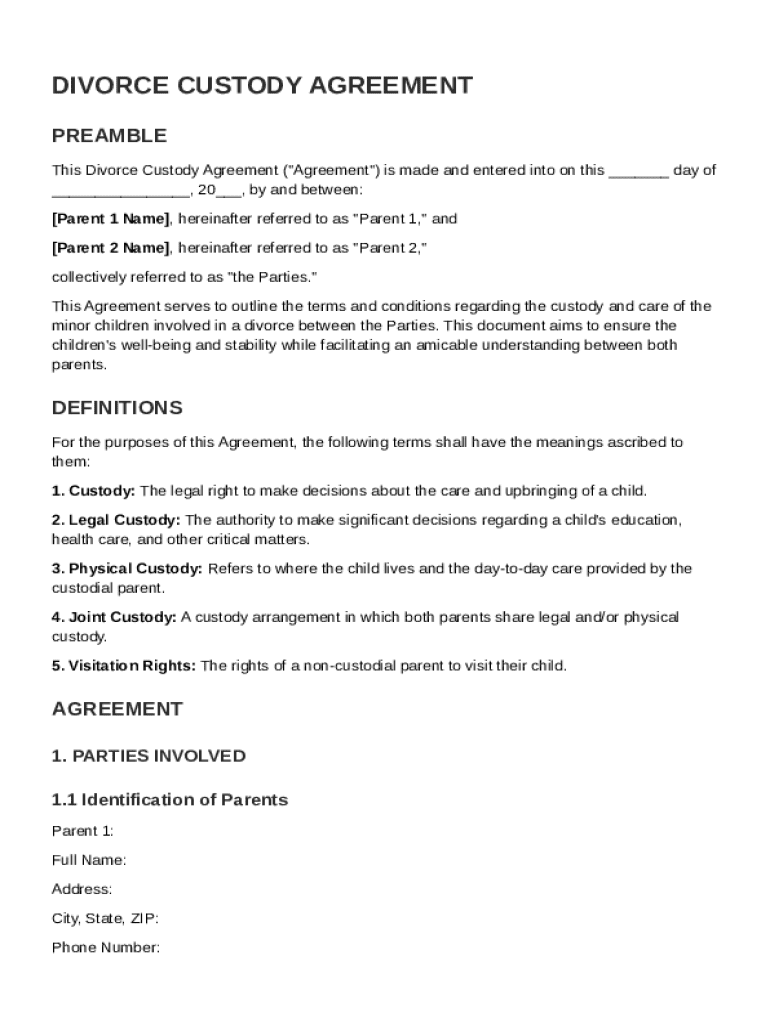







Definition & Meaning
The Divorce Custody Agreement Template serves as a foundational document that outlines the terms for the custody and care of minor children following a divorce. It details arrangements between the divorcing parents regarding legal and physical custody, ensuring both clarity and structure. Legal custody involves decision-making authority over the child's upbringing, while physical custody refers to where the child resides. This template also outlines visitation schedules to facilitate the non-custodial parent's access to their children. Additionally, it includes clauses on financial responsibilities, such as child support and shared educational expenses. Joint decision-making is emphasized to foster cooperation in parenting, ensuring the child’s welfare is the primary focus.
How to Use the Divorce Custody Agreement Template
Using the Divorce Custody Agreement Template involves several steps to ensure clarity and amicable agreements between both parties. Start by reviewing the entire document to familiarize yourself with each section. Next, complete personal information fields for both parents and children involved. Identify and agree on the type of custody arrangement - sole or joint - and define any unique terms fitting your family circumstances.
- Custody and Visitation: Clearly outline visitation schedules, including holidays and special occasions.
- Financial Obligations: Establish agreements on child support, educational expenses, and any other financial responsibilities.
- Dispute Resolution: Detail dispute resolution mechanisms, such as mediation or arbitration, to prepare for potential disagreements.
Ensure both parties review the completed template for accuracy and completeness. Seal the agreement with signatures from both parents and, if required, notarization to validate its authenticity.
Steps to Complete the Divorce Custody Agreement Template
Completing the Divorce Custody Agreement Template requires a sequential approach. Follow these steps to ensure all elements are explicitly covered:
- Gather Required Information: Collect personal information for both parents and children, including full names and addresses.
- Decide Custody Arrangements: Consult your partner to decide whether joint or sole custody fits your situation. Include a rationale for the chosen arrangement.
- Specify Visitation Details: Outline the visitation schedule, ensuring it accounts for weekends, weekdays, and special occasions.
- Determine Financial Support: Calculate necessary financial support, covering child support and other expenses. Clearly state amounts and payment frequency.
- Review and Revise: Carefully review the document with your partner and an attorney, where applicable, to confirm legality and completeness.
- Finalize and Sign: Once both parties agree on all sections, sign the document. It may require notarization to have legal standing.
This step-by-step approach helps ensure all essential details are covered and legally validated.
Important Terms Related to the Divorce Custody Agreement Template
Understanding critical terminology in a Divorce Custody Agreement is vital for ensuring the document’s accuracy and adherence to U.S. legal standards. Key terms include:
- Legal Custody: Authority to make critical decisions regarding the child's health, education, and welfare.
- Physical Custody: Details where the child will live and who will provide day-to-day care.
- Visitation Rights: Non-custodial parent's right to spend time with the child according to a schedule.
- Child Support: Financial contributions from the non-custodial parent to support the child's living expenses.
- Mediation: A conflict resolution process where a neutral third party facilitates agreement between the parties.
Familiarity with these terms ensures clearer communication and understanding between all parties involved.
Legal Use of the Divorce Custody Agreement Template
The Divorce Custody Agreement Template is a legally binding document used to formalize custody arrangements post-divorce. In the U.S., it must comply with state-specific laws that regulate custody and child support. Once both parties sign the agreement, the provisions within become enforceable by law, meaning any breach can be contested in court.
- State Compliance: Ensure the agreement aligns with local jurisdictional laws and court approval may be required in some states.
- Enforcement: Courts enforce terms concerning custody, visitation, and child support, providing a legal framework for resolving violations.
- Modifications: Alterations to the agreement can be made if both parties agree and follow legal procedures, often requiring court consent.
Legal precision in crafting this document protects both parties' interests and promotes the child's best interests.
Key Elements of the Divorce Custody Agreement Template
The Divorce Custody Agreement Template encompasses several crucial elements tailored to safeguard the child's and parents’ rights and responsibilities. These include:
- Custody Arrangements: Detailed provisions for legal and physical custody.
- Visitation Schedules: Specific dates and times allocated for parental visitation, ensuring regular contact.
- Child Support Details: Explicit financial contributions for child maintenance, including calculation methods.
- Parental Responsibilities: Shared responsibilities for significant decisions affecting the child’s life.
- Dispute Resolution Clause: Established methods for handling disagreements without litigation, promoting amicable solutions.
Every element plays a pivotal role in the enforceability and effectiveness of the agreement, making deliberation essential during completion.
State-Specific Rules for the Divorce Custody Agreement Template
Different states across the U.S. may impose specific regulations guiding the formation of custody agreements. These variations necessitate adjustments to the Divorce Custody Agreement Template to comply with local laws:
- Residency Requirements: Many states have stipulations on where the child should reside to establish jurisdiction.
- Visitation Standards: Some states have standard visitation frameworks that may dictate proposed schedules.
- Child Support Calculations: Methods and minimum support levels may differ by state, impacting how finances are documented.
- Court Approval Requirements: Certain states necessitate judicial approval to finalize the agreement.
Consulting a family law attorney familiar with local legal standards can help tailor the template to uphold its legal validity in the relevant jurisdiction.
Examples of Using the Divorce Custody Agreement Template
Practical scenarios illustrate how a Divorce Custody Agreement Template might be applied. Consider the following examples:
- Scenario 1: Parent A, living in New York, agrees to joint legal custody while Parent B, residing in California, has sole physical custody of two children. The template incorporates provisions for extensive holiday visitation for Parent B.
- Scenario 2: Two parents in Florida share custody of their child but disagree on education decisions. Mediation clauses within the template avoid prolonged legal battles by providing a pre-determined arbitration route.
- Scenario 3: A single parent in Texas secures sole custody after the former partner moves overseas, with reciprocal agreement for supervised annual visits documented.
Each scenario demonstrates various ways this template can adapt to fulfill distinct parental and child requirements while respecting legal boundaries.




