






Definition and Meaning
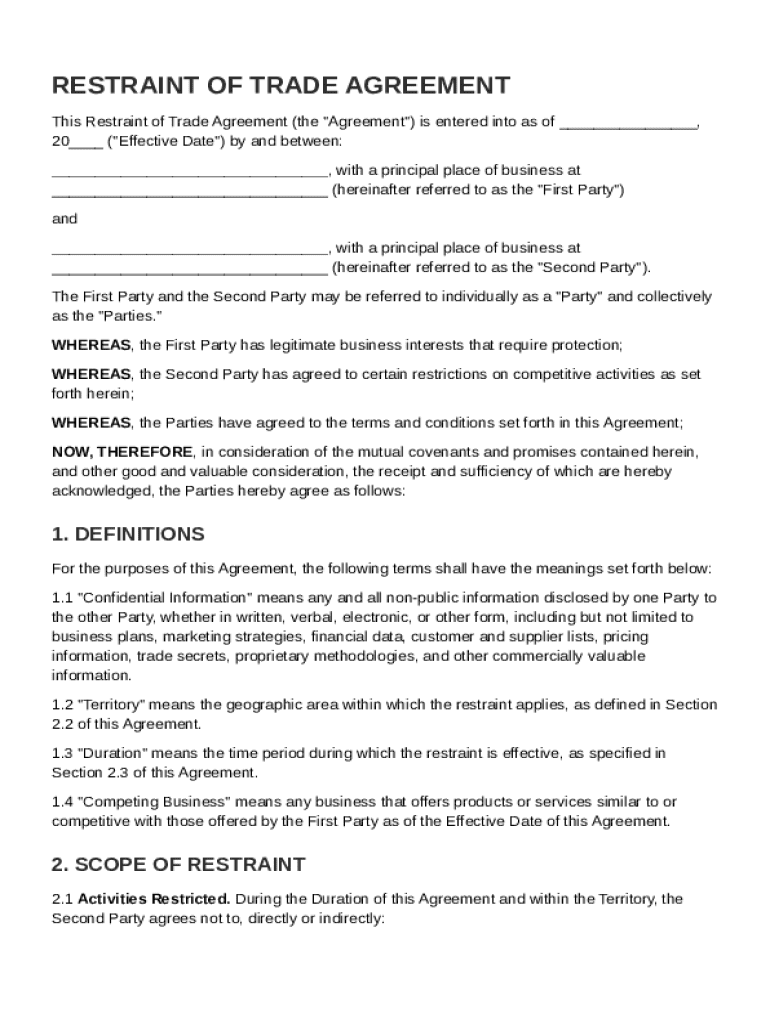
The Restraint of Trade Agreement Template defines the contractual terms outlining restrictions on competitive activities between two parties. This document is crucial for protecting the legitimate business interests of the First Party by preventing the Second Party from engaging in activities deemed competitive during and after the terms of the agreement. Key concepts such as "Confidential Information" are clearly defined, ensuring both parties understand the scope, duration, and territory of the agreed-upon constraints. This agreement is typically tailored to address confidentiality, exceptions, limitations of liability, and the governing law, aiming to ensure compliance and prevent unauthorized disclosures.
Key Elements of the Restraint of Trade Agreement Template
The template serves as a detailed blueprint for structuring an enforceable restraint of trade agreement. Essential components include:
- Confidentiality Provisions: Clauses that maintain the confidentiality of sensitive business information.
- Restriction Scope: Defines activities deemed competitive and barred during and post-agreement.
- Temporal Limits: Specifies the duration for which restrictions apply.
- Geographical Restrictions: Outlines the territory or regions where the restrictions are valid.
- Liability Limitations: Sets out the extent to which each party is liable under the agreement.
- Amendment Procedures: Describes how changes to the agreement can be effectively documented and agreed upon.
These elements ensure comprehensive protection of business interests.
Legal Use of the Restraint of Trade Agreement Template
Understanding the template’s legal context is vital. The agreement must comply with antitrust and competition laws in the United States, which aim to promote fair competition. Courts often scrutinize these agreements under the doctrine of reasonableness, balancing the employer’s protections against the employee's right to work freely. Crafting a legally sound agreement often requires customizing generic templates to meet specific legal requirements, taking into account jurisdictional variations across states.
Steps to Complete the Restraint of Trade Agreement Template
- Identification: Clearly state the parties involved, their roles, and contact details.
- Define Restricted Activities: Enumerate activities or roles considered as direct competition.
- Establish Terms: Outline the duration and geographical applicability of the restrictions.
- Set Confidentiality Clauses: Specify what constitutes confidential information and the protection period.
- Add Legal Provisions: Include governing law and dispute resolution mechanisms.
- Review and Modify: Adapt standard clauses to fit specific business needs.
- Seek Legal Advice: Ensure compliance with laws and seek legal counsel to review terms.
- Sign and Execute: Both parties should sign the agreement, indicating acceptance of terms.
Examples of Using the Restraint of Trade Agreement Template
Considerations include scenarios such as:
- Industry Protection: An IT company might restrict former employees from working with competitors to protect proprietary software.
- Market Expansion: A retail company could prevent former sales managers from starting competing businesses within specific regions.
- Mergers and Acquisitions: During business transitions, agreements can prevent key employees from soliciting clients away, protecting the buyer’s investment.
These examples illustrate the application in various sectors requiring confidentiality and strategic protections.
Important Terms Related to the Restraint of Trade Agreement Template
Key terminologies in the agreement include:
- "Confidential Information": Non-public information proprietary to the business that provides competitive advantage.
- "Non-compete clause": A provision preventing the Second Party from engaging in specified competitive activities.
- "Governing Law": Legal jurisdiction under which the agreement is enforced.
- "Non-solicitation agreement": Restrictions on poaching clients or employees.
Understanding these terms is crucial for precise drafting and execution of the agreement.
State-Specific Rules for the Restraint of Trade Agreement Template
U.S. states have varying interpretations and enforcement of these agreements. Notably:
- California: Generally disallows non-compete clauses, favoring employee mobility.
- Florida: Enforces agreements that are reasonable in scope and duration.
- Texas: Requires agreements to be ancillary to an otherwise enforceable agreement for validity.
The variation emphasizes the necessity of customizing agreements based on jurisdictional laws to ensure enforceability.
Who Typically Uses the Restraint of Trade Agreement Template
This template is widely utilized by:
- Employers: To safeguard proprietary information and maintain competitive advantages.
- Franchisors: To protect branding and market territories.
- Partnerships: To ensure members don’t exploit trade secrets post-association.
Each user group leverages the agreement to align with strategic and competitive objectives, reinforcing its importance in diverse business contexts.