
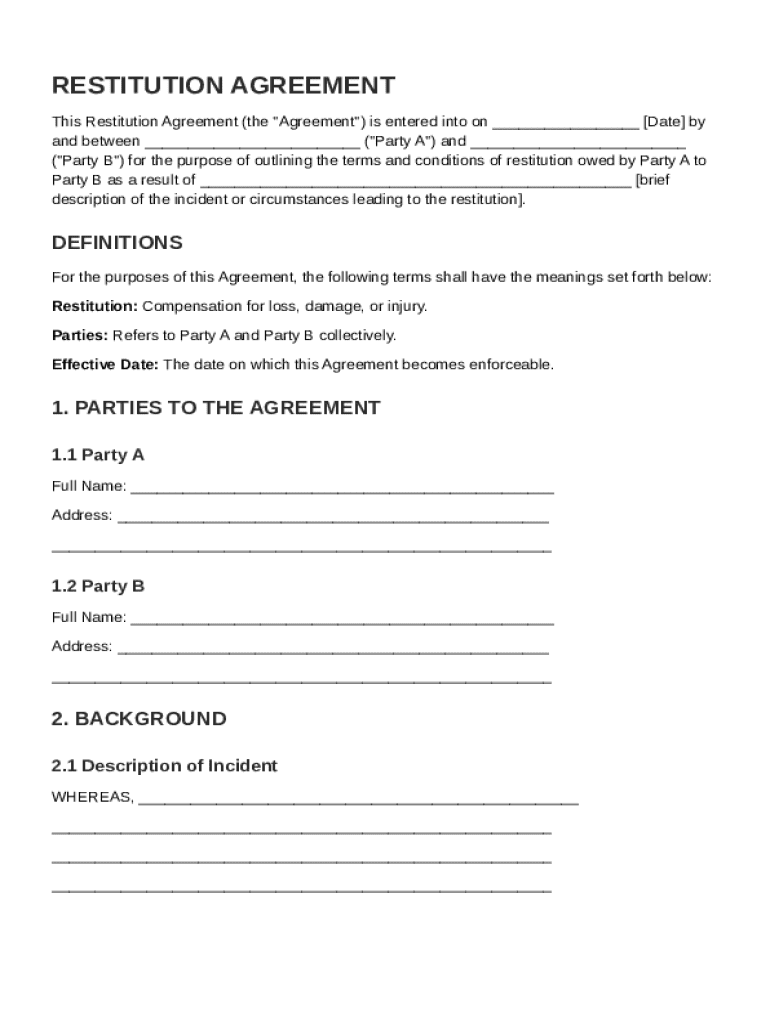







Definition & Meaning
A Restitution Agreement Template is a formal document that outlines the conditions under which one party (Party A) agrees to compensate another party (Party B) for losses incurred due to a specific incident. This agreement is designed to clearly define the responsibilities of each party, specifying the terms of compensation, such as the amount to be paid, the schedule of payments, and any interest applicable on outstanding balances. It also includes critical elements such as mutual release of liability upon fulfillment of the agreement and the laws governing the contract. By providing a structured framework, this template helps ensure that both parties have a clear understanding of their obligations and expectations, minimizing the risk of disputes.
Key Elements of the Restitution Agreement Template
The Restitution Agreement Template includes several crucial elements that provide a comprehensive framework for the compensation process:
- Definitions and Parties Involved: Clearly identifies Party A and Party B, as well as any other relevant entities or individuals involved in the agreement.
- Payment Terms: Specifies the exact amounts to be compensated, the schedule of payments, and any interest rates applied to late payments.
- Mutual Release of Liability: Outlines conditions under which both parties will be free from further claims once the agreement's terms are met.
- Governing Law: States the jurisdiction whose laws will govern the agreement, ensuring legal clarity.
- Amendments Provision: Allows for revisions to the agreement if necessary, with mutual consent.
These elements are integral to creating a legally binding and enforceable agreement.
Steps to Complete the Restitution Agreement Template
Completing a Restitution Agreement Template involves several structured steps to ensure accuracy and compliance:
- Identify the Parties: Begin by filling in the names and contact details of both parties entering the agreement.
- Specify the Incident: Clearly describe the event or circumstances that led to the restitution requirement.
- Outline Compensation Terms: Detail the financial terms, including amounts, payment methods, and schedules.
- Insert Governing Laws: Include the specific jurisdiction and laws that apply to the agreement.
- Review and Sign: Both parties should review the completed agreement thoroughly before signing to confirm their understanding and agreement to all terms.
By following these steps, the parties ensure that the document is complete and legally sound.
How to Use the Restitution Agreement Template
Utilizing the Restitution Agreement Template efficiently requires a clear understanding of its structure and purpose:
- Customization: Adapt the template based on the specific details of your case, ensuring all fields accurately reflect the agreed terms.
- Consult Legal Counsel: It is advisable to have a lawyer review the template to ensure compliance with applicable laws and to address any potential legal issues.
- Execution: Once finalized, the agreement should be executed by obtaining signatures from all involved parties.
- Record Keeping: Retain copies of the signed agreement for future reference, in case any disputes arise.
These practices enable the effective use of the template in resolving the compensation process.
Legal Use of the Restitution Agreement Template
Incorporating a Restitution Agreement Template into legal practice involves understanding its binding nature:
- Legal Enforceability: Once signed, the agreement serves as a legally binding contract between the involved parties.
- Compliance with ESIGN Act: When used electronically, the agreement must comply with the ESIGN Act to ensure signatures are legally recognized.
- Dispute Resolution: The agreement can be used in court proceedings to demonstrate agreed terms and resolve disputes.
Legal expertise can enhance the enforceability of the agreement and provide assurance of its compliance with applicable laws.
Important Terms Related to Restitution Agreement Template
Understanding certain terms associated with the Restitution Agreement is essential for clarity:
- Indemnification: The obligation to compensate for loss or damage as set out in the agreement.
- Interest Rates: The percentage charged on outstanding amounts as agreed in the contract.
- Liability: Legal responsibility for one's acts or omissions, detailed in the agreement.
- Amendments: Changes made to the agreement after its initial execution, requiring mutual consent.
Clarifying these terms helps ensure both parties understand their rights and obligations under the agreement.
State-Specific Rules for the Restitution Agreement Template
U.S. states may have unique requirements or stipulations for restitution agreements:
- California: Requires detailed disclosure of the restitution process and terms.
- New York: Mandates clear definitions of indemnification and liabilities.
- Texas: Specifies interest rates that can be charged on overdue payments.
Familiarity with these and other state-specific provisions can ensure compliance and prevent legal challenges.
Practical Examples of Using the Restitution Agreement Template
Real-world scenarios elaborate on the application and versatility of restitution agreements:
- Business Partnership Dispute: A business partner agrees to compensate the other for losses derived from breach of contract.
- Property Damage: A tenant reimburses a landlord for damages caused to property during their lease.
- Employment Dispute: An employer compensates a former employee for financial losses following wrongful termination.
These examples illustrate the template's adaptability to various situations requiring formalized compensation agreements.




