




01. Edit your form online
Type text, add images, blackout confidential details, add comments, highlights and more.

Type text, add images, blackout confidential details, add comments, highlights and more.

Draw your signature, type it, upload its image, or use your mobile device as a signature pad.

Send it via email, link, or fax. You can also download it, export it or print it out.
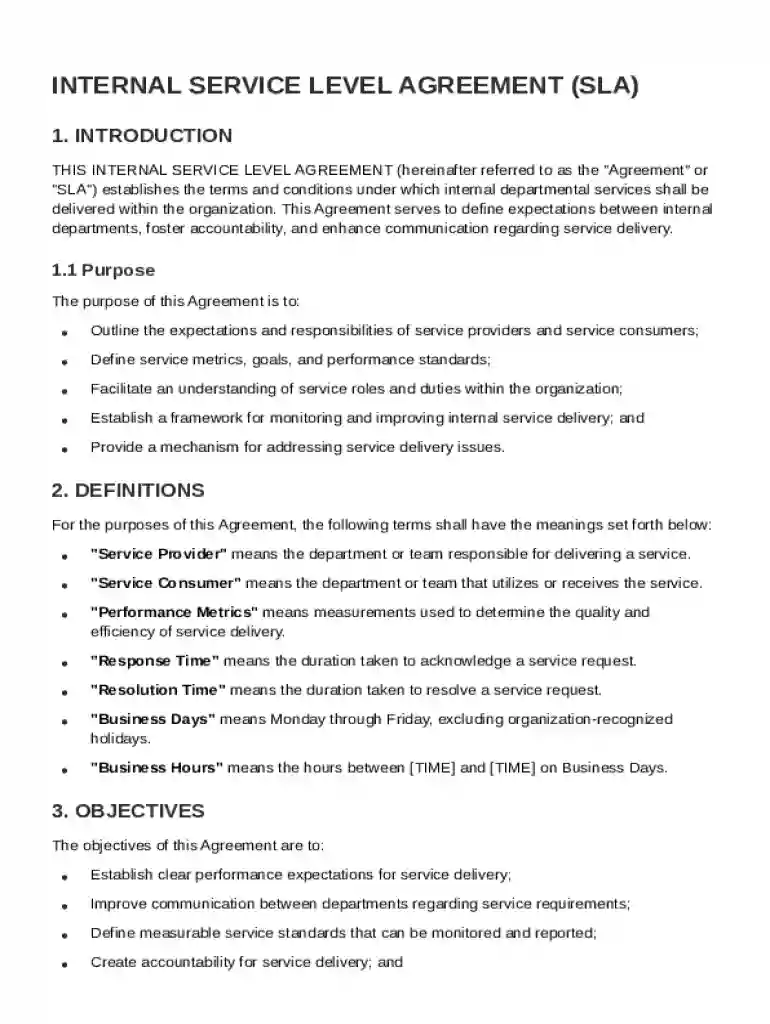
An Internal Service Level Agreement (SLA) is a formalized document used within organizations to define the service expectations between internal departments. This document details the roles, responsibilities, performance metrics, and service standards necessary for effective collaboration and accountability. The goal is to ensure a mutual understanding of service delivery objectives and performance monitoring, enhancing communication and resolving any disputes that may arise.
Crafting an effective Internal SLA involves several critical steps that guide departments in reaching a comprehensive understanding.
Identify Stakeholders: Begin by determining which departments and personnel are involved in the agreement. This ensures that all relevant parties contribute to creating a meaningful SLA.
Define Services: Clearly list and describe the services covered by the agreement. Detailing these services helps manage expectations and sets a clear foundation for accountability.
Set Performance Targets: Establish clear and quantifiable metrics for evaluating the service level. These targets should be realistic and achievable to motivate compliance.
Outline Responsibilities: Assign specific tasks and roles to each department, detailing who is responsible for each aspect of the service delivery.
Develop Monitoring Processes: Create mechanisms to regularly track and report service performance. This step is vital for maintaining transparency and ongoing improvement.
Review and Revise: Regularly revisit the SLA to make necessary adjustments in response to changes within the organization or the environment.
Certain elements are crucial for an effective Internal SLA, creating a robust framework for service expectations and delivery.
Internal SLAs are predominantly used by large organizations where multiple departments need to coordinate service delivery effectively. Common users include:


Understanding specific terminology is crucial for interpreting and constructing an effective SLA.
While the Internal SLA is not a legally binding contract, it serves as a significant organizational document ensuring structured and agreed-upon service delivery within departments. It establishes expectations but should not be confused with external contracts that carry legal obligations.
The practical application of an SLA can span various scenarios:
The Internal SLA template can be effectively managed and integrated using various software solutions. Platforms like DocHub allow for seamless editing, sharing, and signing of agreements, supporting numerous file formats such as DOC, PPT, XLS, and TXT. This compatibility enables easy integration within existing organizational workflows without the need for substantial adjustments in software systems.
At DocHub, your data security is our priority. We follow HIPAA, SOC2, GDPR, and other standards, so you can work on your documents with confidence.






Jul 1, 2026 This Service Level Agreement (SLA) is intended to identify the basic services, and any agreed upon optional services provided by RutgersRead more
THESE TERMS AND CONDITIONS ARE THE CONTRACT BETWEEN YOU (THE CUSTOMER or THE CLIENT) AND WORKFLOWFIRST SOFTWARE LLC (COMPANY) RELATING TO THE SOFTWARERead more
This Service Level Agreement (SLA) defines the terms of the partnership between the Business Services Center (BSC) and the agencies we host, including theRead more


