






Definition & Meaning
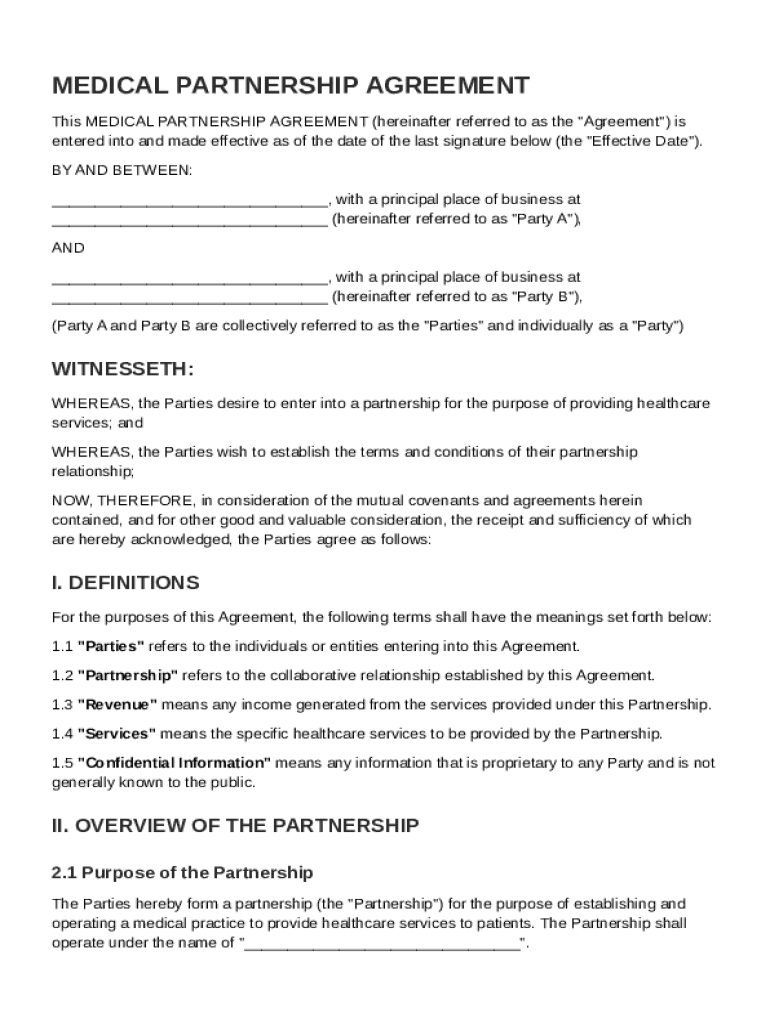
A Medical Partnership Agreement Template serves as a legal document that outlines the terms and conditions for forming a partnership between two or more entities to provide healthcare services. This template is crucial for structuring the operational, financial, and administrative aspects of a medical practice partnership. It typically includes provisions related to profit-sharing, capital investments, decision-making processes, confidentiality, liability, and the responsibilities each party must fulfill.
Key Provisions
- Profit Sharing: Details how profits will be distributed among partners.
- Capital Contribution: Specifies the initial capital each partner must invest.
- Decision-Making: Outlines the processes for making major business decisions.
- Confidentiality: Ensures protection of patient and business information.
Understanding Its Importance
Using a Medical Partnership Agreement protects all parties involved by clearly defining roles, responsibilities, and expectations. This document is not only a protective measure but also a proactive approach to managing disputes and aligning business goals.
How to Use the Medical Partnership Agreement Template
Using a Medical Partnership Agreement Template involves a series of careful steps that ensure the agreement reflects the specific needs and conditions of the parties involved. This template acts as a foundational document that can be customized to suit the unique dynamics and objectives of the partnership.
Steps to Customize
- Consultation with Legal Experts: Engage healthcare law professionals to advise on necessary legal provisions.
- Drafting Initial Terms: Start with the basic template and input the core elements agreed upon by all parties.
- Customization: Tailor sections such as financial arrangements and operational responsibilities to meet specific partnership needs.
Practical Examples
For instance, if two medical practices decide to merge, the Medical Partnership Agreement Template can define how both entities' assets and liabilities will be managed under the new partnership.
Key Elements of the Medical Partnership Agreement Template
The template encompasses several crucial elements that ensure a comprehensive and legally sound partnership agreement. These elements are vital to the template's structure and functionality, addressing various aspects of the partnership.
Core Components
- Roles and Responsibilities: Clearly delineates the duties of each partner within the practice.
- Termination Clause: Specifies conditions under which the partnership may be dissolved.
- Dispute Resolution: Provides a framework for handling conflicts through mediation or arbitration.
Detailed Breakdown
- Financial Clauses: These outline the financial duties, including how shared expenses and revenues are managed.
- Regulatory Compliance: Ensures all activities align with federal and state healthcare regulations, maintaining legal integrity.
Legal Use of the Medical Partnership Agreement Template
The legal application of a Medical Partnership Agreement Template involves several compliance factors to ensure the document's enforceability and alignment with applicable healthcare laws.
Legal Considerations
- Regulatory Compliance: Adheres to federal healthcare laws such as the Stark Law and Anti-Kickback Statute.
- Binding Agreement: Acts as a legally binding contract once signed by all parties involved.
Compliance Examples
For example, the document must ensure all business practices adhere to patient confidentiality laws under the Health Insurance Portability and Accountability Act (HIPAA).
Who Typically Uses the Medical Partnership Agreement Template
This template is predominantly used by healthcare providers who are looking to form partnerships, such as doctors, clinics, and healthcare facilities. It is instrumental in facilitating cooperation between parties who share common business interests in the medical field.


Typical Users
- Physician Groups: Doctors forming a partnership to share resources and expand services.
- Medical Practices: Independent practices merging to increase market reach and enhance service delivery.
Practical Context
Consider a scenario where a pediatric practice wishes to partner with a family medicine group to offer more comprehensive patient care; a Medical Partnership Agreement Template would formalize this new collaborative effort.
State-Specific Rules for the Medical Partnership Agreement Template
Each state may impose different regulations and requirements regarding medical partnerships, influencing how the Medical Partnership Agreement Template is utilized.
State Variations
- Licensing Requirements: Depending on the state, the agreement may need to address specific licensing prerequisites.
- State Laws: Some states might have unique partnership regulations that affect profit sharing and ownership structures.
Case Study
For example, California has specific legal requirements regarding who can own a medical practice, affecting how agreements are drafted for partnerships within the state.
Digital vs. Paper Version
The advent of digital documents has transformed how Medical Partnership Agreements are created and maintained. Choosing between digital and paper versions depends on convenience, security, and the technological capabilities of the involved parties.
Advantages of Digital Versions
- Ease of Access and Storage: Digital versions allow for easy access and secure storage.
- Real-Time Edits and Collaboration: Facilitates real-time updates and enables collaboration across locations via platforms like DocHub.
Considerations
While digital versions offer convenience, ensuring that electronic signatures comply with laws like the ESIGN Act is necessary to maintain legal validity.
Important Terms Related to the Medical Partnership Agreement Template
Understanding the specific terms used within a Medical Partnership Agreement Template is crucial for ensuring all parties comprehend their rights and obligations.
Common Terms
- Capital Account: A ledger that records a partner's investment in the partnership.
- Fiduciary Responsibility: The obligation to act in the best interest of the partnership and its shared benefits.
- Non-Compete Clause: A provision preventing partners from starting a competing practice within a defined area.
Explanation of Terms
For example, fiduciary responsibility implies that all partners must prioritize the partnership's success and not engage in activities that could harm the business or its reputation.