




01. Edit your form online
Type text, add images, blackout confidential details, add comments, highlights and more.

Type text, add images, blackout confidential details, add comments, highlights and more.

Draw your signature, type it, upload its image, or use your mobile device as a signature pad.

Send it via email, link, or fax. You can also download it, export it or print it out.
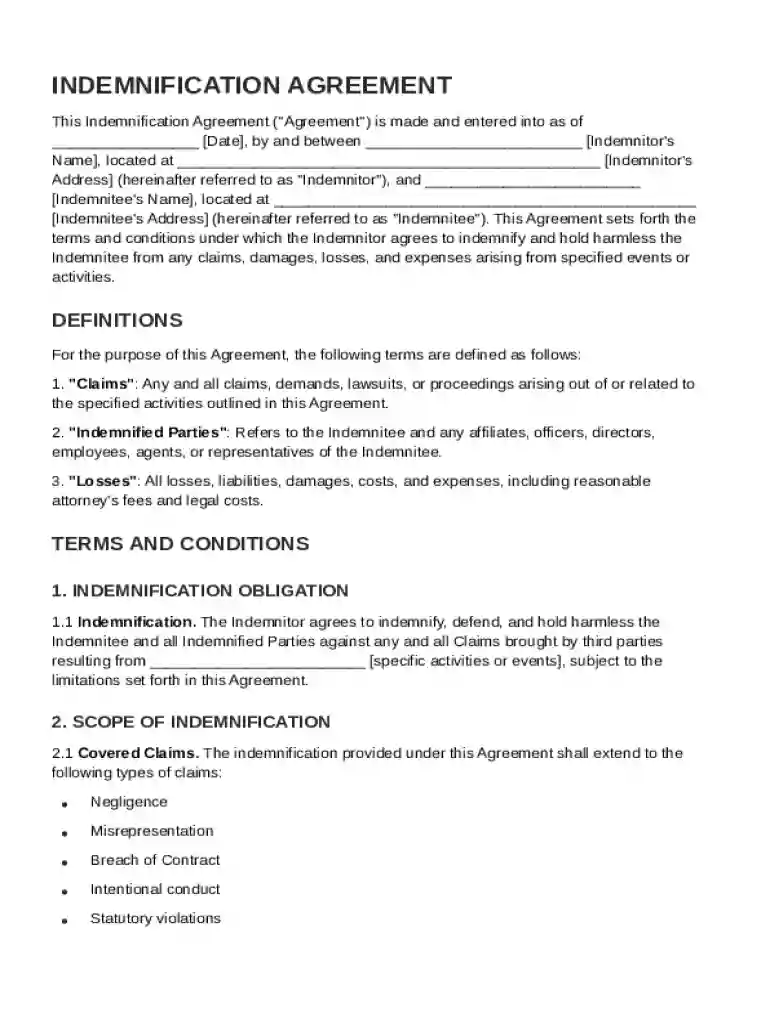
The Indemnification Agreement is a legal document that articulates the terms under which one party, known as the Indemnitor, agrees to compensate another party, the Indemnitee, for any claims, damages, losses, or expenses that may arise due to specific activities. The agreement's purpose is to protect the Indemnitee from financial liabilities that could occur from third-party claims or unforeseen incidents. This type of agreement is prevalent in various business contexts, ensuring that stipulated risks are managed efficiently and transparently. For instance, a construction company might use an indemnification agreement to ensure that a subcontractor bears the costs of any legal disputes resulting from their work.
An Indemnification Agreement Template serves as a standardized document that can be customized to suit specific circumstances. Users should start by identifying the parties involved and the scope of activities covered by the agreement. The template usually contains sections where users can input the indemnification scope, limitations, and conditions under which indemnification obligations are triggered. It is crucial for both parties to carefully review each section, ensuring that the legal obligations are clear and mutually agreed upon. For example, if a tech startup is entering a partnership with a larger corporation, the template can be adapted to cover liabilities related to software development and data security breaches.
The template generally includes several crucial components that ensure its effectiveness and enforceability:
These elements must be carefully tailored to match the specific needs and legal requirements of the parties involved.
The legal enforceability of an Indemnification Agreement depends on its proper drafting and compliance with applicable laws. In the United States, such agreements are generally upheld by courts if they adhere to standard legal principles, including clear language and mutual consent. It's essential for the document to be comprehensive, covering all potential liabilities and specifying the exact nature of indemnification. To ensure legal compliance, parties may seek legal counsel to review the agreement, especially when complex or high-risk activities are involved. For example, a contract manufacturer may use an indemnification agreement when entering a new production contract, ensuring protection from patent infringement claims.
State laws can significantly impact the interpretation and enforcement of indemnification agreements. Certain states have specific statutes limiting the scope of indemnity clauses, particularly in construction contracts, to prevent unfair risk allocation. For instance, in California, any provision in a construction contract that purports to indemnify the promisee against liability for damages arising from their own active negligence is void. Parties should be aware of these jurisdictional nuances and may need to adapt the template accordingly or seek legal guidance to ensure compliance.
Completing the Indemnification Agreement Template involves a systematic approach to ensure all details are accurately captured:
Understanding the terminology used in indemnification agreements is crucial for ensuring the parties' obligations are clear. Key terms include:
Each term must be explicitly defined within the agreement to avoid ambiguity and ensure mutual understanding.
Indemnification Agreements are used across various industries and scenarios. In technology, a company providing cloud services may require clients to sign an indemnification agreement to protect against data breach claims. Similarly, a real estate developer might use such an agreement when hiring contractors to shield itself from liability for accidents on a construction site. By adapting the template to meet industry-specific risks, parties can effectively manage potential exposures.
This template is commonly utilized by businesses and individuals engaging in activities that could pose legal or financial risks. Corporations, small businesses, freelancers, contractors, and even non-profit organizations may rely on indemnification agreements to manage potential liabilities. Any entity involved in partnerships, service agreements, or projects with inherent risks can benefit from using this legal tool to protect its interests efficiently.


At DocHub, your data security is our priority. We follow HIPAA, SOC2, GDPR, and other standards, so you can work on your documents with confidence.


Indemnification -- The basic one-way Sponsor indemnity, conduct of the study, (2) notification, and (3) right to control defense.
To indemnify, also known as indemnity or indemnification, means compensating a person for damages or losses they have incurred or will incur related to aRead more


