
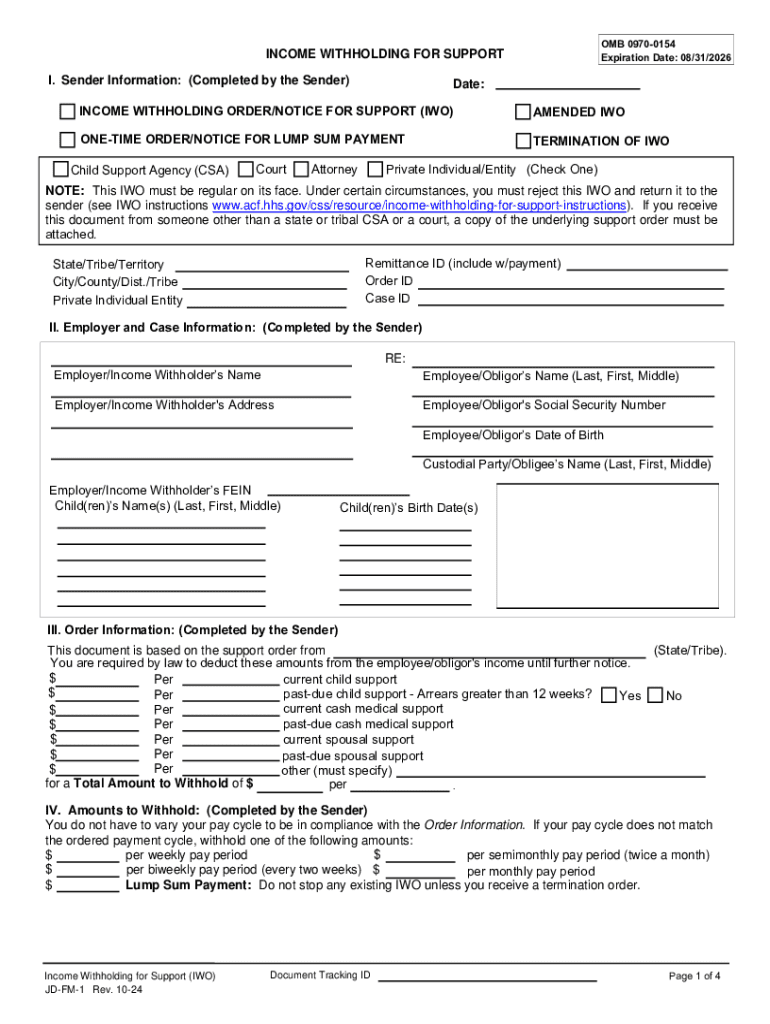







Definition and Meaning of Income Withholding for Support
Income Withholding for Support (IWO) is a legally mandated process used to ensure timely and efficient collection of support payments, specifically child and spousal support. Under this system, an employer directly withholds the specified amount from an employee's wages and remits it to the relevant state authority responsible for child support enforcement. This mechanism is a crucial tool for guaranteeing that support obligations are fulfilled consistently and without delay.
Steps to Complete the Income Withholding for Support
-
Receive the IWO Notice: Employers will receive an official notice indicating the need to withhold income as per a court order or administrative process.
-
Verify Details: Carefully review the notice to ensure all employee, employer, and case information is accurate. Any discrepancies should be communicated to the issuing authority promptly to avoid legal complications.
-
Calculate Withholding Amount: Follow the guidelines outlined in the IWO notice regarding the specific percentage or monetary amount that needs to be withheld from the employee’s income. Ensure this calculation complies with both federal and state withholding limits.
-
Implement Withholding: Begin withholding the specified amount from the employee's wages within the timeframe indicated in the notice, ensuring no undue delay.
-
Remit Payments: Forward the collected amount to the designated agency as per the notice specifications. Remittance instructions are typically included in the IWO, detailing methods and timing of payments.
-
Keep Records: Maintain detailed records of all transactions and correspondences related to the IWO for future reference and compliance verification.
Legal Use of the Income Withholding for Support
The IWO process complies with both federal and state laws regarding support enforcement. Under federal regulations, such as the Personal Responsibility and Work Opportunity Reconciliation Act (PRWORA), employers are legally obligated to withhold the specified support amounts. Furthermore, the IWO serves as a safeguard for custodial parents, ensuring that financial support is consistently provided for the welfare of dependents. Each state may have specific provisions related to the enforcement and administration of the IWO, which employers must adhere to ensure compliance.
Key Elements of the Income Withholding for Support
-
Sender Information: Includes details about the agency or individual who issues the IWO, ensuring clarity about the source of the notice.
-
Employer and Case Details: Information about the employer responsible for withholding and the specific child support case related to the deductions.
-
Order Information: Outlines the legal basis for the withholding, including court orders if applicable.
-
Amounts to Withhold: Specifies the exact monetary amount or percentage of income to be withheld.
-
Remittance Instructions: Provides directions on how and where to remit the withheld funds.
-
Employer Responsibilities: Outlines the obligations of employers, such as timelines for compliance and penalties for non-compliance.
State-Specific Rules for Income Withholding for Support
While the IWO is federally regulated, specific procedures and limits can vary by state. These include variances in maximum withholding limits, administrative processes for contesting an IWO, and specific remittance protocols. Employers must familiarize themselves with the state-specific guidelines applicable to each employee’s case to guarantee compliance with local regulations. State child support agencies often provide detailed guidance and support to employers navigating these differences.
Important Terms Related to Income Withholding for Support
-
Obligor: The individual who owes the support payments, typically the noncustodial parent.
-
Obligee: The recipient of support payments, usually the custodial parent or legal guardian.
-
Disposable Income: The portion of an employee's earnings remaining after mandatory deductions, which is considered for withholding.
-
Administrative Fee: Some states allow employers to deduct a nominal fee from the employee's pay for processing the IWO.
Penalties for Non-Compliance
Employers who fail to comply with an IWO may face penalties, including fines or legal action. Non-compliance can result from failing to begin withholding in the specified timeframe, withholding incorrect amounts, or delaying the remittance of funds. Employers might also be held liable for the entire amount that should have been withheld if they neglect their responsibilities. Therefore, it is essential for employers to establish protocols to handle IWOs accurately and efficiently.
Examples of Using the Income Withholding for Support
Consider the case of a divorced parent who is required to provide child support. With the IWO process, the parent's employer deducts the designated amount directly from their paycheck, ensuring the ex-spouse receives timely payments. Another scenario involves an individual with a past due support balance. The IWO can be adjusted to include an additional amount aimed at gradually settling arrears. These examples highlight the effectiveness of income withholding as a tool for maintaining the consistency and reliability of support payments.




