







Definition and Meaning
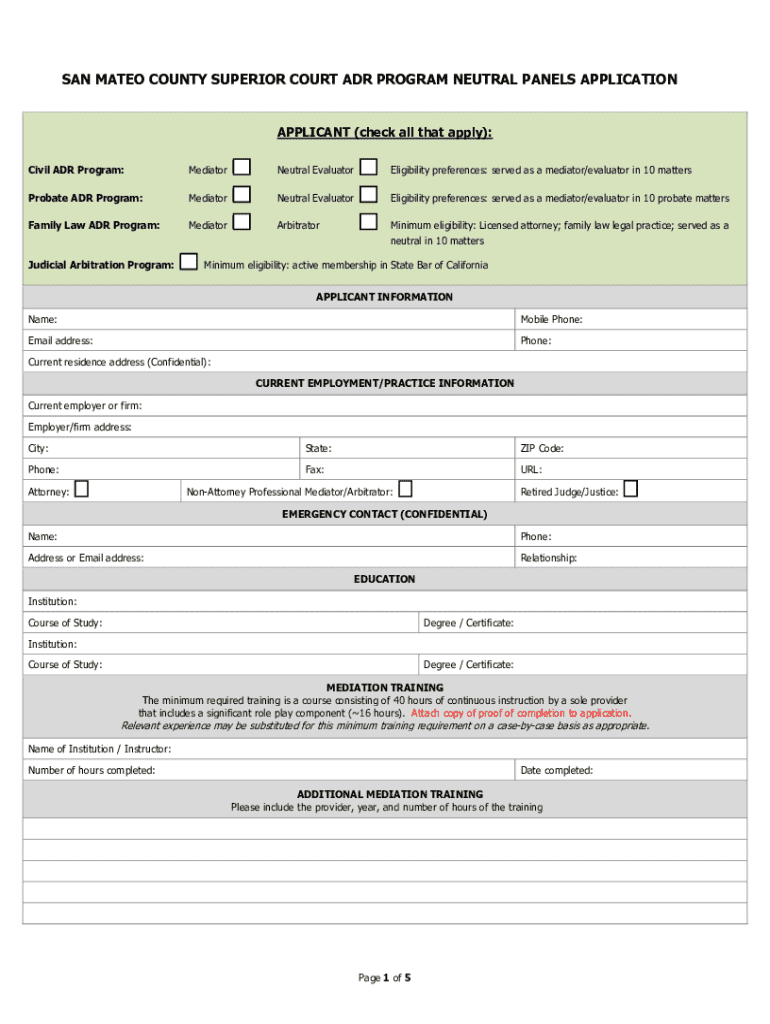
The "Application for New ADR Panelist" serves as a formal request to join an Alternative Dispute Resolution (ADR) panel. Typically associated with courts like the San Mateo County Superior Court, this application is designed for individuals seeking roles as mediators, arbitrators, or evaluators in civil, probate, and family law ADR programs. It reflects the applicant's willingness and qualifications to provide dispute resolution services.
Importance of ADR Panelists
- Role Clarity: ADR panelists facilitate the resolution of disputes outside of the traditional courtroom setting.
- Contributions to the Legal System: They offer expedited and often less adversarial solutions compared to standard litigation.
ADR programs often enhance access to justice by providing alternative pathways to resolve disputes efficiently.
Key Elements of the Application
This application form includes several essential sections that prospective panelists must complete:
- Applicant Information: Collects basic details such as name, contact information, and professional background.
- Mediation Training: Requires documentation of relevant training and certifications in mediation and dispute resolution.
- Experience: Applicants must detail their relevant experience in ADR, showcasing their expertise in handling disputes.
- Professional References: Lists individuals who can vouch for the applicant's skill and credibility in ADR services.
Each of these elements helps assess the applicant's suitability for the ADR program.
Eligibility Criteria
Applicants for the ADR panel must meet specified criteria to be considered:
- Professional Credentials: Often requires legal background or specific mediation training.
- Experience: Demonstrated history in mediation or arbitration, preferably within the context of civil, probate, or family law.
- References: Recommendations from reputable sources verifying the applicant’s capability and character.
These criteria ensure that only qualified individuals serve on the ADR panel, maintaining the quality and integrity of the resolution process.


Steps to Complete the Application
Filling out the "Application for New ADR Panelist" involves a multi-step process:
- Gather Required Information: Ensure all personal, professional, and contact details are accurate and up-to-date.
- Document Relevant Experience: Provide comprehensive details of prior ADR-related work.
- Submit Training Certifications: Attach proof of any mediation or conflict resolution training completed.
- Acquire Professional References: Secure letters or testimonials from qualified references.
- Finalize and Submit: Review all provided information for accuracy before submission.
Completing the form meticulously helps prevent delays in the application review process.
Who Typically Uses the Application
The application is primarily utilized by professionals in the legal and mediation fields who seek to join court ADR panels:
- Attorneys: Legal professionals specializing in mediation or arbitration.
- Mediators and Arbitrators: Individuals dedicated to resolving disputes through alternative methods.
- Legal Academics: Educators in law and conflict resolution fields.
These individuals contribute significantly to reducing case backlogs in courts and providing alternative solutions to disputants.

Legal Use of the Application
The application serves a critical function within the legal framework by:
- Formalizing Entry: Establishing a structured and standardized process for selecting qualified ADR panelists.
- Ensuring Compliance: Aligning applicants with court requirements and ethical standards.
- Maintaining Records: Documenting qualifications and experience for accountability and transparency.
Using this application ensures uniformity and fairness in the selection of ADR panelists.
How to Obtain the Application
Potential applicants can access the form through various channels:
- Court Websites: Check the specific court's website for downloadable forms.
- Mail Requests: Request physical copies from the court's administration office.
- In-Person Pickup: Visit the court to obtain forms directly.
Obtaining the right form and understanding the requirements can expedite the application preparation process.
Application Process and Approval Time
The process of applying and gaining approval as a new ADR panelist generally follows these stages:
- Submission of Application: Complete the form and submit it through the designated channels (online, mail, or in-person).
- Review by Court Officials: Applications are reviewed for completeness and eligibility.
- Interviews or Assessments: Some courts may require applicants to undergo further interviews or assessments to evaluate suitability.
- Notification of Results: Successful applicants are notified about their acceptance, including any further steps or training requirements.
Total time from submission to approval varies based on the court’s processing speed and the volume of applications received.




