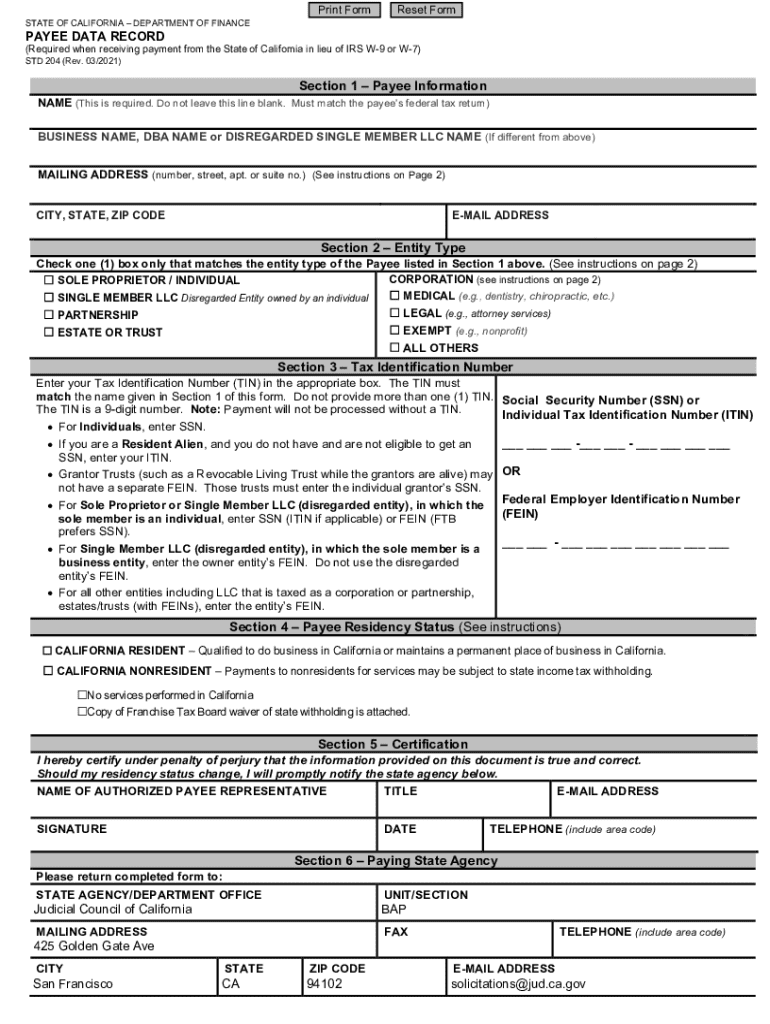







Definition and Purpose of STD 204
The STD 204 form, known as the Payee Data Record, is required by the State of California for entities and individuals receiving state payments. This form collects essential data, such as payee details, entity type, tax identification number, and residency status. It ensures compliance with tax regulations and facilitates the preparation of Information Returns, including the Form 1099. Completion of this form is mandatory for non-governmental payees to prevent payment delays and potential withholding of payments.
How to Use the STD 204 Form
To utilize the STD 204 effectively, individuals or entities need to accurately complete all fields requested. The form is used to furnish the California state agency with enough information to generate a Form 1099 for the payee, ensuring that taxation is correctly processed. Inaccurate completion may result in administrative delays or miscalculation of taxes owed. Each section of the form will guide the user on the specific data required, ensuring comprehensive compliance and processing.
- Gather Required Information: Before beginning, collect all necessary information including Tax Identification Number and residency status.
- Complete the Form: Fill out each section carefully, ensuring that all fields are accurate and up-to-date. Omissions or errors can lead to rejections or processing delays.
- Review for Accuracy: Double-check the completed form to verify the precision of the data provided.
- Submit to Relevant Agency: Once completed, the form should be submitted to the requesting California state agency.
Steps to Complete the STD 204
Filling out the STD 204 form is a straightforward process if followed properly. Here is a step-by-step guide to completing the form:
- Section I - Payee Information: Enter the name, business name (if applicable), and type of entity. It is important to specify whether the payee is an individual, corporation, partnership, or another type of entity.
- Section II - Tax Identification Number: Provide the correct Social Security Number or Employee Identification Number. This is crucial for tax reporting purposes.
- Section III - Residency Status: Declare whether you are a California resident or non-resident. Residency status affects state tax obligations.
- Section IV - Certification: Sign and date the form certifying that the information is true and correct. This section must be completed to validate the form.
Key Elements of the STD 204 Form
Understanding the key elements of the STD 204 will help ensure accurate completion:
- Payee Details: Includes individual or business name, business type, and contact information.
- Taxpayer Identification: Either a Social Security Number or Employer Identification Number must be provided.
- Residency Declaration: Indicates if the payee resides in California, which impacts state tax requirements.
- Certification and Signature: Validates the information provided as accurate and honest, legally binding the payee to the information disclosed.
Who Typically Uses the STD 204 Form
The STD 204 is primarily utilized by:
- Contractors and Freelancers: Independent workers receiving payment from California state agencies must complete this form.
- Small Businesses: Entities offering goods or services to the state government will often need to submit the STD 204.
- Corporations and Partnerships: Larger businesses contracted by the state must also file this form to ensure compliance.
- Non-Profits: Organizations receiving funds through state contracts are similarly required to submit the form.


State-Specific Rules for STD 204
While the STD 204 is primarily a requirement of California, the form adheres to state-specific rules regarding:
- Residency Requirements: Determines tax obligations based on whether the payee is within or outside California.
- State Agency Submission: Different agencies may have specific submission guidelines or deadlines.
- Withholding Regulations: Non-compliance may result in withholding of payments, as determined by California tax laws.
Legal Compliance and Implications
Legal compliance is critical when handling the STD 204:
- ESIGN Act Compliance: When using electronic signature platforms like DocHub, signatures collected on the form are legally binding.
- Tax Law Adherence: The form must comply with federal and state tax laws, ensuring correct taxation processes and information reporting.
- Audit Preparedness: Proper completion and submission ensure that businesses are prepared for any potential audits by state agencies.
Required Documents for Submission of STD 204
When completing the STD 204, ensure you have the following documents on hand:
- Employer Identification Number (EIN) Documentation: For businesses, an official EIN document ensures accuracy.
- Taxpayer Identification Confirmation: A recent notice from the IRS or a similar document can confirm the validity of your tax number.
- Proof of Residency: For individuals claiming California residency, official documentation such as a driver's license or utility bill may be required as evidence.
This comprehensive guide ensures that all aspects of the STD 204 are thoroughly covered, providing clarity and assistance to those required to complete it.