




01. Edit your form online
Type text, add images, blackout confidential details, add comments, highlights and more.

Type text, add images, blackout confidential details, add comments, highlights and more.

Draw your signature, type it, upload its image, or use your mobile device as a signature pad.

Send it via email, link, or fax. You can also download it, export it or print it out.
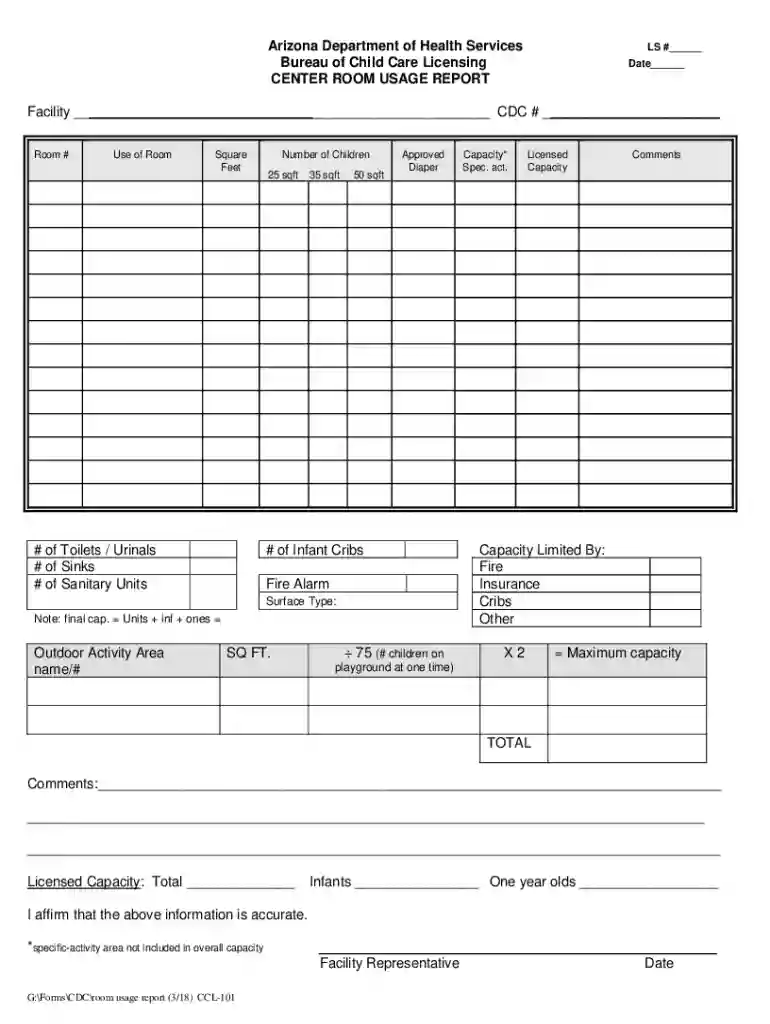
Arizona Department of Health Services (ADHS) Child Care Facilities Licensing is a regulatory framework established to ensure that child care facilities operate safely and meet specific standards. The licensing aims to protect the health, safety, and well-being of children by setting conditions on the physical environment, staff qualifications, and care practices. By mandating compliance with these standards, ADHS promotes high-quality child care services across Arizona.
Licensing encompasses several key elements, including building safety, hygiene practices, staff-to-child ratios, and educational programs. Facilities must undergo regular inspections and provide documentation proving compliance, ensuring that child care centers maintain a safe and supportive environment for children.
Completing the ADHS Child Care Facilities Licensing involves several steps that ensure a facility meets rigorous standards. This process typically includes:
Submitting an Application: Acquiring a licensing application from ADHS, either through their website or by contacting the department directly.
Facility Inspection: Scheduling a facility inspection with state officials to verify compliance with safety and health standards, including building codes, sanitation requirements, and space measurements.
Staff Credential Verification: Providing documentation that all staff members meet the necessary qualifications and have undergone required background checks.
Policy and Procedure Review: Developing and submitting an operational plan that includes care policies, emergency procedures, and parental involvement guidelines.
Compliance Confirmation: Addressing any issues identified during the inspection and submitting proof of correction to ADHS for final approval.
Obtaining a license requires several steps from the application to approval. Facilities must first request a licensing packet from ADHS, detailing all required documentation and standards for compliance. After gathering the necessary documents—such as proof of ownership, health inspections, and safety protocols—a formal application can be submitted to ADHS.
The department then conducts an on-site inspection to verify compliance. Upon successfully addressing any compliance issues, facilities receive a licensing certificate authorizing operation. This certificate must be displayed prominently at the facility and renewed regularly, incorporating ongoing compliance with changing standards.
Several core components must be included in the licensing application to ensure comprehensive evaluation:
Ensuring these elements are complete and accurate is critical for a smooth application process and subsequent inspections, securing an environment conducive to child development and safety.
Understanding specific terminology is crucial for navigating the ADHS licensing process efficiently:
Grasping these terms helps applicants communicate effectively with regulatory bodies, understanding requirements, and maintaining compliance.
Arizona has unique specifications compared to other states regarding child care licensing, primarily in terms of space requirements, ratios, and specific safety protocols. For example:
Familiarity with these state-specific standards is vital for ensuring compliance and successfully obtaining and maintaining a license.
Operating without a license or failing to comply with ADHS regulations can result in substantial penalties. Non-compliance might lead to fines, mandatory closure of facilities, and lasting reputational damage. Maintaining current knowledge of licensing requirements and proactively addressing areas of non-compliance helps avoid these adverse outcomes.
Regular training for staff on the latest health practices, safety protocols, and developmental activities also forms part of ensuring continued compliance. Records of inspections, training, and policy updates serve as compliance evidence during inspections.
Practically, ADHS licensing impacts daily operations significantly. For illustrative purposes:
Highlighting these examples emphasizes the direct, positive impacts licensing standards can have on a child care facility's environment and operational efficacy.
We've got more versions of the ADHS - Child Care Facilities Licensing form. Select the right ADHS - Child Care Facilities Licensing version from the list and start editing it straight away!
| Versions | Form popularity | Fillable & printable |
|---|---|---|
| 2018 | 4.9 Satisfied (23 Votes) |
At DocHub, your data security is our priority. We follow HIPAA, SOC2, GDPR, and other standards, so you can work on your documents with confidence.




Apr 18, 2024 Adds behavioral health residential care facilities to the list of places for which ADHS cant accept accreditation in lieu of a compliance.Read more
The new Child Care Licensing Management System is now live. hours Monday to Friday 8:00 a.m. to 5:00 p.m. 602-542-1025 Fax Icon 602-542-0883


