




01. Edit your form online
Type text, add images, blackout confidential details, add comments, highlights and more.

Type text, add images, blackout confidential details, add comments, highlights and more.

Draw your signature, type it, upload its image, or use your mobile device as a signature pad.

Send it via email, link, or fax. You can also download it, export it or print it out.
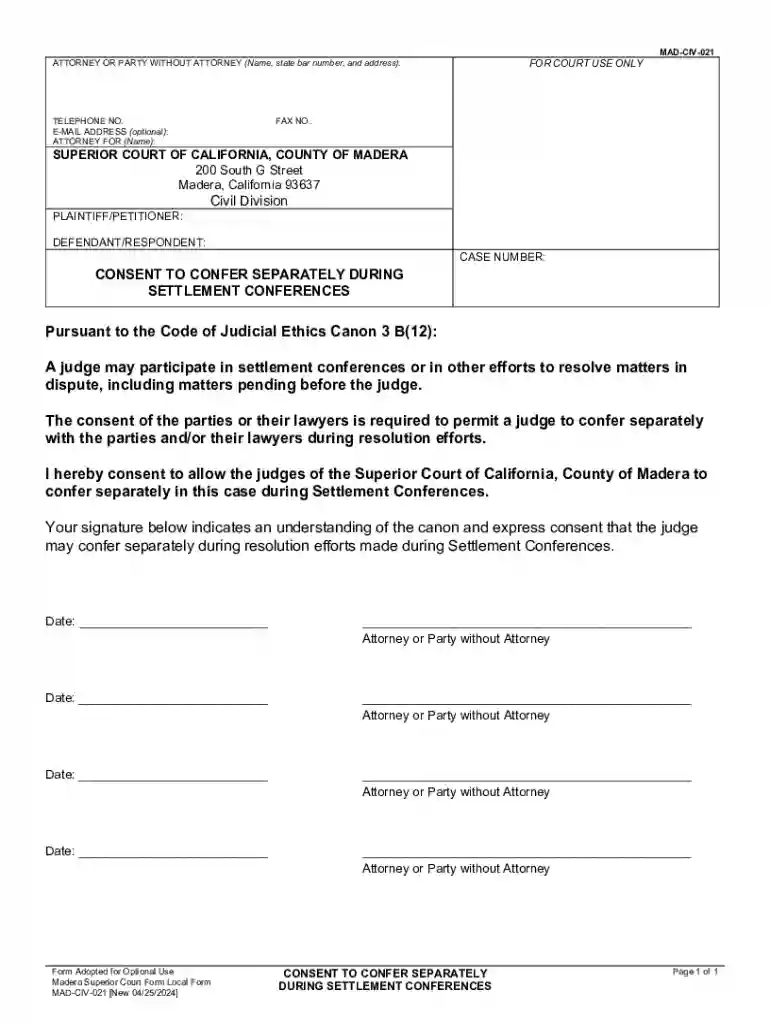
The Mad-civ-021 form is a crucial document used in the Superior Court of California, County of Madera. It primarily serves as a consent form in legal proceedings, allowing judges to engage individually with involved parties during settlement conferences. This form functions as an agreement under the Code of Judicial Ethics, ensuring all parties understand the procedural framework of their legal case. It is specifically tailored to facilitate fair and transparent communication between the judiciary and parties involved, highlighting the importance of consent in ethical judicial practice.
Review Legal Information: Before filling out the form, parties should carefully review all legal sections to understand the implications and requirements surrounding the consent for separate judicial communication.
Fill Out Personal Details: Accurately enter all requested personal and case-related information at the top sections of the form.
Consent Statement: Ensure all parties understand and agree to the consent statement as outlined, which is crucial for the form's validity.
Signature Requirements: Both attorneys and self-represented parties must sign the document. Ensure that all signatures are completed in the specified areas to prevent delays.
Submission: Once filled and signed by all required parties, submit the form to the appropriate court channel as instructed.
Completing Mad-civ-021 requires attention to detail and accuracy to ensure that all legal protocols are respected and that the parties' participation in the case is fully compliant with court requirements.
The legality of the Mad-civ-021 is grounded in its basis for consent in legal proceedings within the Superior Court of California. By using this form, involved parties are participating in a process that complies with the Code of Judicial Ethics. The consent provided via this form facilitates judges' abilities to manage settlement conferences more effectively, paving the way for a resolution that aligns with judicial standards.
Consent Agreement: Central to the form, this agreement authorizes separate judicial discussions with parties involved in the legal case.
Signatures: Spaces are included for signatures from attorneys or parties who are not represented by legal counsel.
Judicial Ethics Clearance: By agreeing to separate conferencing, parties acknowledge that they consent to a process that adheres to ethical standards.
Understanding these key elements is essential for all parties involved to ensure appropriate and lawful participation in settlement conferences within California's judicial system.
This form is typically utilized by attorneys and parties involved in legal proceedings in the Superior Court of California, County of Madera. It is crucial for those engaged in settlement conferences that require separate judicial discussions. The form is especially relevant for self-represented parties and legal practitioners who must ensure all procedural and ethical guidelines are met. Additionally, judges rely on this form to orchestrate settlement discussions in accordance with legal and ethical norms.


Consent: Acknowledgement and agreement to separate discussions with a judge during legal proceedings.
Judicial Ethics: Ethical standards that govern the behaviors and practices of judges to maintain impartiality and integrity.
Settlement Conference: A meeting aimed at resolving a legal case without going to trial, involving parties and often facilitated by a judge.
These terms are foundational for comprehending the scope and usage of the Mad-civ-021 form within legal contexts.
In California, specifically within the Madera County Superior Court, this form adheres to state-specific judicial procedures. It is crafted to reflect California’s legal standards regarding consent in judicial proceedings. Understanding local rules can ensure that all parties are properly informed and compliant with regional legal practices, which may vary between different jurisdictions.
Parties involved in legal proceedings must be attentive to filing deadlines associated with the Mad-civ-021 form to ensure timely consent and compliance. Typically, the form should be completed and submitted before a scheduled settlement conference. Missing these deadlines can impact the ability to participate in such conferences, which could affect case outcomes. Consulting with legal professionals can provide guidance on specific timing requirements tailored to individual cases.
When completing this form, parties need to have pertinent legal documents readily available. Typically, these may include:
This documentation supports the form's comprehensive accuracy, enabling judges to conduct informed settlement discussions.
We've got more versions of the Mad-civ-021 form. Select the right Mad-civ-021 version from the list and start editing it straight away!
| Versions | Form popularity | Fillable & printable |
|---|---|---|
| 2024 | 4.7 Satisfied (50 Votes) |
At DocHub, your data security is our priority. We follow HIPAA, SOC2, GDPR, and other standards, so you can work on your documents with confidence.




Click on a Docket # for more detailed information on that case. Click on a plaintiff or defendant to see other cases they were involved in (searches byRead more
Consent to Confer Separately during Settlement Conferences (MAD-CIV-021) PDF Document, MAD-CIV-021, Optional, Apr 25, 2024. Consent and Waiver of StatutoryRead more
Media:cvani1001021.ogg Kyoko Sakura: Are we just gonna run away? Media:cvani1001022.ogg Homura Akemi: If you want to fight it, drop that needless


