






Definition & Meaning
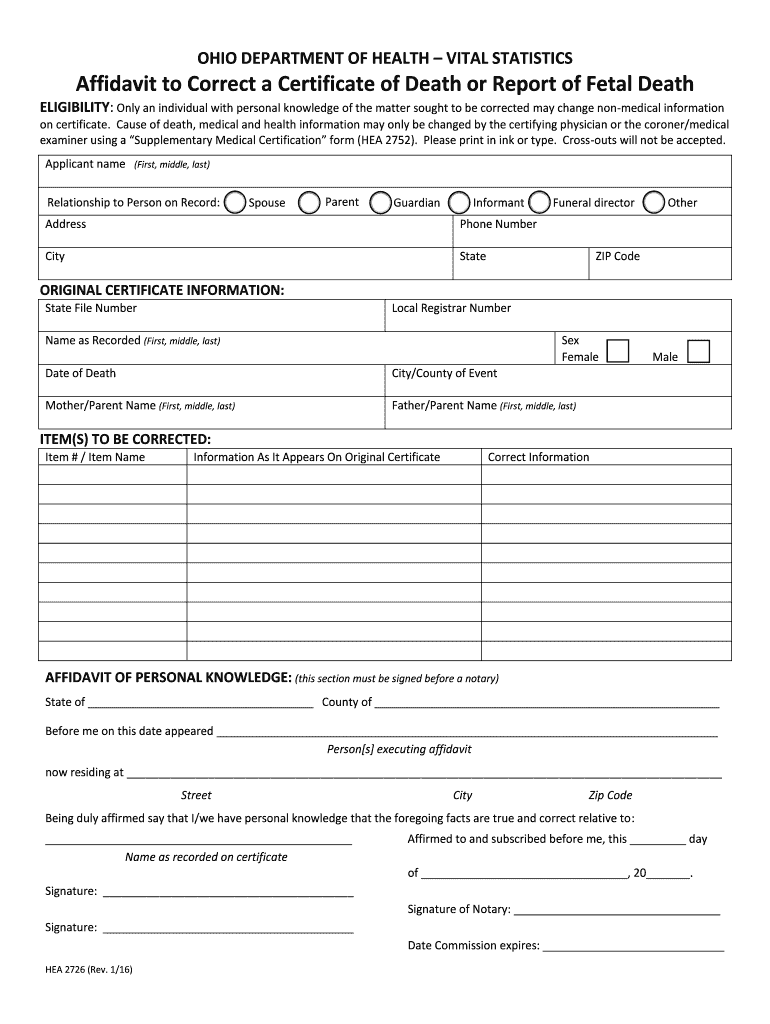
The affidavit to correct a certificate of death or report of fetal death is a legal document used to request changes to non-medical information on these certificates. Commonly, corrections are made to address inaccuracies in personal details such as names, birthdates, or other identifying information. This form ensures that vital records accurately reflect the intended information, which is crucial for legal, genealogical, and statistical purposes.
Purpose and Importance
- Provides an official method to amend records at the state level.
- Ensures the integrity and accuracy of public records.
- Facilitates necessary legal processes such as inheritance or insurance claims.
Steps to Complete the Affidavit
Completing the affidavit involves several important steps to ensure accuracy and compliance with state regulations.
- Gather Necessary Information: Collect all information that needs correction, including a copy of the original certificate.
- Fill Out Personal Details: Provide your name, contact information, and relationship to the deceased.
- Specify Corrections: Clearly indicate the errors on the original document and provide the accurate information.
- Notarization Requirement: The affidavit must be signed in the presence of a notary public, ensuring its legal validity.
- Attach Supporting Documents: Include any documentation that supports the requested amendments, such as birth certificates or court orders.
- Submit the Form: Follow the state-specific submission process, which may include mailing or delivering to the vital records office.
Notarization Tips
- Make an appointment with a notary to avoid delays.
- Bring a valid, government-issued ID for the notary's verification.
Who Typically Uses the Affidavit
This form is generally utilized by individuals closely related to the deceased, such as family members, or persons with legal rights to request changes.


Common Users
- Immediate family members
- Legal representatives or executors of the estate
- Authorized agents of the family or estate

Scenario Examples
- A spouse correcting their name due to a typographical error.
- A child updating a parent’s age to align with formal records.
Key Elements of the Affidavit
Understanding the essential components of this affidavit is critical for accurate completion.
- Affiant's Information: Details about the person requesting the correction.
- Description of Errors: A clear statement outlining inaccuracies on the certificate.
- Corrected Information: The accurate data to be reflected on the amended certificate.
- Notary Section: An area designated for the notary's signature and seal.
Supporting Documentation
- Court orders
- Previous certificates indicating correct information
- Notarized statements from individuals with personal knowledge
Legal Use of the Affidavit
This affidavit serves a legal purpose by ensuring public records are both accurate and trustworthy.
- Verification of Personal Details: Necessary for the settlement of estates or execution of wills.
- Compliance with State Laws: Each state mandates its specific requirements for form completion and submission.
- Foundation for Further Legal Actions: Accurate records are essential for subsequent legal or administrative procedures.
State-Specific Rules
Different states may have varying requirements for submitting and processing this affidavit.
Ohio-Specific Guidelines
- Non-medical information corrections require personal knowledge.
- Medical corrections must be completed by a licensed healthcare professional.
Regional Variations
- Some states may offer online submission options.
- Fees for processing might vary; check with the local vital records department.
Required Documents
Certain documents must be submitted alongside the affidavit to verify and support the requested corrections.
- Copy of Original Certificate: Necessary for comparison to the amended form.
- Identity Verification: A copy of a government-issued ID to confirm the affiant's identity.
- Additional Proof: Birth certificates, marriage licenses, or other documents validating the correct information.
Best Practices for Documentation
- Ensure all documents are legible and complete.
- Provide certified copies when possible to enhance credibility.
Form Submission Methods
The method for submitting the affidavit may differ depending on the state and specific circumstances.
- Mail: Send the completed form and any accompanying documents to the designated state office.
- In-Person: Some states allow for in-person submission at a vital records office.
- Online: A few jurisdictions might offer an online platform for submission, ensuring quicker processing times.
Important Considerations
- Confirm the preferred submission method with the state's vital records office.
- Include any applicable fees as required by the state.
Penalties for Non-Compliance
Failing to appropriately complete or submit the affidavit can lead to significant issues.
- Rejection of the Application: Incorrect submissions may be rejected, delaying the correction process.
- Legal Consequences: Intentional false statements could result in legal action.
- Inaccurate Records: Failure to correct inaccuracies might result in legal or financial complications.
Avoiding Penalties
- Double-check all entries for accuracy before submission.
- Ensure all necessary sections are notarized and include proper documentation.