






Definition and Meaning of Icwa-090
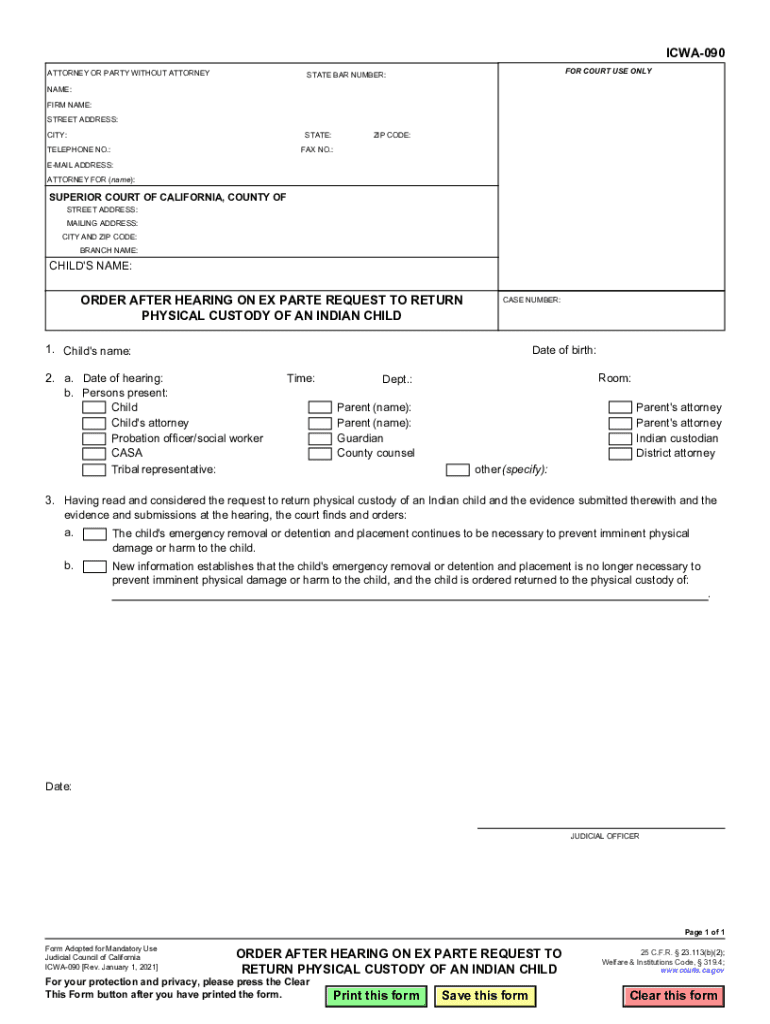
The "Icwa-090" form is used in the context of child custody issues under the Indian Child Welfare Act (ICWA) within the Superior Court of California. This legal document pertains to ex parte requests for the return of physical custody of an Indian child. ICWA was enacted to preserve Native American families and tribes, recognizing that states often removed a high number of Native American children from their families. Icwa-090 provides a standardized method for requesting the court to evaluate and decide the custody of an Indian child.
How to Use the Icwa-090
Using the Icwa-090 involves submitting a formal request to the court. This form must be prepared with precise details regarding the hearing at which custody was discussed. It should outline participants, specific findings related to the child’s safety, and evidence supporting the need to return the child to their family or tribe. Each section of the form must be completed comprehensively, ensuring that the submission adheres to ICWA guidelines.
Steps to Complete the Icwa-090
-
Collector Information: Gather all relevant information about the child, including their full name, tribe, and any identifying numbers or documents provided by the tribe.
-
Document Custody Circumstances: Through detailed narratives, explain the current custody circumstances. Highlight why an ex parte action is necessary for the child’s well-being.
-
Provide Supporting Facts: Include all facts pertinent to the child's safety and best interest. This involves medical, psychological, and any pertinent family history.
-
Attach Necessary Documentation: Compile and attach any supporting documents, such as affidavits from tribal representatives or family members that support the claims presented.
-
Submit the Form: Provide the completed form to the court clerk in the respective jurisdiction and keep a copy for personal records and reference.
Legal Use of the Icwa-090
The Icwa-090 form is an essential legal document employed when seeking to return an Indian child to their familial or tribal home. It is a tool to help ensure compliance with ICWA, a federal law protecting Indigenous children’s rights. The form is designed to prevent unwarranted removal of Indian children from their families and tribes, further ensuring that state proceedings respect and incorporate tribal connections and cultures.
Key Elements of the Icwa-090
- Identification Section: Detailed identification of the child and their familial link to the tribe.
- Emergency Declaration: A clear statement of why emergency action is warranted.
- Evidence Section: Comprehensive inclusion of evidence supporting why the child’s return is in their best interest.
- Tribal Coordination: Documentation of efforts to involve the tribe in the case.
- Judicial Findings: Capture and document specific judicial findings during previous hearings.
Important Terms Related to Icwa-090
- Ex Parte: A legal proceeding brought by one person in the absence of and without representation or notification of other parties.
- Indian Child: Under ICWA, this refers to any unmarried person under age 18 who is either a member of, or eligible for membership in, a federally recognized tribe.
- Tribe: A federally recognized entity that is eligible for certain benefits and rights under Indian law.
State-Specific Rules for the Icwa-090
California's adoption of ICWA-related standards may have state-specific rules that require additional compliance steps beyond the federal requirements. It's crucial to familiarize oneself with California statutes that pertain to child custody under ICWA, as they might influence the way Icwa-090 needs to be filled or used. Consulting legal counsel experienced in ICWA and state family law is recommended for precise compliance.
Examples of Using the Icwa-090
For instance, if a child from the Navajo Nation was removed from their home due to alleged neglect, the Icwa-090 could be used by the tribe to request their return to tribal jurisdiction. The form would need to show that the removal was not in line with ICWA guidelines. Another scenario might involve extended family use of the form to secure the child’s placement with relatives instead of state facilities, which would entail ample documentation and evidence of the family’s capability to provide care.