






Definition & Meaning
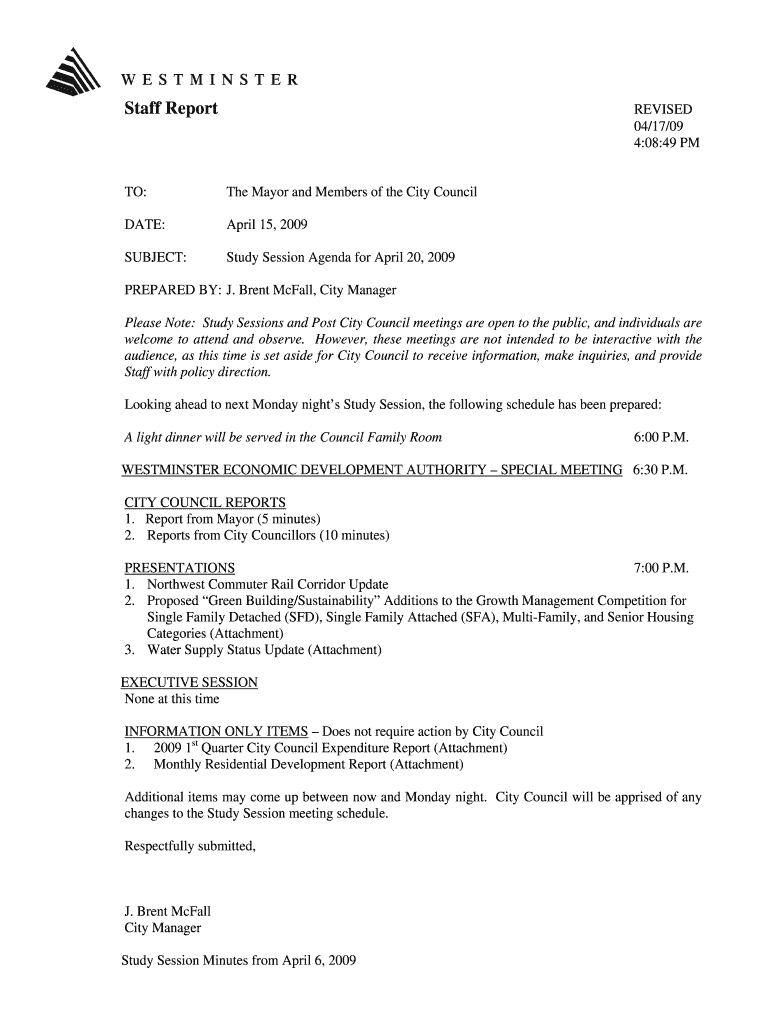
A "staff report" is a document typically prepared for governing bodies such as city councils, agencies, or boards. It serves as an informational resource that compiles data, analyses, and recommendations on specific topics or issues. These reports are crucial in supporting decision-making processes by providing structured and comprehensive insights into various subjects. Staff reports often contain updates on projects, evaluations of proposals, status reports, and relevant financial details. By offering an organized presentation of information, these reports facilitate informed discussions and help stakeholders understand complex issues.
How to Use the Staff Report
Using a staff report effectively involves understanding its structure and content, which allows the reader to extract pertinent information quickly. Staff reports are designed with sections that address specific topics, making it easier for readers to focus on areas of interest without sifting through unnecessary details. Users should start by reviewing the table of contents or an executive summary, which provides an overview of the issues addressed. Detailed sections may include background information, analysis, options, and a staff recommendation, all of which are essential for informed decision-making.
Key Sections to Focus On
- Background Information: Provides context and history, helping readers understand the development of the issue.
- Analysis and Discussion: Offers in-depth examination and insights into the topic, including data analysis and evaluation of alternatives.
- Recommendations: Presents staff's advised actions or decisions based on the analysis.
Steps to Complete the Staff Report
Completing a staff report involves a methodical approach, from gathering data to presenting finding in a structured format. Here's a step-by-step process:
- Define Objective: Clearly state the purpose of the report. Clarifying the objective ensures that the information collected is relevant.
- Gather Data: Collect relevant data from credible sources to support the issues discussed. This step is critical for building a reliable document.
- Analyze Information: Evaluate and organize the data, looking for patterns or significant findings that impact the topic.
- Draft Report Sections: Begin writing each section. Start with background, move to analysis, and conclude with recommendations.
- Review and Revise: Proofread the document for clarity, accuracy, and coherence. Make necessary revisions to improve the quality.
- Seek Approval: Before final submission, have the document reviewed by appropriate supervisors or stakeholders for validation.
Key Elements of the Staff Report
Staff reports typically include several key elements that help structure the document and ensure it meets its intended purpose. These elements comprise:
- Title and Date: Indicates what the report addresses and its timeliness.
- Table of Contents: Provides easy navigation of the report sections.
- Introduction: Offers an overview and states the purpose.
- Body: Contains detailed analysis, discussions, and data interpretation.
- Conclusion/Recommendations: Summarizes findings and proposes the next steps.
- Appendices: Includes supplementary materials or data not within the main body.
Examples of Using the Staff Report
Staff reports are used across various scenarios such as urban planning, budget assessments, and policy development. For example, a local government might use a staff report to evaluate the pros and cons of a new housing development project. The report would analyze impacts on infrastructure, community feedback, environmental concerns, and financial implications. Another example could involve a school board using a staff report to decide on integrating new technologies into classrooms, where costs, educational benefits, and potential hurdles would be assessed and documented.
Legal Use of the Staff Report
Legally, staff reports often serve as part of the official records within municipal or organizational decision-making processes. Their use encompasses various regulatory and procedural contexts requiring formal documentation of discussions and decisions. In some cases, they may be subject to public records laws, ensuring transparency and accountability in government operations. Legal considerations also involve adhering to guidelines concerning the disclosure of sensitive or proprietary information, ensuring compliance with applicable laws and regulations.
Who Typically Uses the Staff Report
Staff reports are commonly utilized by individuals involved in governance such as city council members, administrative officials, and board or committee members. Additionally, these reports are crucial tools for department heads and project managers tasked with evaluating ongoing initiatives or proposing new actions. They are also invaluable resources for external stakeholders like community groups and local businesses who need insight into governmental decision-making processes, helping them align their interests accordingly.


Form Submission Methods (Online / Mail / In-Person)
The submission of a staff report can vary based on its intended purpose and organizational protocols. Staff reports are often submitted:
- Online: Many organizations utilize digital platforms or email for the efficient distribution and submission of reports.
- In-Person: In some cases, especially during formal meetings, physical copies of staff reports are distributed.
- Mail: While less common in the digital age, postal service may be used for sending physical copies when required.
Each method ensures proper documentation and communication within the organization's framework, facilitating informed decision-making processes.