01. Edit your form online
Type text, add images, blackout confidential details, add comments, highlights and more.

Type text, add images, blackout confidential details, add comments, highlights and more.

Draw your signature, type it, upload its image, or use your mobile device as a signature pad.

Send it via email, link, or fax. You can also download it, export it or print it out.
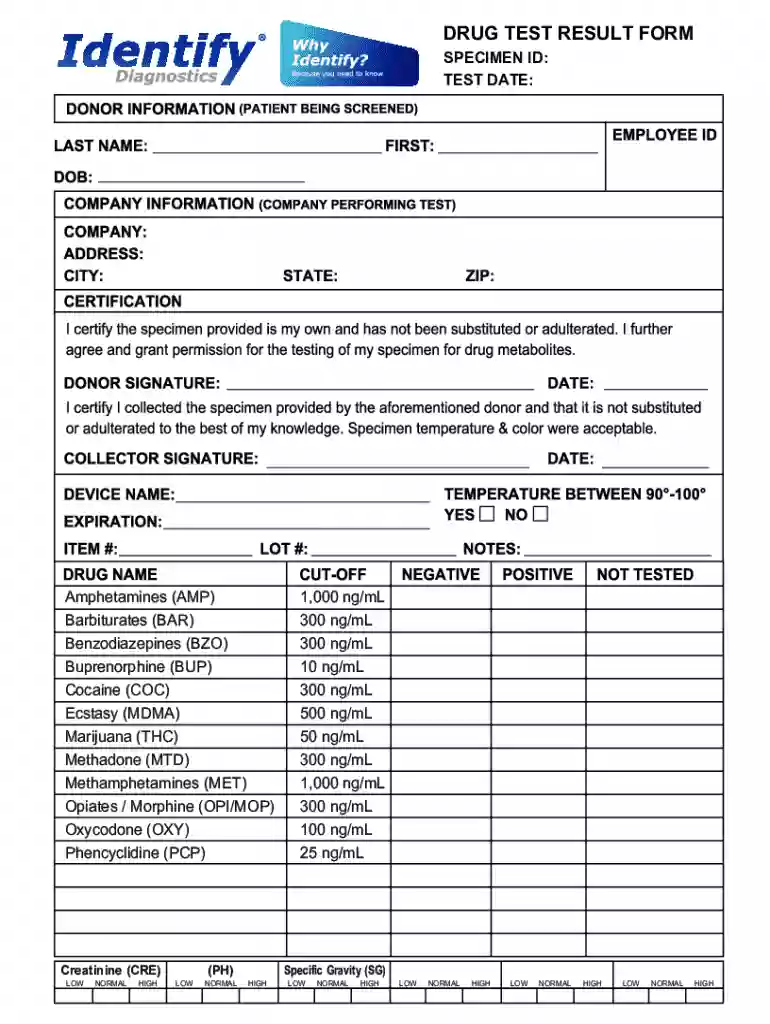
A Drug Test Result Form is an essential document used to record the results of a drug screening test. These forms are crucial for various organizations, including employers, hospitals, and legal entities, for verifying whether an individual has used any prohibited substances. The form typically lists multiple substances such as amphetamines, cocaine, marijuana, and opiates, along with their detection thresholds. Additionally, it includes parameters like creatinine levels and specific gravity, which help assess the validity of the specimen.
Utilizing a Drug Test Result Form involves multiple steps, from completing the initial sections to interpreting the results accurately. It starts with the individual undergoing testing, followed by the laboratory analysis and concluding with the interpretation by authorized personnel.
The Drug Test Result Form is used by various professionals and institutions to maintain safety and compliance within their organizations.



This form plays an integral role in both employment law and medical legislation. Utilizing the Drug Test Result Form legally entails ensuring the confidentiality of the results and adhering to state and federal guidelines.
Drug testing regulations vary across states, impacting how the Drug Test Result Form is used and administered. Organizations must be aware of and adhere to these variances to stay compliant.
Understanding practical uses of the Drug Test Result Form can help illustrate its importance in real-world applications.
Proper completion of the Drug Test Result Form often requires additional documentation to support the validity of the testing process.
Submitting the Drug Test Result Form can be done through various methods, providing flexibility in how organizations handle documentation.
Adhering to regulatory standards is essential when utilizing a Drug Test Result Form. Non-compliance can lead to significant consequences.
These sections provide comprehensive insight into the Drug Test Result Form's purpose, usage, legal implications, and procedural requirements, aligning with the platform's capabilities to streamline document workflows efficiently.
At DocHub, your data security is our priority. We follow HIPAA, SOC2, GDPR, and other standards, so you can work on your documents with confidence.