




01. Edit your form online
Type text, add images, blackout confidential details, add comments, highlights and more.

Type text, add images, blackout confidential details, add comments, highlights and more.

Draw your signature, type it, upload its image, or use your mobile device as a signature pad.

Send it via email, link, or fax. You can also download it, export it or print it out.
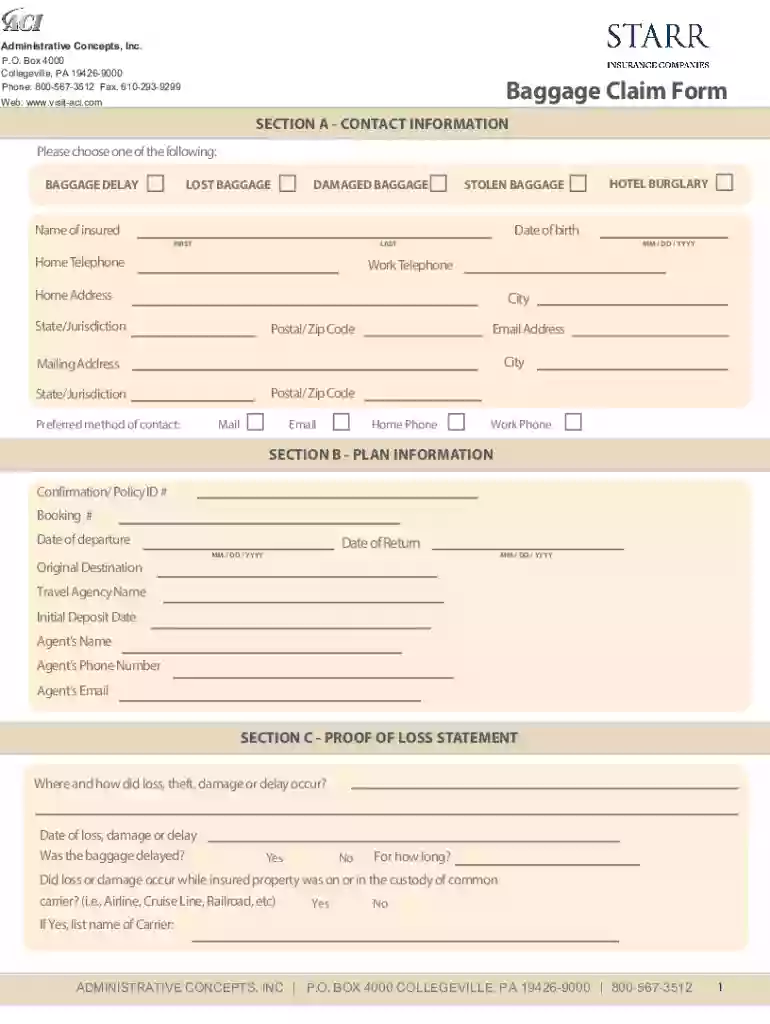
The Baggage Claim Form, often utilized in the context of travel and transportation, serves as a formalized document used to report issues related to baggage such as delays, loss, damage, or theft. The form is a crucial tool for both travelers and service providers in handling and resolving baggage-related grievances efficiently. It typically requires detailed information about the situation, allowing carriers to process claims and offer solutions or compensation in compliance with industry regulations. The document also plays a role in ensuring transparency and fairness in the claims process.
Identify the Issue: Clearly define the baggage problem—whether it’s delayed, lost, damaged, or stolen. Knowing the specific issue guides you in filling out the form accurately.
Gather Necessary Information: Collect all pertinent details about your flight, baggage, and any evidence of the issue. This includes baggage tags, receipts, and any prior correspondence with the carrier.
Complete the Form: Fill out each section of the form precisely. Ensure that your personal and flight information matches the records. Describe the issue in detail, providing as much context as possible.
Submit Required Documentation: Attach any supporting documents, such as proof of loss, travel itineraries, and baggage labels. This documentation helps substantiate your claim.
Submit the Form: Depending on the airline or service provider’s requirements, submit the form online, via mail, or in person. Retain a copy of the submission for your records.
Completing the Baggage Claim Form involves a series of steps to ensure all necessary information is provided for processing:
Enter Personal Information: Include your full name, contact details, and travel information. Ensure accuracy to prevent delays.
Provide Flight Details: Document your flight number, departure and arrival destinations, and travel dates. This information helps in identifying your travel schedule.
Describe the Baggage Issue: Elaborate on the issue with your baggage, stating when and where it occurred. Highlight any attempts you have made to resolve it beforehand.
Attach Evidence: Include copies of your flight ticket, baggage claim ticket, and any photos or repair estimates for damages.
Sign the Form: Date and sign the form, acknowledging the accuracy of the information provided. Some forms may allow for electronic signatures.
Contact Information: Full name, address, phone number, and email for communication purposes.
Flight Details: Airline, flight number, and dates of travel to trace the baggage handling process.
Baggage Details: Description of the baggage, including dimensions, brand, and any unique identifiers.
Incident Description: Detailed account of the issue and any relevant circumstances.
Documentation Section: List of required documents to accompany the form, such as receipts and proof of purchase.
To substantiate a baggage claim, several documents are typically required:
Flight Itinerary: Provides proof of your travel schedule and booking details.
Baggage Claim Ticket: Serves as evidence of checked baggage and its tracking information.
Purchase Receipts: Offers proof of value for any items lost or damaged, aiding compensation claims.
Photo Evidence: Visual documentation of damage or condition of received baggage.
Ensuring that you have all necessary documents ready when submitting the claim can significantly expedite the process.
The Baggage Claim Form is a legally binding document that establishes your claim within the contractual rights and obligations between traveler and service provider. It is used to initiate compensation or resolution for baggage issues according to industry and regulatory requirements. Allegations of misinformation or fraudulent claims can lead to legal repercussions, underscoring the importance of honesty and accuracy in your submission. Compliance with the carrier's terms and conditions is also a fundamental part of utilizing the form effectively.
Consider a scenario where a traveler arrives at their destination to find their luggage missing. After confirming that the baggage was indeed checked in, the traveler fills out a Baggage Claim Form, providing flight details, luggage description, and attaching a baggage claim ticket. Another example involves a traveler discovering damage to their luggage upon retrieval. The traveler documents the damage with photos, gathers receipts for the luggage, and submits the claim form for compensation or repair.
The Baggage Claim Form can be completed in either digital or paper formats, depending on the passenger's preference and the carrier's available options. Digital forms are easier to submit and track online, providing real-time status updates. They also allow attachments to be added electronically. Paper versions, however, might be necessary in areas with limited internet access or for customers who prefer physical documentation. Both versions require the same information, but the method of completing and submitting them may vary slightly.
Providing multiple formats enhances accessibility, accommodating various preferences and technological capabilities.
At DocHub, your data security is our priority. We follow HIPAA, SOC2, GDPR, and other standards, so you can work on your documents with confidence.





You may file a claim if you are injured or your property is lost or damaged during the screening process. Contact your airline for lost or missing baggage.
Aug 26, 2026 File a written claim within 7 days for damage and 21 days for delay under the Montreal Convention 1999. If the airline refuses or delays,Read more


