




01. Edit your form online
Type text, add images, blackout confidential details, add comments, highlights and more.

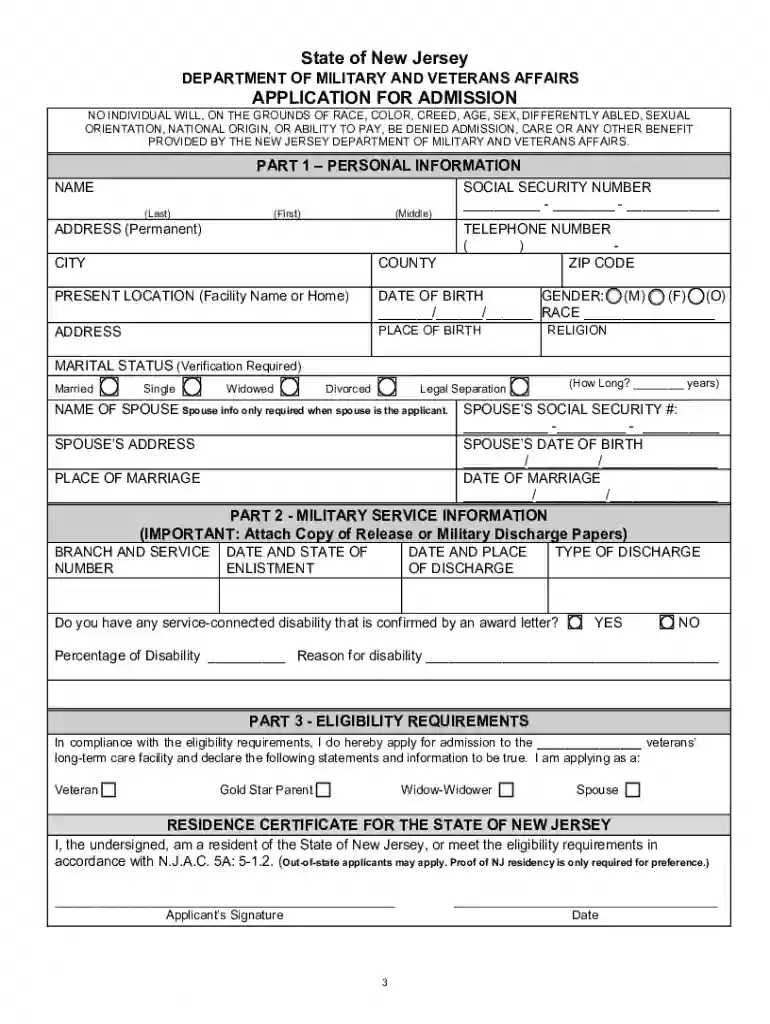
Type text, add images, blackout confidential details, add comments, highlights and more.

Draw your signature, type it, upload its image, or use your mobile device as a signature pad.

Send it via email, link, or fax. You can also download it, export it or print it out.
An Application for Admission is an official document utilized to request entry into specific institutions or programs, such as educational institutions, residential homes, or professional associations. Understanding the intricacies of the application process is crucial for successful submission and acceptance. This form, particularly when linked to facilities like the New Jersey Veterans Memorial Homes, also serves as an extensive informational guide, detailing the eligibility criteria and requirements needed for assessment. It is important to note that every field and section in the form plays a specific role in providing pertinent information about the applicant.
Each part of the form is intended to ensure that comprehensive data is collected to make informed decisions regarding an individual's admission prospects.
Successfully completing an Application for Admission involves following several sequential steps that ensure all necessary information is properly documented and submitted.
Gather Personal Information: Collect basic details about the applicant. This includes name, date of birth, and contact information, which serve as identifiers for the application.
Verify Eligibility Requirements: Assess the applicant's qualifications against the criteria specified in the application. For example, veterans applying to the New Jersey Veterans Memorial Homes need to confirm their military service status.
Prepare Necessary Documentation: Compile all supplementary documents required by the form. This can range from proof of identity to service records or other relevant certificates.
Complete the Form Sections: Fill in all sections of the form meticulously. Any inaccuracies or omissions can lead to delays or rejections.
Review and Double-Check Entries: Examine each section for completeness and accuracy. Ensure that all required fields are appropriately filled.
Submit the Form: Once verified, submit the application through the specified method, be it online, via mail, or in person.
Completing these steps ensures a comprehensive and accurate application, increasing the likelihood of acceptance.
Accessing the Application for Admission requires knowledge of the platforms or offices that distribute these forms.
Most institutions, including veterans' homes, offer downloadable versions of their application forms on their official websites. This provides a convenient way for applicants to access forms from any location, provided they have internet connectivity.
In some cases, forms might be available at institutional offices or support centers. For example, applicants can visit the admissions office of a veterans' home to pick up a hard copy.
For those unable to retrieve the form online or in person, requesting a mailed copy from the issuing institution is another option. This approach may take more time due to postal delays but ensures that applicants receive the necessary documentation.
A crucial part of the application process is the provision of supporting documentation. These documents serve to verify the information provided within the application form.
These documents must accompany the completed application to avoid any processing delays.
The time frame for the application process can vary based on the institution and the completeness of the submitted application.
Applicants can expedite the approval process by promptly supplying any additional information requested by the reviewing institution.
The Application for Admission must be used in compliance with legal and institutional standards, ensuring that the collection and processing of applicants' information is done lawfully.
These legal considerations help uphold the integrity of the application process and protect both the applicant and the institution.
For a comprehensive application, several elements need to be meticulously crafted and accurately filled out.
Focusing on each element thoroughly ensures that applications are complete and fulfill all institutional requirements.
Choosing between a digital or paper version of the Application for Admission requires understanding the advantages and limitations of each format.
Each format's choice will depend on the applicant's needs and access to resources.
By outlining precise definitions, steps, and requirements, this detailed guide offers a comprehensive understanding of the Application for Admission, ensuring users can effectively navigate and complete the process.
We've got more versions of the Application for Admission form. Select the right Application for Admission version from the list and start editing it straight away!
At DocHub, your data security is our priority. We follow HIPAA, SOC2, GDPR, and other standards, so you can work on your documents with confidence.




Undergraduate Admissions How to Apply; The CUNY Application. Future Students. Apply here using your CUNYfirst application account. Start your Application.Read more
Typically due between October and November 2024. Regular Decision: Deadlines range from December 2024 to January 2025.


