
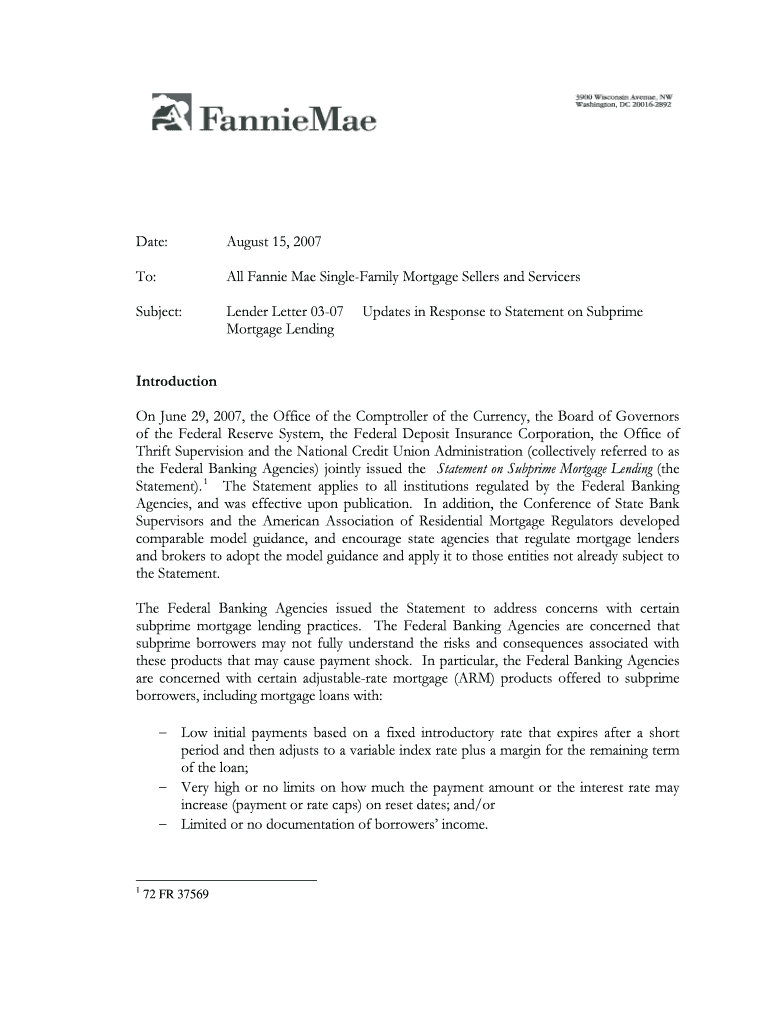







Definition & Scope of All Fannie Mae Single-Family Mortgage Sellers and Servicers
Fannie Mae's Single-Family Mortgage Sellers and Servicers serve a crucial role in the U.S. residential mortgage market. This involves institutions and entities responsible for selling and servicing single-family home loans to Fannie Mae. Sellers originate loans that conform to Fannie Mae’s standards, while servicers are responsible for managing payments, customer service, and delinquency management. These participants ensure mortgage loans meet not only financial but also regulatory standards, maintaining market stability and protecting homeowners.
How to Use the Form for Sellers and Servicers
Utilizing this Fannie Mae form involves specific steps. Sellers must ensure the loans they sell conform to Fannie Mae’s guidelines regarding creditworthiness and risk assessment. Servicers must utilize the form to establish procedures for payment collection and default management. It's vital to keep accurate records and follow pre-defined protocols for handling borrower inquiries and complaints, ensuring compliance with both Fannie Mae and federal regulations.
Key Considerations:
- Ensure loans meet eligibility criteria before selling.
- Follow procedures for loan modifications and loss mitigation when servicing.
- Maintain documentation for all activities concerning servicing agreements.
Steps to Complete the Form
Completing the form involves multiple stages, each critical for compliance and accuracy.
- Information Gathering: Collect all relevant borrower data and loan details.
- Data Verification: Cross-check information against Fannie Mae guidelines.
- Form Filling: Complete sections related to loan terms, service procedures, and borrower details.
- Review & Signatures: Ensure all necessary signatures are collected.
- Submission: Submit the completed form following Fannie Mae’s submission processes.
Each step demands attention to detail to ensure that no section is left incomplete or inaccurate.
Important Terms Related to the Form
Understanding key terms related to this form is essential for proper use and compliance. Some important terms include:
- Conforming Loan: A mortgage that meets Fannie Mae’s funding criteria.
- Delinquency: Failure to make mortgage payments on time.
- Modification: A change to the original terms of a loan to assist a borrower in financial distress.
- Servicer Reporting: Regular updates provided to Fannie Mae concerning loan performance.
These terms outline fundamental aspects that sellers and servicers must manage to maintain compliance and effectiveness.
Legal Use and Compliance
Compliance with Fannie Mae standards is non-negotiable. Sellers and servicers must adhere to legal guidelines such as the Truth in Lending Act and the Fair Debt Collection Practices Act. Compliance ensures that loans sold and serviced protect consumer rights and adhere to federal and state regulations. Legal use of the form mandates adherence to Fannie Mae's legal requirements and procedures, promoting transparency and responsibility in mortgage transactions.
Compliance Steps:
- Regular audits of selling and servicing processes.
- Implementing rigorous training for compliance officers.
- Ensuring comprehensive record-keeping.
Key Elements of the Form
The form includes several critical elements:
- Borrower Information: Essential details about the borrower.
- Loan Details: Comprehensive data regarding terms, interest rates, and the principal amount.
- Servicing Plan: Outline of how the loan will be managed, including payment schedules and default protocols.
- Signatory Requirements: Formal signatures from authorized representatives of all involved parties.
Each element is crucial to ensuring that both selling and servicing processes align with Fannie Mae’s guidelines.
Who Typically Uses the Form
Primarily, the form is used by financial institutions that participate in the secondary mortgage market. This includes:
- Banks: Major financial institutions servicing a large volume of mortgages.
- Credit Unions: Member-focused entities providing mortgage services.
- Mortgage Companies: Specializing in finding mortgage solutions and selling them to agencies like Fannie Mae.


Examples of Using the Form in Practice
In real-world scenarios, consider a bank originating a new set of thirty-year fixed-rate mortgages to be sold to Fannie Mae. The seller ensures all documentation supports the loan’s compliance with Fannie Mae requirements before using the form for the transaction. Meanwhile, a servicer remains in charge of the day-to-day management of these loans, using the form to document processes like payment handling, loan modifications, and delinquency resolutions. These practical applications highlight the form’s role in both simplifying and standardizing processes across different stakeholders.




