
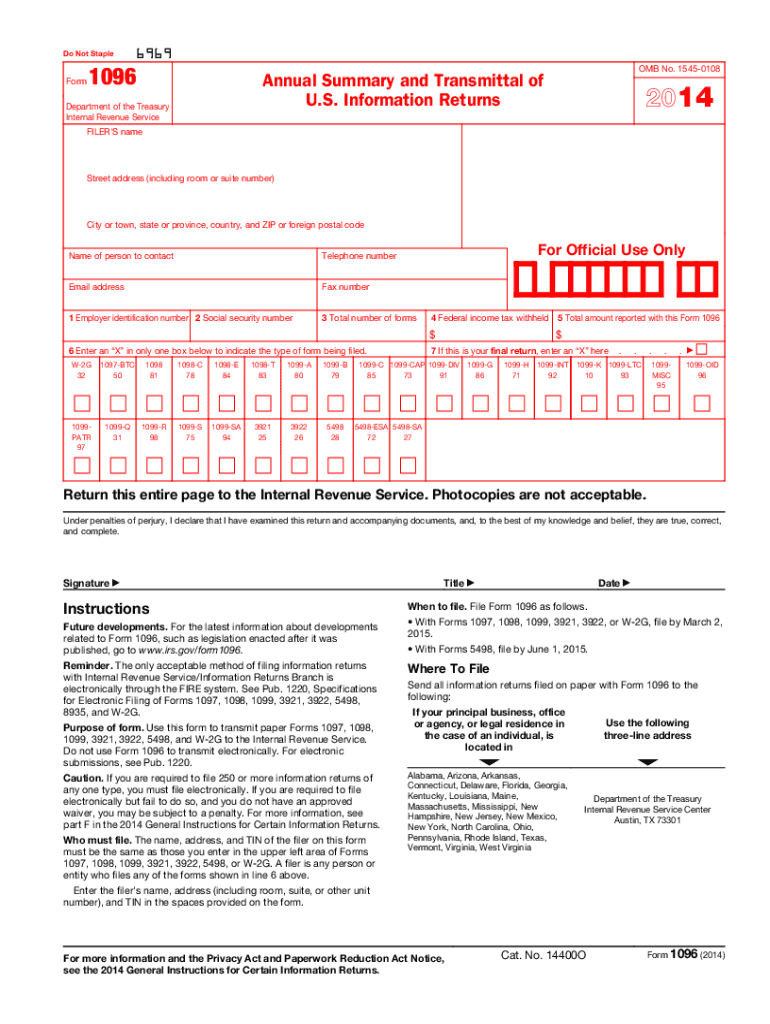







Definition and Purpose of the 2 Form
The 2014 Form 1096, officially titled "Annual Summary and Transmittal of U.S. Information Returns," serves as a cover sheet used by employers or entities to transmit specific tax forms to the Internal Revenue Service (IRS). This form is instrumental in summarizing information returns, which include forms such as 1099, 1098, and others required for reporting various types of income beyond traditional wages. Understanding its purpose is crucial for businesses and individuals transmitting multiple information returns.
The primary role of Form 1096 is to facilitate the proper organization and submission of multiple information returns, ensuring the IRS receives complete and accurate information pertaining to financial activities. It's important to note that Form 1096 can only be used for paper-filing information returns with the IRS; electronic filers must adhere to separate filing procedures.
How to Use the 2 Form
Utilizing the 2014 Form 1096 involves several critical steps to ensure compliance with IRS requirements. This form acts as a transmittal document for specific information returns, which means each type of return (such as 1099-MISC or 1098) requires a separate Form 1096 with the corresponding details:
- Count and Organize: Begin by counting the total number of each type of information return being filed. Ensure each batch of forms has its dedicated Form 1096.
- Fill in Basic Information: Complete the top section of Form 1096 with your organization's name, address, and federal tax identification number.
- Include Tax Form Details: Specify the type of forms being submitted by checking the appropriate box. This step ensures the IRS understands the nature of the financial information enclosed.
- Accuracy Check: Verify all entries for correctness to prevent processing delays or rejections.
- Submission: Attach the corresponding information returns and mail to the IRS at the appropriate address, depending on the forms and total amounts involved.
Properly following these steps guarantees that the information you file is accurate and reaches the IRS in compliance with their standards.
How to Obtain the 2 Form
Acquiring the 2014 Form 1096 can be achieved through several methods aimed at accessibility for all taxpayers. Here are effective ways to obtain this essential form:
-
IRS Website: The IRS provides downloadable versions of the form, along with instructions, directly from their website.
-
Local IRS Office: Visit a local IRS office to obtain printed copies of Form 1096 and any other required forms or publications.
Availability through these channels ensures that taxpayers can access the necessary documents to fulfill their filing obligations accurately.
Steps to Complete the 2 Form
Accurate and meticulous completion of the 2014 Form 1096 is essential for the successful transmittal of information returns. Engage in the following step-by-step instructions to ensure compliance with tax filing protocols:
- Entity Details: Start by entering the filer’s name and address, ensuring this information matches the IRS records exactly.
- Taxpayer Identification: Enter your entity's Employer Identification Number (EIN) or Social Security Number (SSN).
- Return Type Selection: Use the checkboxes to denote which information return type is being reported (e.g., Form 1099-MISC).
- Record Count: Indicate the total number of information returns included in this submission.
- Gross Payments: Specify the total amount of payments reported on the attached information forms.
- Verification: Double-check for any numerical or typographical errors to avoid discrepancies.
- Mailing Preparation: Prepare the form for mailing by ensuring all attached information returns are accurately accounted for and properly affixed.
Making certain that every detail on the form is correct not only simplifies communication with the IRS but also avoids potential fines or penalties.
Who Typically Uses the 2 Form
The typical users of the 2014 Form 1096 hail from a wide array of business and individual backgrounds, each with the necessity to report certain types of payments. Common users include:
- Small Business Owners & Freelancers: Reporting contractor payments via Form 1099-MISC or similar forms.
- Educational Institutions: Transmitting Forms 1098 for tuition and related financial aid.
- Financial Institutions: Filing interest income (1099-INT) or dividend income (1099-DIV) information returns.
Understanding who needs to use Form 1096 can aid in identifying filing requirements and minimizing reporting errors.


Key Elements of the 2 Form
Several critical elements must be managed correctly when filling out the 2014 Form 1096 to ensure the form fulfills its directive without issue:
- Type of Form Transmitted: Distinct forms such as 1099, 1098, or 5498 require accurate designation.
- Filer's Identification: Consistent and proper notation of the filing entity’s information.
- Total Amount Reported: The cumulative total as reflected on all accompanying forms must be indicated.
- Recipient Taxpayer Information: Ensure each batch of returns aligns with the corresponding payer and recipient data.
These elements are integral in determining the form's accuracy and effectiveness in facilitating IRS processing.
Filing Deadlines and Important Dates for 2 Form
Adhering to IRS deadlines is crucial for maintaining compliance and avoiding penalties. Important dates to bear in mind include:
- Due Date for Filers: The 2014 Form 1096 is typically due to the IRS by February 28th for paper filings, or by March 31st if filing electronically.
- Recipient Delivery Requirement: Information returns filed with Form 1096 should be furnished to the recipients, such as contractors or clients, by January 31st.
These deadlines ensure the timely dispersal and submission of financial information, aligning with federal tax regulations.
Penalties for Non-Compliance with the 2 Form
Non-compliance with Form 1096 submission requirements can lead to substantial penalties impacting the filer. Penalties are generally enforced based on the lateness or degree of inaccuracy:
- Late Filing Penalties: Penalties escalate based on the length of the delay. Failing to meet deadlines results in increased fees.
- Incomplete or Incorrect Form Penalties: Errors in information such as incorrect taxpayer ID numbers or omitted amounts attract fines proportionate to the errors' severity.
Being knowledgeable about these potential penalties underscores the importance of filing the 2014 Form 1096 punctually and meticulously.
By meticulously following these comprehensive guidelines and focusing on the critical aspects of the 2014 Form 1096, users can ensure proper compliance and significantly minimize the risk of errors or penalties.


