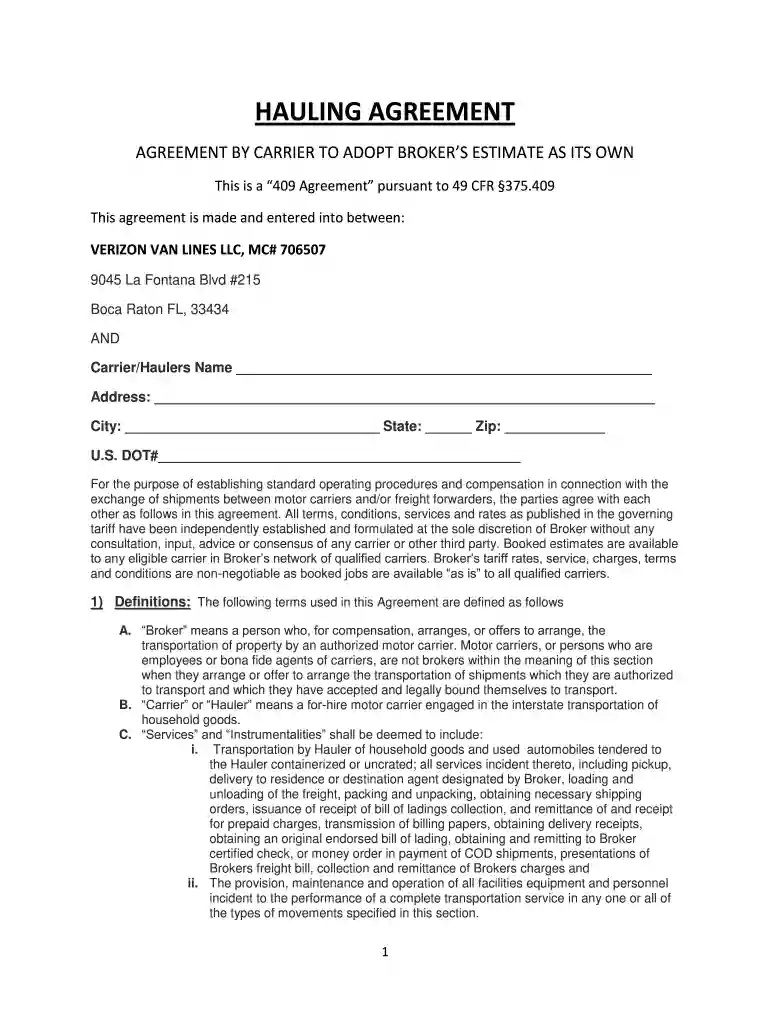
HAULING AGREEMENT - Myloadsboardcom 2026

Get Form
hauling contract agreement sample Preview on Page 1

Here's how it works

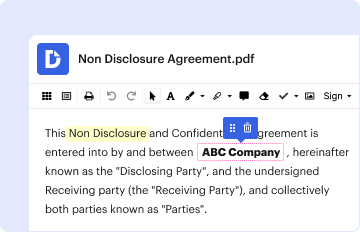
01. Edit your hauling contract agreement sample online
Type text, add images, blackout confidential details, add comments, highlights and more.

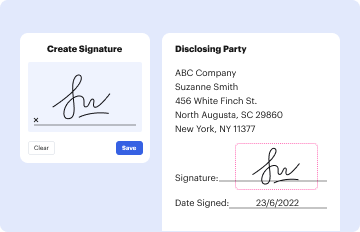
02. Sign it in a few clicks
Draw your signature, type it, upload its image, or use your mobile device as a signature pad.
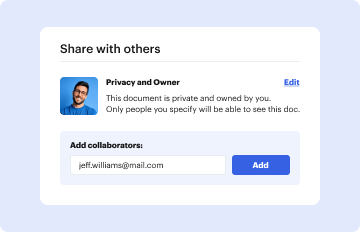
03. Share your form with others
Send hauling contract sample via email, link, or fax. You can also download it, export it or print it out.

How to use or fill out HAULING AGREEMENT - Myloadsboardcom with DocHub

Form edit decoration
9.5
Ease of Setup
DocHub User Ratings on G2
9.0
Ease of Use
DocHub User Ratings on G2
  1. Click ‘Get Form’ to open the HAULING AGREEMENT in our editor.
  2. Begin by filling in the Carrier/Hauler's Name and Address. Ensure that all details are accurate for proper identification.
  3. Input the U.S. DOT number, which is essential for compliance with federal regulations.
  4. Review the Definitions section carefully to understand key terms like 'Broker' and 'Carrier'. This will help you navigate the agreement effectively.
  5. Proceed to fill out the Term of Agreement, ensuring you understand the renewal conditions outlined.
  6. Complete the Payment section, noting how payments will be collected and any obligations regarding deposits.
  7. Finally, review all sections for accuracy before signing. Use our platform’s tools to add your signature electronically.

Start using our platform today to streamline your document editing and signing process for free!

be ready to get more

Complete this form in 5 minutes or less

Get form

Got questions?

We have answers to the most popular questions from our customers. If you can't find an answer to your question, please contact us.
Contact us
Haulage usually refers to the movement of goods predominantly by land and rail. This involves moving bulk materials, heavy loads, or commercial goods using lorries, trucks or trains. Haulage services are commonly used in industries like construction, manufacturing and logistics.
Haulage involves a bilateral agreement between two or more carriers. One carrier, the haulage rights carrier, hires another, the hauling carrier, to act as its agent. Usually, the haulage rights carrier is responsible for car hire while the hauling carrier physically handles cars in haulage service.
Both parties sign an owner-operator agreement detailing responsibilities and obligations. It outlines the terms for the driver to provide services with their truck or lease from the carrier. Depending on the agreement, the company might pay the driver to haul goods on their behalf.
haulage contract means a contract between a network operator and a user for the transportation of gas through the network operators GDS and, for the purposes of clause 86(1), also means that: View Source. Based on 15 documents.
A) Transportation Services: The Sub-Hauler, as an independent contractor and not as an. employee of the Prime Carrier, agrees to furnish transportation of certain materials. consisting of. and other. materials for the Prime Carrier, and to furnish all equipment and perform all services.

Security and compliance

At DocHub, your data security is our priority. We follow HIPAA, SOC2, GDPR, and other standards, so you can work on your documents with confidence.

Learn more
be ready to get more

Complete this form in 5 minutes or less

Get form

People also ask

What is an example of a haulage? A good example would be a lorry transporting bricks from a factory to a building site. Another might be a refrigerated truck delivering chilled food to a supermarket. If goods are being moved by vehicle for commercial purposes, its considered haulage.
Some of the best ways to find truck loads for owner-operators are: Working with a freight broker. Using a freight dispatcher. Working directly with a shipper. Becoming a government contractor. Expanding cargo specializations and contract types. Taking advantage of a load board.
Haulage is the business of transporting goods by road or rail between suppliers and large consumer outlets, factories, warehouses, or depots. This includes everything humans might wish to move in bulk from vegetables and other foodstuffs, to clothes, ore, coal, and other supplies.