Definition and Meaning of Form IRA
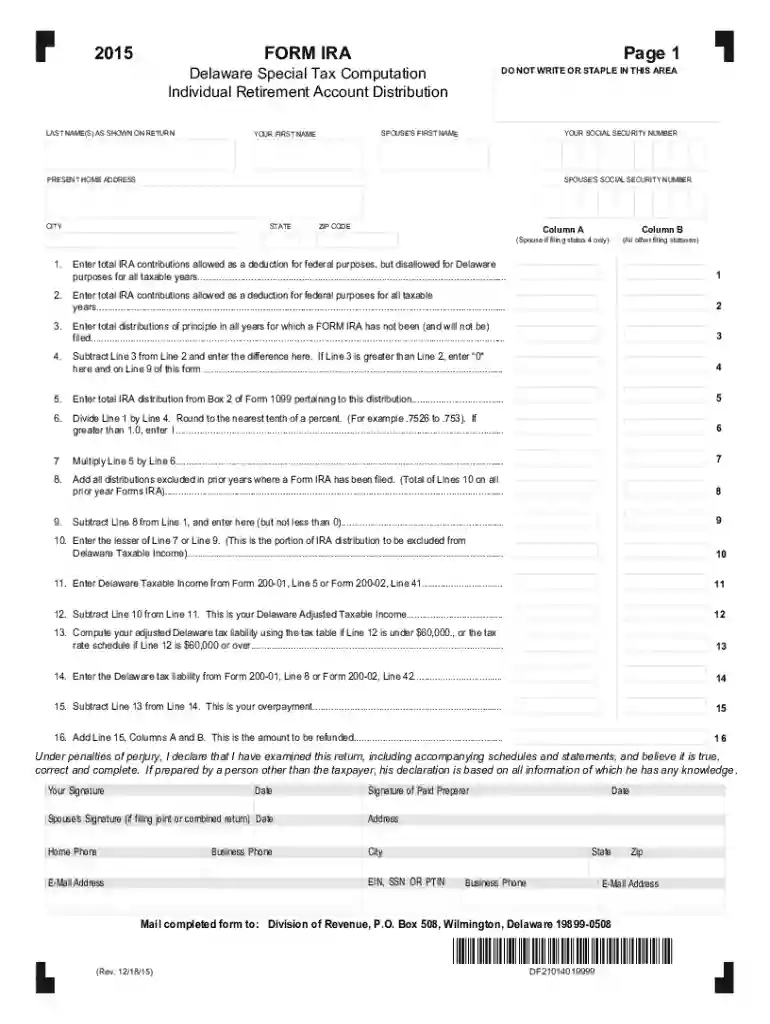
Form IRA, primarily associated with retirement accounts like Individual Retirement Accounts, helps taxpayers report distributions that may affect tax computations. It's crucial for accurately calculating taxable income, especially when dealing with distributions that may have special tax implications. Various types of Form IRA can include reporting for traditional IRAs, Roth IRAs, and other retirement savings plans.
Variations of the Form
- Traditional IRA: Contributions may be tax-deductible, with taxes paid upon withdrawal.
- Roth IRA: Contributions are made with after-tax dollars, facilitating tax-free withdrawals on qualified distributions.
- SEP IRA and SIMPLE IRA: Catered for self-employed individuals or small business employees, offering higher contribution limits compared to personal IRAs.
Steps to Complete the Form IRA
Successfully completing Form IRA involves several steps, ensuring all pertinent details are accurately reported:
Identifying Information: Complete your personal data, including name, Social Security number, and address.
Distribution Details: Document all IRA distributions, specifying the distribution type and any associated penalties or exceptions.
Tax Computation: Utilize the provided form sections to calculate any tax liabilities resulting from IRA distributions.
Specific Considerations
- Required Minimum Distributions (RMDs): Ensure RMDs for individuals over 72 are correctly recorded to avoid penalties.
- Exceptions to Early Withdrawals: Explicitly list any qualified exceptions for early withdrawal penalties.
Common Scenarios
- Self-Employed Individuals: Utilizing SEP IRAs or SIMPLE IRAs.
- Employees with Employer Plans: Transitioning from workplace retirement accounts into personal IRAs.
Important Terms Related to Form IRA
Understanding common terms related to Form IRA ensures accurate completion:
- Adjusted Gross Income (AGI): Essential for calculating tax liabilities on IRA distributions.
- Non-Deductible Contribution: Contributions to a traditional IRA not eligible for a tax deduction.
- Rollover: Moving funds from one retirement account to another without incurring penalties.
Clarifications
- Contribution Limits: Set annually by the IRS, affecting both traditional and Roth IRAs.
- Taxable and Non-Taxable Distributions: Differentiation between these is crucial for accurate reporting.
Key Elements of the Form IRA
Key components to focus on when filling Form IRA include:
- Instructions for Distribution Codes: Correctly applying distribution codes to signify types of withdrawals.
- Tax Calculation Sections: Detailed computing areas to accurately determine owed taxes.
- Signature and Date: Ensuring authenticity by signing and dating the form where required.
Critical Details
- Marginal Tax Rates: Affects net distributions and should be accounted for.
- Previous Year Contributions: Impact current tax computations and should be considered.
IRS Guidelines for Form IRA
Adhering to IRS guidelines is imperative for compliant usage of Form IRA. These guidelines include:
- Filing Requirements: Who must file and the criteria.
- Distribution Rules: Details on handling early withdrawals and penalties.
- Documentation Retention: Keeping detailed records as per IRS instructions.
Filing Preparation
- Using IRS Publications: Consulting IRS publications for additional guidance.
- Electronic Filing Options: Streamlined processes and potential benefits of e-filing.
Required Documents for Completing Form IRA
Prior to starting Form IRA, gather necessary documentation such as:
- Statements of IRA Account: Details on contributions and distributions.
- IRS Publications: Reference materials to understand complex distribution rules.
- Tax Return from Previous Year: Helpful for continuity and consistency.
Ensuring Compliance
- Correct Documentation: Avoid missing critical details that may result in penalties.
- Verification: Double-check data for accuracy before submission.
State-Specific Rules for the Form IRA
Understanding variations in state rules related to IRA distributions can prevent compliance issues:
- State Tax Treatment: Differences in how states tax IRA distributions.
- State-Specific Deductions: Available credits or deductions affecting retirement income.
- Reporting Requirements: Varying paperwork or forms required by different states.
State Examples
- California: Distinct rules around early retirement and tax implications.
- Florida: No state income tax; effects on retirement planning and reporting.
By exploring these comprehensive aspects related to Form IRA, users can ensure precise and compliant management of their retirement distributions.