01. Edit your form online
Type text, add images, blackout confidential details, add comments, highlights and more.

Type text, add images, blackout confidential details, add comments, highlights and more.

Draw your signature, type it, upload its image, or use your mobile device as a signature pad.

Send it via email, link, or fax. You can also download it, export it or print it out.
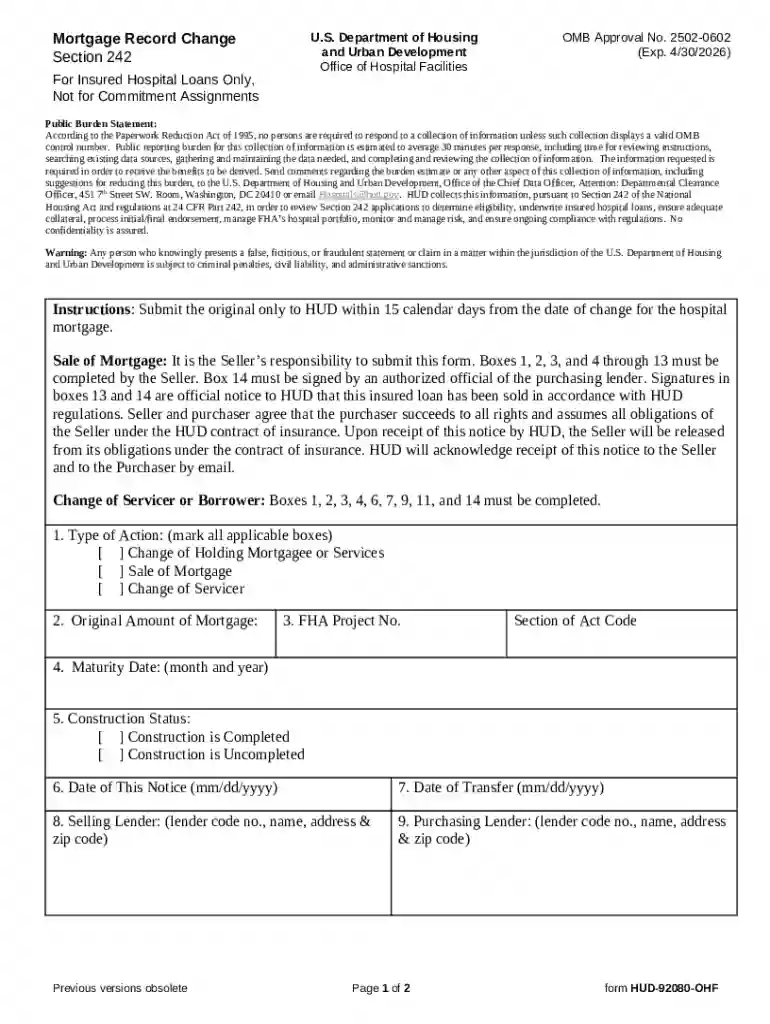
The Office of Hospital Facilities (OHF) is a critical component of the U.S. Department of Housing and Urban Development (HUD). It administers the Federal Housing Administration's (FHA) Section 242 mortgage insurance program, which covers hospital facilities. This program is designed to finance the construction, renovation, and refinancing of hospitals, thereby supporting the healthcare infrastructure in the United States. By providing mortgage insurance, the OHF aims to reduce the financial risks associated with investing in hospital facilities, making it more feasible for hospitals to access the necessary funds for improvement and expansion.
The FHA's hospital mortgage insurance under Section 242 includes several key components:
Understanding these elements helps hospitals assess whether this program can meet their financing needs and align with their long-term goals.
Acute care hospitals, both privately and publicly owned, are the primary users of the OHF's FHA program. These institutions may be in various stages of development, such as newly planned hospitals seeking initial construction funding or existing hospitals needing renovation or expansion funds. Non-profit and government-owned hospitals are particularly common participants, but for-profit institutions may also qualify if they meet all program criteria.


Hospitals participating in the OHF program are required to comply with numerous legal and regulatory requirements:
Non-compliance can result in penalties, including loss of insurance or financial sanctions.
Penalties for failing to comply with OHF program regulations can be severe:
Hospitals must adhere strictly to program guidelines to avoid these consequences.
Applicants have the flexibility to submit their applications either digitally or on paper. However, digital submission via the HUD's electronic filing system is encouraged and often more efficient. Digital submissions allow for quicker processing times, enhanced tracking capabilities, and reduced risks of document loss or errors. Paper submissions are still accepted but may result in slower processing and require additional follow-up.
While the OHF program is federally managed, different states might have additional regulations affecting hospital financing:
Hospitals need to carefully consider these state-specific requirements when planning their participation in the FHA program.
Understanding and navigating these elements will significantly enhance a hospital's ability to leverage The Office of Hospital Facilities' FHA program effectively.
We've got more versions of the The Office of Hospital Facilities (OHF) administers FHA's form. Select the right The Office of Hospital Facilities (OHF) administers FHA's version from the list and start editing it straight away!
At DocHub, your data security is our priority. We follow HIPAA, SOC2, GDPR, and other standards, so you can work on your documents with confidence.