01. Edit your form online
Type text, add images, blackout confidential details, add comments, highlights and more.

Type text, add images, blackout confidential details, add comments, highlights and more.

Draw your signature, type it, upload its image, or use your mobile device as a signature pad.

Send it via email, link, or fax. You can also download it, export it or print it out.
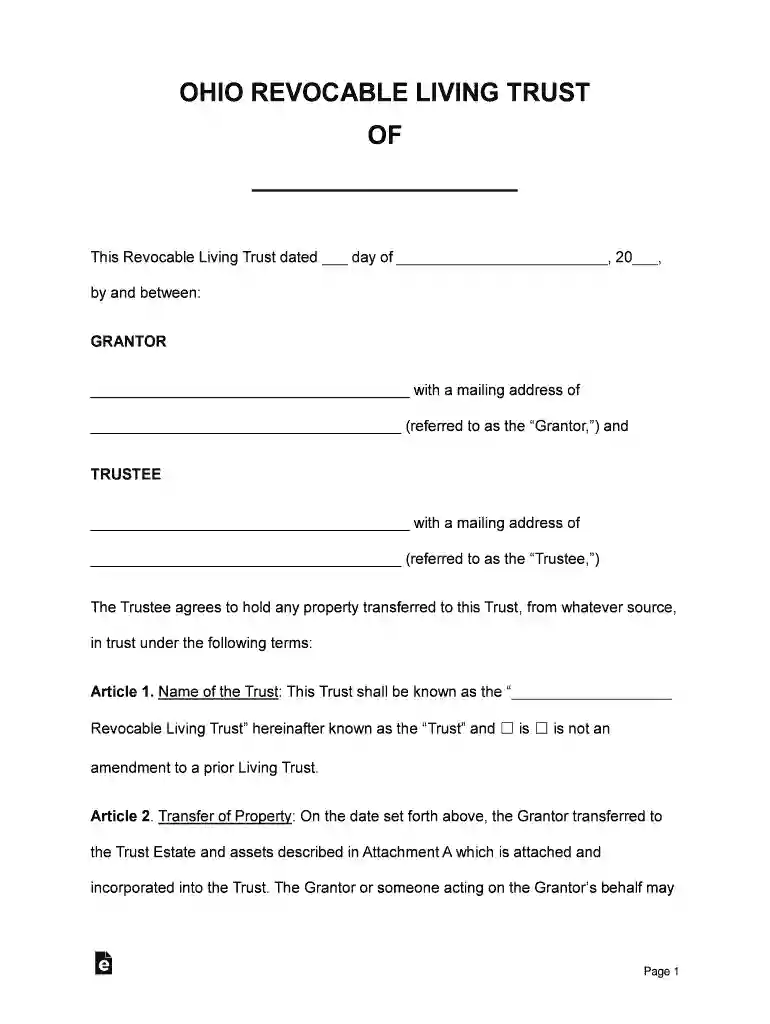
An Ohio Revocable Living Trust (ORLT) is a legal arrangement that allows the Grantor—the individual who creates the trust—to manage their assets during their lifetime and specify how those assets should be distributed after their death. Unlike a will, a revocable living trust does not pass through probate, making the distribution process faster and more private. The trust is "revocable," meaning the Grantor retains the right to modify or terminate it at any time during their lifetime. This flexibility allows the Grantor to respond to changes in circumstances or wishes.
An Ohio Revocable Living Trust functions as both a mechanism for managing assets during one's lifetime and a tool for post-mortem asset distribution. Once the trust is set up, it's critical to transfer ownership of assets—such as real estate, bank accounts, and investments—into the trust's name. This process is known as "funding the trust" and is necessary for the trust to function effectively. Failure to transfer assets could result in them not being covered by the trust, leading to probate proceedings.
Identify and List Assets: Begin by taking stock of all assets including real estate, investments, and bank accounts you wish to include in the trust.
Select a Trustee and Successor Trustee: Choose a responsible individual or corporate entity to serve as the Trustee. Additionally, appoint a Successor Trustee to take over in the event of the Grantor's incapacitation or death.
Determine the Beneficiaries: Clearly designate who will receive the trust assets upon the Grantor's death. Specify the particular assets or percentage each beneficiary will receive.
Draft the Trust Document: With the help of a qualified attorney, create the legal document reflecting the trust terms. This document should outline the management and distribution specifics of the trust assets.
Transfer Assets into the Trust: Execute deeds, retitle accounts, and update beneficiary designations to reflect the trust as the asset owner.
Review and Adjust as Needed: Periodically revisit the trust to make amendments as life circumstances change.
The ORLT functions under Ohio state law and offers a legal mechanism to manage and distribute personal assets efficiently. It's a flexible strategy to minimize estate taxes, ensure privacy, and provide precise directions as opposed to a will. The trust becomes irrevocable upon the Grantor's death, at which point the Successor Trustee steps in to manage the distribution according to the outlined terms.
Ohio law requires certain formalities in the drafting and execution of a Revocable Living Trust, including signatures and, in some cases, notarization. It's advisable to consult local regulations or a trusted attorney to ensure compliance.
Property and debts in other states may require specific attention to integrate seamlessly into the Ohio-based trust structure.
Ohio's legal landscape dictates specific provisions for crafting and overseeing an ORLT. These include mandated registration processes for substantial properties included in the trust and adherence to state tax regulations impacting Trusts. Additionally, any real property titled under the trust within the state must comply with Ohio's transfer and registration laws.
An ORLT can be instrumental in managing and potentially reducing estate tax commitments in Ohio. Strategic placement of assets into the trust can shield certain holdings from taxation, underscoring the importance of professional legal and tax consultation for proper planning.
Certain asset types, like insurance policies and retirement plans, might require separate considerations or indirect inclusion into the trust due to regulatory constraints. This necessitates the adaptation of strategies, such as naming the trust as a beneficiary instead of a direct owner.
Understanding the terminology associated with ORLTs is vital for effective setup and management:
Consider a couple, John and Mary, who wish to ensure their financial legacy supports their children and charities after they pass. By creating an Ohio Revocable Living Trust, they transfer their family home and investment portfolio into the trust. They name themselves as Trustees and their eldest child as the Successor Trustee. Upon their passing, the trust ensures the home and investments are maintained and distributed as specified, all without the complications of probate and public disclosure.
As families grow, trusts can be amended to include new members, such as grandchildren. Grantors may update terms to accommodate life events, ensuring that their asset distribution reflects current wishes and family dynamics.
We've got more versions of the OHIO REVOCABLE LIVING TRUST form. Select the right OHIO REVOCABLE LIVING TRUST version from the list and start editing it straight away!
| Versions | Form popularity | Fillable & printable |
|---|---|---|
| 2017 | 4.8 Satisfied (85 Votes) |
At DocHub, your data security is our priority. We follow HIPAA, SOC2, GDPR, and other standards, so you can work on your documents with confidence.