01. Edit your form online
Type text, add images, blackout confidential details, add comments, highlights and more.

Type text, add images, blackout confidential details, add comments, highlights and more.

Draw your signature, type it, upload its image, or use your mobile device as a signature pad.

Send it via email, link, or fax. You can also download it, export it or print it out.
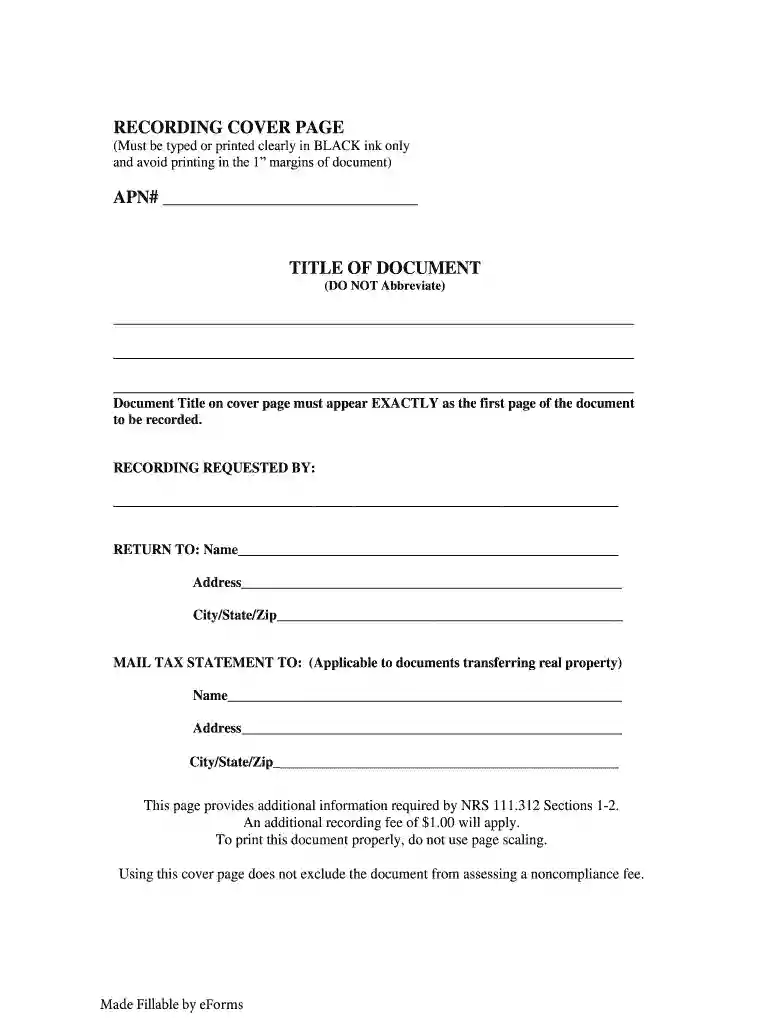
A Nevada Deed Cover Sheet Form serves as a recording cover page required for the submission of legal documents in Nevada. It is essential for outlining the necessary information and formatting standards stipulated by the state's recording office. The form typically includes sections for details such as the APN number, document title, and requester information. By using this form, individuals ensure compliance with Nevada Revised Statutes (NRS) 111.312, which governs the proper execution of deed recording in the state and includes an additional recording fee.
To effectively use the Nevada Deed Cover Sheet Form, follow these steps:
Gather Required Information: Make sure to have all necessary details at hand, including the APN number, document title, and requester information.
Complete with Accuracy: Fill out the form using clear black ink to maintain legibility and accuracy, as required for official submissions.
Attach to Primary Document: The cover sheet must accompany the primary document meant for recording. It serves as a guide for the recording office to process the document correctly.
Verify Compliance: Ensure the form complies with NRS 111.312 to avoid rejection or delays during the recording process.
Submit for Recording: Once filled out and verified, submit the form along with the primary document and applicable fees to the appropriate recording office in Nevada.
Completing the Nevada Deed Cover Sheet Form involves several key steps. Here’s a detailed process:
APN Number: Enter the Assessor's Parcel Number clearly, as this identifies the exact real estate property involved.
Document Title: Provide the appropriate title of the document being recorded, such as a deed or agreement.
Requester Information: Fill in the name and contact information of the individual or entity requesting the recording.
Tax Statement Details: Specify where the property tax statement should be mailed. This includes the name and address of the recipient.
Check Compliance: Double-check all entries for completeness and compliance with Nevada-specific legal requirements.
Fee Payment: Prepare the necessary recording fees as specified by the recording office guidelines.
This form is mandated by Nevada state law for the recording of deeds and related legal documents through county offices. The form's purpose is to ensure that each submission is correctly cataloged and processed within Nevada's legal framework. The NRS 111.312 necessitates this form to promote consistent handling and filing of documents, thereby simplifying property transactions and record keeping.
Several critical elements are included in the Nevada Deed Cover Sheet Form:
Understanding these core elements is essential for the successful use of the form.
The form complies with specific regulations from Nevada Revised Statutes, highlighting necessary details and formatting. Some of these rules include:
Staying informed about these rules helps ensure lawful and smooth processing of document recordings.
Consider these scenarios where the Nevada Deed Cover Sheet Form is used:
These examples illustrate the versatility and crucial role of the form in various property-related activities.
When submitting the Nevada Deed Cover Sheet Form, ensure the following documents are included:
Having these documents ready ensures a seamless and efficient processing time with Nevada's recording offices.
At DocHub, your data security is our priority. We follow HIPAA, SOC2, GDPR, and other standards, so you can work on your documents with confidence.