






Definition & Meaning
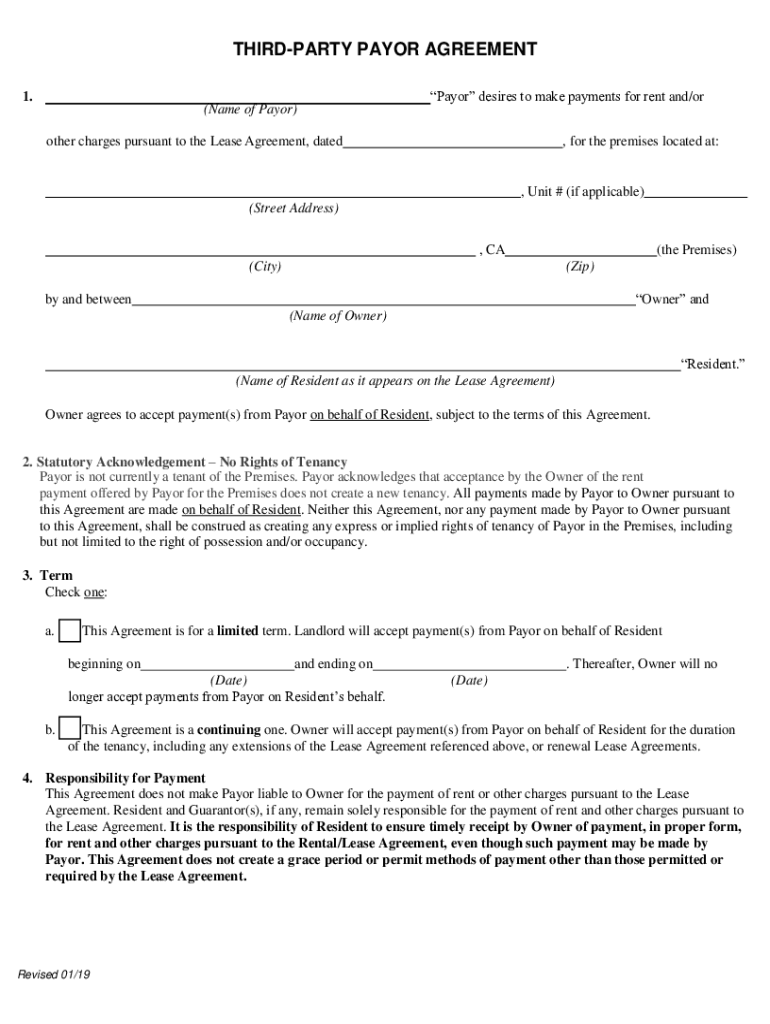
A Third-Party Payor Agreement is a legal document that allows a designated third party to make payments, typically rent payments, on behalf of a resident to a property owner. This arrangement is commonly used in situations where residents may need financial assistance from family members, organizations, or other external sources. The agreement outlines the terms and responsibilities of each party involved, clarifying that the third-party payor does not gain tenancy rights. Instead, the resident remains primarily responsible for fulfilling all lease obligations.
Purpose and Utility
- Provides financial support to residents who cannot cover costs independently.
- Ensures property owners receive timely payments without breaking the agreements.
- Protects third-party payors from gaining unintended tenancy rights.
Key Elements of the Third-Party Payor Agreement
Understanding the key elements of a Third-Party Payor Agreement can help clarify expectations and responsibilities for all involved parties.
Essential Components
- Agreement Term: Specifies the duration for which the third-party arrangement is valid.
- Payment Responsibilities: Details the specific financial obligations of the payor, including payment amounts and due dates.
- Limitations of Payor Rights: Clearly states that the payor does not acquire any tenancy rights or authority over the lease terms.
- Resident Responsibilities: Highlights that the resident remains liable for all non-financial lease obligations.
Practical Considerations
- Consideration of potential adjustments in payment amounts or arrangement terms.
- Provisions for how disagreements or breaches will be resolved.
How to Use the Third-Party Payor Agreement
Utilizing a Third-Party Payor Agreement involves several steps to ensure compliance and clarity for all parties involved.
Steps to Implement
- Identify Participants: Determine the resident, property owner, and third-party payor.
- Draft the Agreement: Ensure all terms, including payment responsibilities and duration, are explicitly stated.
- Review Legalities: Consult with legal advisors to ensure the agreement complies with state and federal regulations.
- Sign and Verify: All parties should sign the agreement to validate its legality and enforceability.
Considerations for Use
- Ensure transparency and thorough communication among the involved parties.
- Utilize resources such as legal professionals to review and optimize the agreement's effectiveness.
Steps to Complete the Third-Party Payor Agreement
Completing this legal form involves careful attention to detail to secure a valid and enforceable agreement.
Detailed Process
- Information Collection: Gather complete details of all participants including names and contact information.
- Drafting: Use a standardized template or seek professional help to draft the agreement.
- Reviewing Terms: Check each term and condition for clarity and legal compliance.
- Negotiation: Discuss and agree on the terms with the involved parties to avoid future disputes.
- Signing: Have all parties sign the agreement with witnesses if necessary to ensure its validity.
Example Scenarios
- Parents serving as payors for a student living in off-campus housing.
- Charitable organizations assisting eligible individuals in meeting their rent obligations.
Who Typically Uses the Third-Party Payor Agreement
This type of agreement is popular among various demographics and organizational structures depending on the financial arrangement nature.


Common Users
- Families: Parents or guardians paying for children's housing.
- Non-Profit Organizations: Providing financial assistance to individuals in need.
- Social Services: Agencies managing supportive housing arrangements for clients.
- Temporary Employers: Assisting relocated employees with housing costs.

Broader Applications
- Used in commercial properties where franchising agreements may involve third-party payments.
Legal Use of the Third-Party Payor Agreement
Understanding the legal implications and boundaries of this agreement is crucial for all parties involved.
Legal Responsibilities
- Binding Obligations: The agreement serves as a contract that binds the signatories to its terms.
- Termination Clauses: Contains conditions under which the agreement may be voided.
- Documentation: Requires adequate record-keeping to furnish proof of compliance in case of disputes.
Legal Advice
- Parties should consult legal professionals to comprehend nuanced obligations and rights.
- Awareness of state-specific laws that might influence agreement terms.
Important Terms Related to Third-Party Payor Agreement
Becoming familiar with the jargon used in these agreements enables clearer understanding and mitigating misinterpretation risks.
Key Terms
- Payor: The third party providing financial payment.
- Resident: The individual benefiting from the third-party's payments.
- Property Owner: The receiver of the payment who provides tenancy to the resident.
- Rent Obligations: The financial duty assigned in the lease that the payor agrees to fulfill.
Contextual Examples
- The distinction between "payor" and "resident" emphasizes the non-transferability of tenancy rights.
State-Specific Rules for the Third-Party Payor Agreement
Different states have varying regulations that can affect how Third-Party Payor Agreements are structured and enforced.
Considerations for State Regulations
- Local Laws: States like California have specific tenant laws that might alter liability and consent provisions.
- Variations in Enforcement: Legal enforceability may differ based on state-specific landlord-tenant laws.
- Documentation Requirements: Certain jurisdictions may require notarization or additional forms for complete compliance.
Advisories
- Tailor agreements according to the resident's and property owner's location for legal compatibility.
- Engage with local legal counsel for sound legal interpretations in respective states.