Monthly Tuberculin Skin Testing (PPD TST) Form andlt;pandgt;Infectious Disease Control UnitMonthly T 2026

Get Form
Monthly Tuberculin Skin Testing (PPD TST) Form andlt;pandgt;Infectious Disease Control UnitMonthly T Preview on Page 1

Here's how it works

01. Edit your form online
Type text, add images, blackout confidential details, add comments, highlights and more.

02. Sign it in a few clicks
Draw your signature, type it, upload its image, or use your mobile device as a signature pad.

03. Share your form with others
Send it via email, link, or fax. You can also download it, export it or print it out.

Definition and Purpose of the Monthly Tuberculin Skin Testing Form

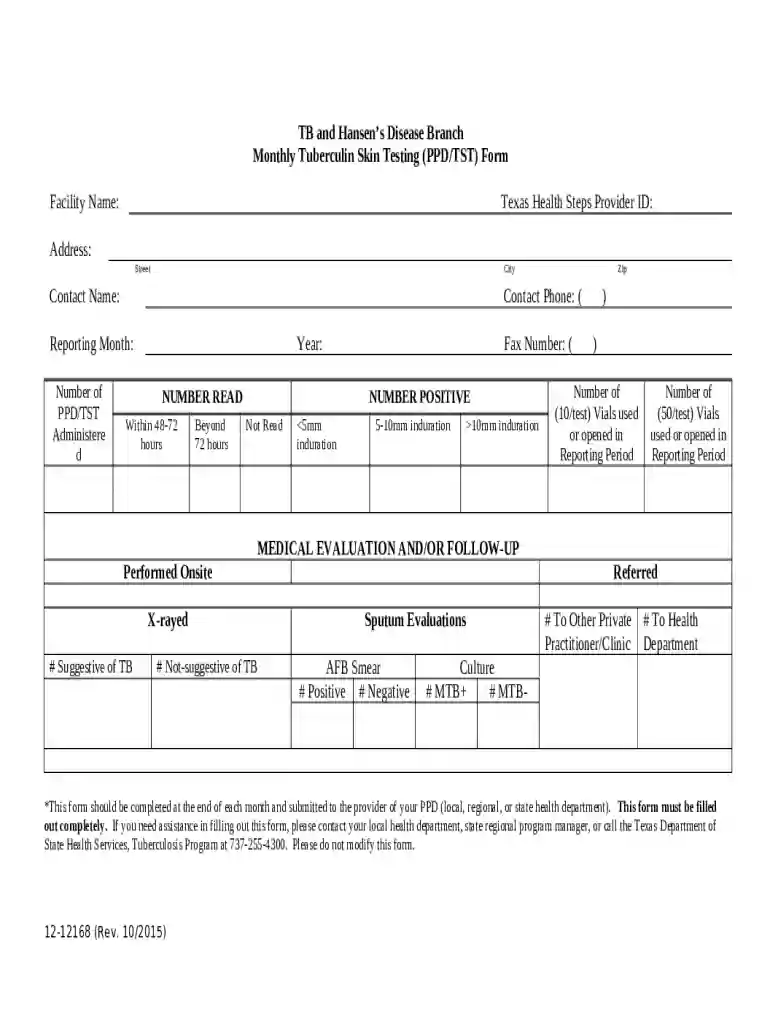
The Monthly Tuberculin Skin Testing (PPD/TST) Form is utilized by health organizations to document and report skin testing data related to tuberculosis (TB). This form supports the Infectious Disease Control Unit’s efforts to track PPD/TST administration, test results, medical evaluations, and follow-up actions. The form is specifically intended for monthly completion and submission to relevant health authorities.

Key Components of the Form

  • Test Administration Details: Includes information about the number of tests administered and the method of testing.
  • Results Record: Documents all test results, differentiating between positive and negative findings.
  • Medical Evaluation Summary: Offers insights into subsequent medical evaluations required for positive test results.
  • Follow-Up Actions: Describes any necessary follow-up actions or treatments detailed in response to the test outcomes.

How to Use the Monthly Tuberculin Skin Testing Form

To effectively use the Monthly Tuberculin Skin Testing Form, follow a structured approach:

  1. Gather Required Data: Collect all relevant data, including counts of administered tests and individual results.
  2. Fill in Administration Section: Include details of testing personnel and the medical facility.
  3. Document Results: Accurately record test outcomes for each individual.
  4. Complete Follow-Up Actions: Note any medical evaluations or follow-ups conducted for positive results.
  5. Review and Submit: Double-check all entered data for accuracy before submitting the form to the health authorities.

How to Obtain the Monthly Tuberculin Skin Testing Form

The form can be obtained through:

  • Health Department Websites: Many state health departments offer downloadable PDFs of the form.
  • Direct Request from Health Authorities: Directly contact the local infectious disease control units to request a physical or digital copy.
  • Online Medical Platforms: Certain accredited platforms may provide access to the forms for registered healthcare providers.

Steps to Complete the Monthly Tuberculin Skin Testing Form

Completing the form involves several critical steps:

  1. Identification Information: Enter the name of the administering health facility.
  2. Test Data Entry: Specify the number of tuberculin skin tests administered within the month.
  3. Results Section: Precisely categorize results by outcome (positive, negative, or inconclusive).
  4. Evaluation and Treatment Records: Fill in details of any follow-up actions taken for individuals with positive results.
  5. Final Review: Ensure all required fields are correctly filled out before submission.

Who Typically Uses the Monthly Tuberculin Skin Testing Form

The form is primarily utilized by:

  • TB Control Units: These agencies oversee the public health aspect of tuberculosis management.
  • Healthcare Providers: Clinics and hospitals conducting TB testing routinely use this form to document and report data.
  • Public Health Organizations: These entities use aggregated form data to monitor and control TB prevalence in the community.
decoration image ratings of Dochub

Legal Use and Compliance

The Monthly Tuberculin Skin Testing Form ensures compliance with:

  • Public Health Reporting Requirements: Mandatory for healthcare providers to report weekly and monthly TB testing results to state agencies.
  • Data Privacy Regulations: Form handling must comply with HIPAA to protect patient data.

Penalties for Non-Compliance

Failure to use or submit the form on time can result in:

  • Fines and Penalties: Imposed by state health departments for non-compliance.
  • Loss of Certification: Healthcare facilities could face penalties affecting their operational certification status.

Key Elements of the Monthly Tuberculin Skin Testing Form

Apart from its primary reporting function, the form includes:

  • Security Features: Protecting sensitive medical data from unauthorized access.
  • Integration Capabilities: Compatible with electronic health record systems to streamline data entry and reporting.

State-Specific Rules and Examples

State Regulations

  • Variability in Reporting: Some states may have additional fields or alternative submission methods based on local health regulations.
  • Case Study - Example State: For instance, in California, extra data on demographics might be required to gauge TB impact across different populations.

Real-World Application

  • Scenario Analysis: A hospital in Texas uses the form to successfully integrate monthly testing data into their public health improvements program, aiding in reducing TB incidence.

Maintaining a comprehensive understanding of these aspects will ensure accurate and efficient use of the Monthly Tuberculin Skin Testing Form, supporting both legal obligations and public health objectives.

be ready to get more

Complete this form in 5 minutes or less

Get form

Got questions?

We have answers to the most popular questions from our customers. If you can't find an answer to your question, please contact us.
Contact us
Tubersol (tuberculin purified protein derivative) is a member of the in vivo diagnostic biologicals drug class and is commonly used for Diagnosis and Investigation. The cost for Tubersol (5 tuberculin units/0.1 mL) intradermal solution is around $128 for a supply of 1 milliliter(s), depending on the pharmacy you visit.
In the Mantoux test, a standard dose of 5 tuberculin units (TU 0.1 ml), ing to the CDC, or 2 TU of Statens Serum Institute (SSI) tuberculin RT23 in 0.1 ml solution, ing to the National Health Service, is injected intradermally (between the layers of dermis) on the flexor surface of the left forearm, mid-
How often do you need a PPD test? We recommend getting a TB test every three years unless youve had potential exposure or are involved in high-risk activityin which case getting retested should be sooner.
The TB skin test, also known as the tuberculin skin test, may be used to find out if you are infected with TB germs. A health care worker will use a small needle to inject testing fluid (called tuberculin) under the skin on the lower part of your inner arm.
The TB skin test is performed by injecting 0.1 ml of tuberculin purified protein derivative (PPD) into the inner surface of the forearm. The injection should be made with a disposable 27-gauge tuberculin syringe, with the needle bevel facing upward. The TB skin test is an intradermal injection.

Security and compliance

At DocHub, your data security is our priority. We follow HIPAA, SOC2, GDPR, and other standards, so you can work on your documents with confidence.

Learn more
ccpa2
pci-dss
gdpr-compliance
hipaa
soc-compliance

People also ask

TB is comparable to the TST in the diagnosis of tuberculosis disease and identification of high-risk children with tuberculosis infection and is more specific than the TST in children who have received the BCG vaccine.
Tuberculin skin tests (TST) are administered to detect the presence of Mycobacterium tuberculosis, the bacterium that causes tuberculosis (TB). The terms Mantoux, TB skin test, tuberculin skin test, and PPDs are often used interchangeably. Mantoux refers to the technique for administering the test.