01. Edit your form online
Type text, add images, blackout confidential details, add comments, highlights and more.

Type text, add images, blackout confidential details, add comments, highlights and more.

Draw your signature, type it, upload its image, or use your mobile device as a signature pad.

Send it via email, link, or fax. You can also download it, export it or print it out.
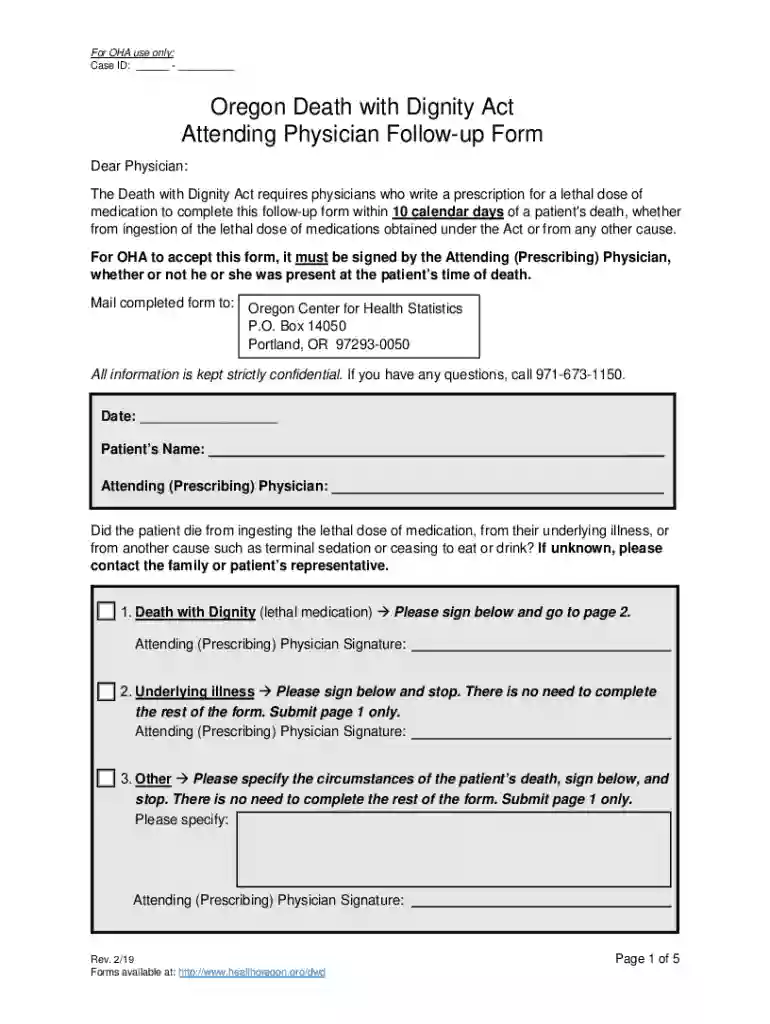
The "Oregon Death with Dignity Act Attending Physician Follow" form serves as a critical document for physicians who are involved in providing end-of-life care under the Oregon Death with Dignity Act. This form is specifically designed to ensure that physicians meet their legal obligations by reporting the details surrounding a patient's death after they have received a prescribed lethal dose of medication. It captures vital information such as whether the attending physician was present at the time of death, the circumstances of the patient's passing, and insights into the patient's decision-making process regarding the choice to request lethal medication.
Physicians utilize this form to comply with statutory requirements under the Death with Dignity Act. Upon a patient's death, the attending physician is responsible for completing and submitting the form within ten days. Key areas include documenting whether the prescribed medication was ingested and the presence of the physician during the patient's dying process. This form facilitates transparency and accountability, ensuring that the provisions of the Act are followed. It is pivotal for physicians to familiarize themselves with the form to ensure accurate and timely submissions.
Gather Required Information:
Complete the Form:
Submit the Form:
Physicians should verify each section for completeness and accuracy before submission.
The form functions within the legal framework of the Oregon Death with Dignity Act, which permits terminally ill adults to voluntarily request and receive a prescription for lethal medication from their physician. By completing this form, attending physicians uphold their legal obligations, ensuring compliance with the Act’s stipulations. It is crucial for legal and ethical reasons to adhere strictly to the reporting and procedural standards set forth by the state of Oregon.
Oregon is the first state to legalize physician-assisted death, with the Act providing specific guidelines that must be followed. Only residents of Oregon can legally make use of this Act. Physicians in Oregon are obligated to report every incidence of a prescribed lethal medication, ensuring that the patient's rights and choices are respected, alongside transparency and compliance with state laws.
Choosing the right submission method ensures that the form is timely and verified according to state protocols.
We've got more versions of the Oregon Death with Dignity Act Attending Physician Follow form. Select the right Oregon Death with Dignity Act Attending Physician Follow version from the list and start editing it straight away!
At DocHub, your data security is our priority. We follow HIPAA, SOC2, GDPR, and other standards, so you can work on your documents with confidence.