




01. Edit your federal excise tax exemption certificate pdf online
Type text, add images, blackout confidential details, add comments, highlights and more.

Type text, add images, blackout confidential details, add comments, highlights and more.

Draw your signature, type it, upload its image, or use your mobile device as a signature pad.

Send federal excise tax exemption certificate via email, link, or fax. You can also download it, export it or print it out.
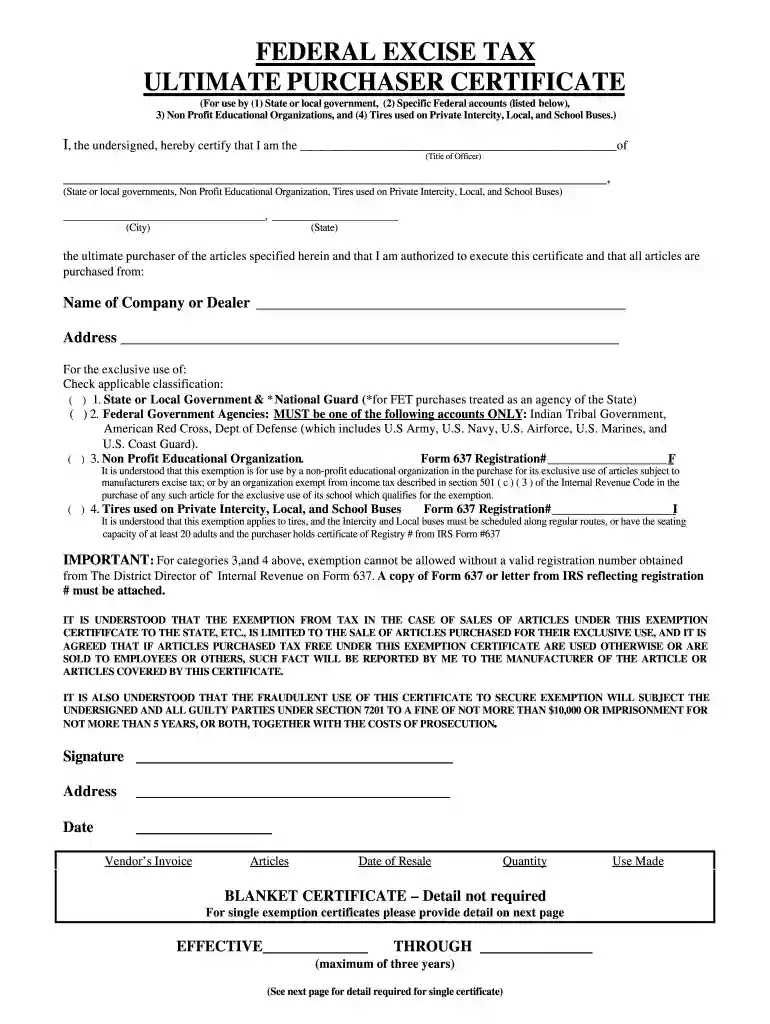
The federal excise tax exemption certificate for tires serves as a key document that allows qualifying entities to claim an exemption from the federal excise tax imposed on the sale of certain tires. This tax exemption is specifically applicable to specific categories of purchasers, including federal, state, and local government agencies, non-profit educational organizations, and vehicles used for certain public transit purposes.
When a purchaser submits this certificate, they declare their status as an ultimate purchaser, which signifies that they are the final consumer of the tires. The exemption generally applies to tires that are intended for use on buses and other qualifying vehicles. The taxation framework surrounding tires is governed under Internal Revenue Code (IRC) Section 4051, detailing exemptions and compliance requirements.
Understanding this certificate's purpose is vital, as it ensures that eligible entities do not pay taxes that they are ultimately exempt from, which can lead to financial savings and better budget management for various organizations.
Acquiring the federal excise tax exemption certificate involves several straightforward steps. While the exact process may vary depending on the applicant's status and location, the general framework remains consistent.
Determine Eligibility: Identify whether your organization qualifies for the exemption based on your status as a governmental agency, educational institution, or approved entity under IRC regulations.
Complete the Certificate: The form requires detailed information, including the purchaser's name, address, and the vendor's information. It must specify the exact nature of the exemption claim and the vehicle type, typically bus or public transport uses.
Signature Requirement: The certificate must be signed by an authorized representative of the purchasing organization, confirming the accuracy of the information provided and the eligibility for tax exemption.
Keep Records: Maintain a copy of the signed certificate for your records and future reference, as it will serve as proof during audits or inquiries.
These steps ensure that the acquisition of the certificate is done properly, allowing organizations to avoid unnecessary taxation.
Completing the federal excise tax exemption certificate for tires accurately is crucial to validate the tax-exempt status of the tires purchased. Here’s a structured approach to filling it out:
Obtain the Form: Access the federal excise tax exemption certificate specific to tires. This form can often be downloaded in PDF format from governmental or tax advising websites.
Fill Out Purchaser Information: Input details, including the purchaser's name, address, and type of entity (e.g., government, educational). This section establishes the identity of the entity claiming exemption.
Vendor Information: Provide the name and address of the vendor or seller from whom the tires are being purchased. This information is necessary for tracking the sale and ensuring the vendor acknowledges the exemption.
Specify the Nature of Use: Clearly describe the intended use of the tires. This typically includes classifications such as "buses" or "other public transport," which matter greatly for the exemption eligibility.
Authorized Signature: Have an authorized representative sign the form. This signature affirms that the information provided is accurate and that the sender understands the consequences of fraudulent claims.
Submission: Once completed, submit the certificate to the vendor, ensuring that they retain it for their records. If required, a copy may also need to be sent to the IRS, although this varies.
Accurate completion and submission of the certificate are fundamental for leveraging tax exemptions.
Understanding the terminology associated with the federal excise tax exemption certificate for tires is essential for both compliance and effective communication within this context. Here are some critical terms:
Ultimate Purchaser: This refers to the entity or individual that purchases tires for their own use rather than for resale. The ultimate purchaser is typically eligible to claim tax exemption.
Federal Excise Tax (FET): A type of tax levied by the federal government on specific goods, including tires, meant to generate revenue for various public services and infrastructure projects.
Certification: The act of confirming that the purchaser is indeed eligible for the exemption. Certification often requires specific documentation, like the exemption certificate itself.
IRS: The Internal Revenue Service, the U.S. government agency responsible for tax collection and tax law enforcement, including managing exemptions.
Understanding these terms not only enhances compliance but also supports effective discussions regarding taxation within organizations.
The federal excise tax exemption certificate for tires is predominantly utilized by various entities that meet specific criteria set forth by the Internal Revenue Service. The primary users typically include:
Government Entities: Local, state, and federal agencies purchasing tires for vehicles that serve the public, such as buses and other public transport vehicles. These entities benefit from the exemption because their operations often rely on public funding.
Non-Profit Organizations: Eligible non-profits that may operate fleet vehicles for community services or educational purposes can claim the exemption on their tire purchases.
Educational Institutions: Schools and universities that maintain transportation systems for students, especially in contexts where student safety and accessibility are priorities.
Certain Business Types: Companies that operate under specific regulatory requirements may also be able to utilize this certificate if they can demonstrate that their purchase of tires is for exempt purposes.
By understanding who the primary users are, organizations can better navigate the application and certification process to optimize their financial resources.


Non-compliance with the regulations surrounding the federal excise tax exemption certificate for tires can lead to significant consequences for entities that fail to adhere to the guidelines:
Financial Penalties: Entities found improperly using the exemption certificate may face substantial fines. This could include paying back taxes along with penalties, which may accumulate interest over time.
Legal Ramifications: Engaging in fraudulent activities regarding the tax exemption can expose individuals to legal issues, including criminal charges in severe instances where intentional tax evasion is proven.
Loss of Future Exemptions: Repeated violations or significant infractions may lead to a loss of eligibility for future tax exemptions, financially impacting organizations attempting to manage operational costs.
Understanding these penalties reinforces the importance of compliance, encouraging organizations to adhere closely to the guidelines established by the IRS.
At DocHub, your data security is our priority. We follow HIPAA, SOC2, GDPR, and other standards, so you can work on your documents with confidence.
It is understood that this exemption applies to tires, and the intercity and local buses must be scheduled along regular routes, or have the seating capacity ofRead more
Jan 23, 2018 Alternative minimum tax exemption increased. The. AMT exemption amount has increased to $54,300. ($84,500 if married filing jointly orRead more
Sep 30, 2025 Form 720, Quarterly Federal Excise Tax Return PDF Form 720-CS Form 1363, Export Exemption Certificates PDF Form 2290, Heavy HighwayRead more


