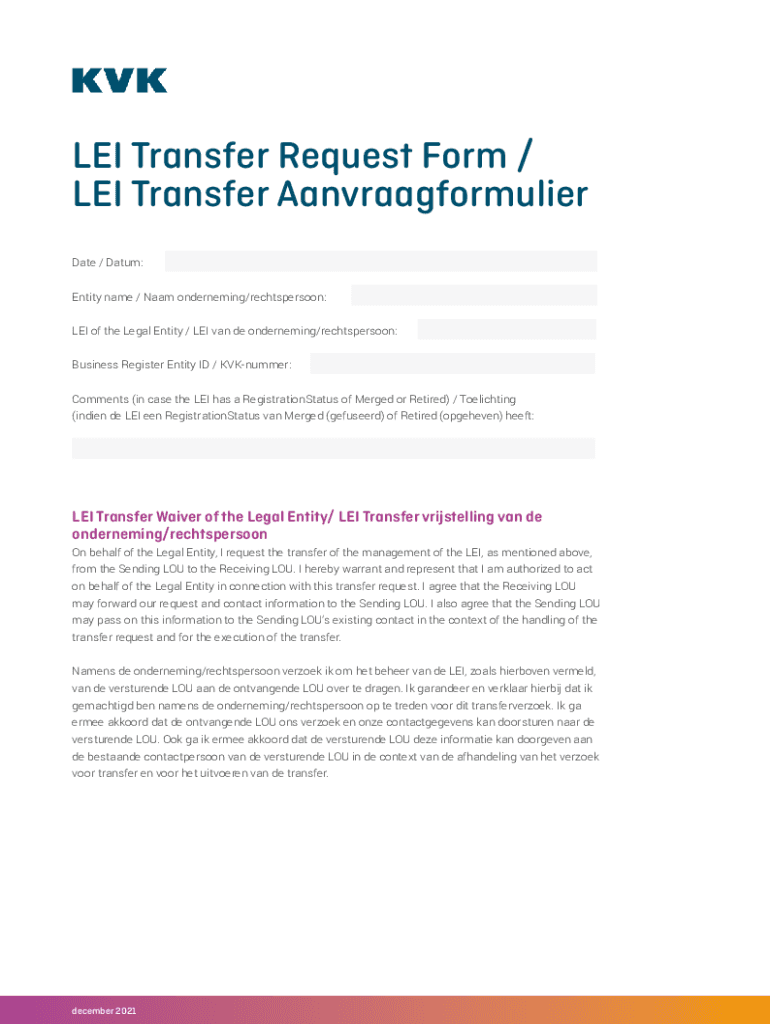







Definition & Meaning of the LEI Transfer Request Form
The LEI Transfer Request Form is essential for those managing Legal Entity Identifiers (LEIs), which are critical in tracking financial transactions globally. This form is used to transfer the management of an LEI from one Local Operating Unit (LOU) to another. The LEI acts as a unique identification number that is assigned to legal entities participating in financial transactions. By transferring an LEI, a company can consolidate or update its entity information with a different LOU, ensuring accurate and current records are maintained across the global financial system.
Key Information Included in the Form
- Entity Details: Information such as the legal name, address, and entity type is crucial.
- LEI Details: Current LOU information and the LEI’s status clarify the transfer's context.
- Authorization: A signed statement authorizing the transfer by a representative ensures validation.
Steps to Complete the LEI Transfer Request Form
Completing the LEI Transfer Request Form accurately is crucial for a smooth transfer process. This section outlines a typical completion procedure.
- Gather Necessary Information: Collect all relevant entity details, such as legal name, address, current LOU, and LEI.
- Fill in Entity Information: Provide accurate legal entity details, ensuring no discrepancies in data.
- Complete the Transfer Section: Specify the new LOU that will manage the LEI and any comments regarding the transfer.
- Authorization: Obtain a signature from an authorized representative of the legal entity to approve the transfer process.
- Review for Accuracy: Double-check all entries to prevent delays caused by errors.
- Submit the Form: Choose the appropriate submission method (online or mail) and ensure deadlines are met.
Common Mistakes to Avoid
- Missing entity details or incorrect information can lead to rejected transfers.
- Lack of required authorization can invalidate the form.
How to Obtain the LEI Transfer Request Form
Obtaining the LEI Transfer Request Form is straightforward, and multiple avenues are available.
- Online Download: Many LOUs offer downloadable PDF versions of the form on their websites.
- Direct Contact: Reach out to the LOU via email or phone to request the form.
- Professional Assistance: Consulting firms or legal advisors who specialize in financial transactions may provide the form.
Considerations When Choosing a Source
- Ensure the source provides the most up-to-date version.
- Verify the LOU’s legitimacy to avoid fraudulent activities.
Who Typically Uses the LEI Transfer Request Form
The primary users of the LEI Transfer Request Form include businesses and legal entities participating in global financial transactions. These users span various industries, such as:
- Banks and Financial Institutions: To maintain compliance with global financial standards.
- Corporates and Large Enterprises: For accuracy in international dealings and organizational restructuring.
- Investment Firms: Ensures transparency in complex financial ecosystems.


Benefits for Different Business Types
- Small Businesses: Streamlines operations when changing LOUs.
- Multinational Corporations: Facilitates central management of international entities.
Important Terms Related to the Form
Understanding key terminology associated with the LEI Transfer Request Form is vital for effective completion.
- LEI: A unique 20-character identifier that enables standardized legal entity tracking.
- LOU: A local entity responsible for issuing and managing LEIs.
- Transfer Request: The formal process to shift the management of an LEI from one LOU to another.
Glossary of Terms
- Legal Entity: Any company or organization participating in financial transactions.
- Authorization: Formal approval by the legal entity or its representative to initiate a transfer.
Legal Use of the LEI Transfer Request Form
The LEI Transfer Request Form is a legally binding document that must adhere to regulations and standards proposed by international financial oversight bodies such as the Global Legal Entity Identifier Foundation (GLEIF).
Compliance Requirements
- ESIGN Act Compliance: Ensures digital signatures on the form are legally binding.
- Data Protection: Shift-sensitive data securely to comply with privacy regulations.
Penalties for Non-Compliance
Failing to comply with the required processes or timelines for LEI transfer may result in several penalties or negative outcomes.
- Regulatory Penalties: May include fines or legal actions from financial regulatory bodies.
- Operational Delays: Interrupted transactions or processing delays due to incorrect LEI management.
- Loss of Business Credibility: Maintaining inaccurate records can lead to reputational risk.
Mitigation Strategies
- Regular audits to ensure data accuracy and compliance.
- Implement reminders and checklists for timely submissions.
Application Process & Approval Time
Transferring an LEI involves a specific timeline that entities must consider to avoid disruptions in their operations.
- Application Submission: After filling out the form, submit to the new LOU.
- LOU Review: The LOU examines the application for completeness and accuracy.
- Approval Notification: Once approved, the legal entity receives confirmation of the transfer.
Typical Duration
- Transfer process averages between one to two weeks, depending on the LOU and accuracy of the form submitted.
- Urgent transfers might be expedited upon request if supported by a compelling business case.