




01. Edit your pre delivery inspection report online
Type text, add images, blackout confidential details, add comments, highlights and more.

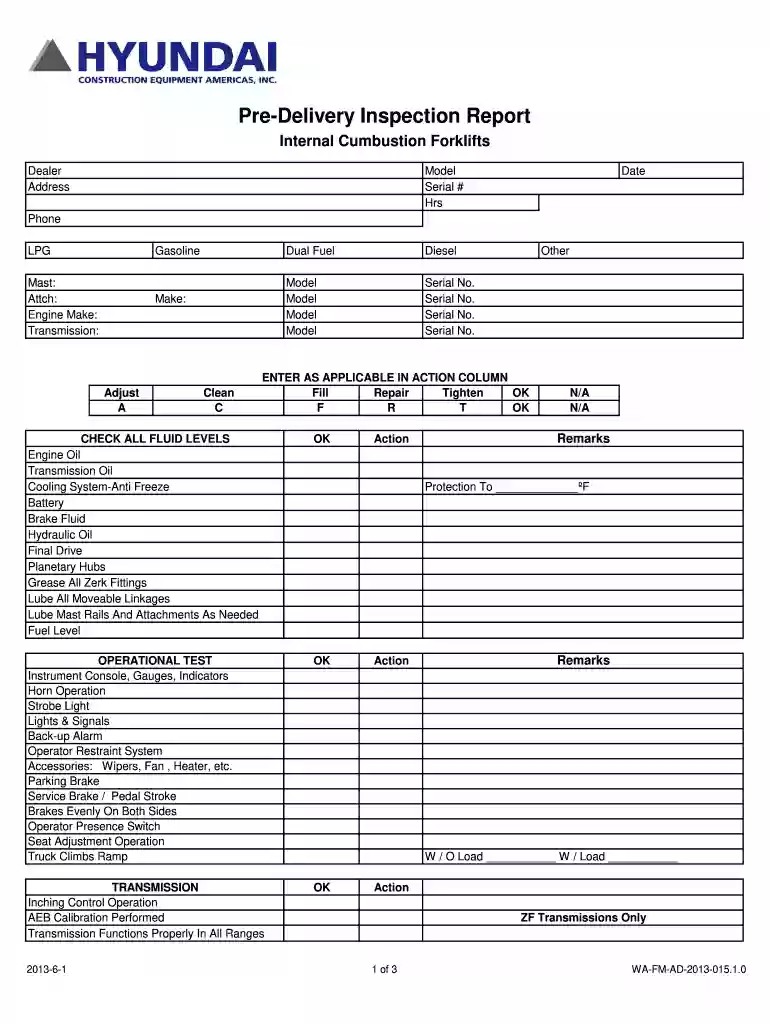
Type text, add images, blackout confidential details, add comments, highlights and more.

Draw your signature, type it, upload its image, or use your mobile device as a signature pad.

Send hyundai pdi checklist via email, link, or fax. You can also download it, export it or print it out.
A Pre-Delivery Inspection (PDI) Report is a critical document in various industries, especially for vehicles and equipment. This report ensures that items are thoroughly checked and verified before delivery to the end user. It helps identify any issues and confirms the item meets quality standards. A PDI Report typically encompasses multiple inspection areas, ranging from mechanical components to aesthetic details, ensuring operational reliability and safety.
A comprehensive PDI Report includes several critical components:
Completing a PDI Report involves a structured process that includes:
The PDI Report plays a key role in several areas:
Different sectors may require specific adaptations of the PDI Report, reflecting industry requirements:
A Pre-Delivery Inspection Report is an indispensable tool in ensuring that items are delivered to customers in optimal condition. By focusing on vehicle and equipment specifics, fluid levels, operational functionality, and final inspection comments, the PDI Report safeguards quality assurance and enhances client satisfaction across multiple industries.
We've got more versions of the pre delivery inspection report form. Select the right pre delivery inspection report version from the list and start editing it straight away!
| Versions | Form popularity | Fillable & printable |
|---|---|---|
| 2013 | 4.3 Satisfied (45 Votes) |
At DocHub, your data security is our priority. We follow HIPAA, SOC2, GDPR, and other standards, so you can work on your documents with confidence.
The Pre Delivery Inspection (PDI) processes described in this bulletin were developed to ensure a. fault-free delivery. This bulletin contains generalRead more
Jun 2, 2018 The pre-delivery preparation report contains checklists for each type of scheduled inspection. Make copies for each inspection. Store completed.Read more
UNDER HOOD - Engine Off. ON INSIDE. Engine oil level. Operation of lights, turn signals, stop signals, courtesy. Steering gear housing fluid level.Read more


