Definition and Meaning
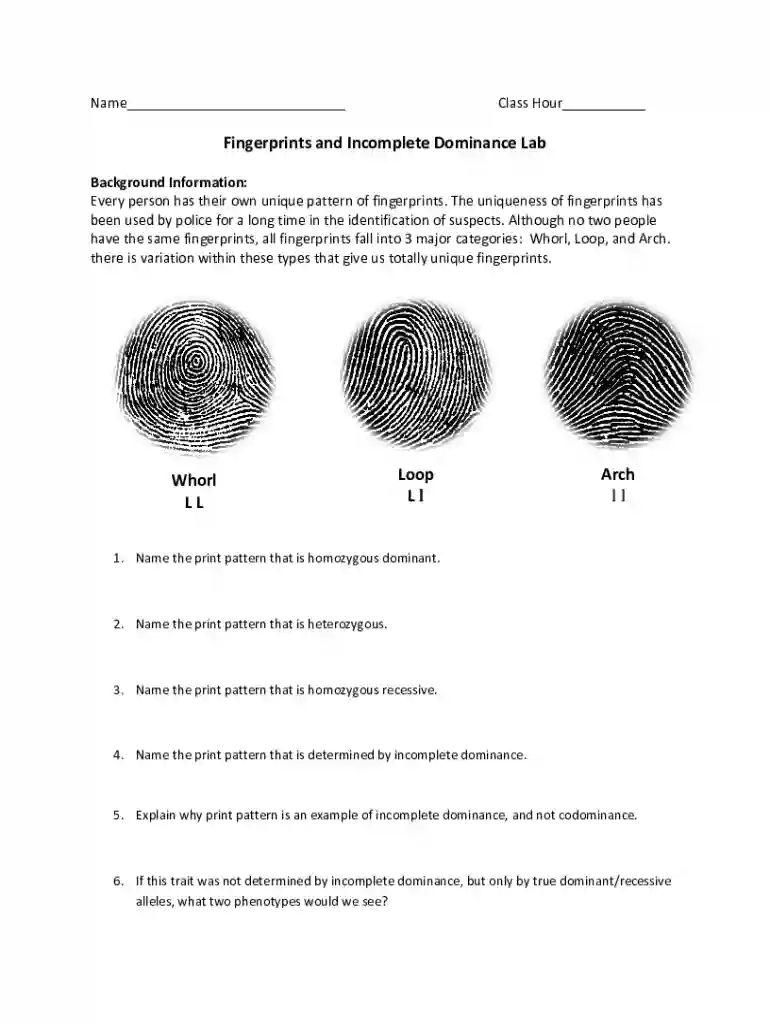
The "Fingerprint Incomplete Dominance Lab" is a genetic analysis activity where individuals analyze their fingerprint patterns to explore genetic concepts. The lab focuses on incomplete dominance in genetics, examining how genetic variations manifest in fingerprint phenotypes and genotypes. Incomplete dominance refers to a genetic scenario where the phenotype is an intermediate of dominant and recessive alleles, rather than one being fully dominant over the other. This lab allows participants to understand this concept by identifying fingerprint patterns such as Whorl, Loop, and Arch, and determining corresponding genotypes.
Key Elements of the Fingerprint Incomplete Dominance Lab
Several critical components make up the Fingerprint Incomplete Dominance Lab, enabling a thorough understanding of genetic implications:
- Fingerprint Patterns: Participants categorize prints into Whorl, Loop, and Arch types, which are fundamental phenotypic expressions.
- Incomplete Dominance: This genetic principle is at the core of the lab, helping to elucidate how mixed genetic traits appear in fingerprints.
- Genotype Analysis: The lab encourages students to infer possible genetic makeups responsible for their specific fingerprint patterns.
- Data Collection: Involves examining one's fingerprints and recording observations, which contributes to phenotype determination.
How to Use the Fingerprint Incomplete Dominance Lab
The lab is typically utilized in educational settings to provide hands-on genetic analysis experience. Participants are guided through various steps:
- Preparation: Gather materials such as an ink pad, paper, and instructions.
- Print Collection: Collect clear and distinct prints of all ten fingers.
- Pattern Identification: Use a reference chart to categorize each fingerprint into one of the predefined types.
- Data Analysis: Compare your fingerprint patterns against genetic models of incomplete dominance to identify phenotypic expressions.
- Conclusions: Draw conclusions about the potential genotypes based on observable fingerprint patterns.
Steps to Complete the Fingerprint Incomplete Dominance Lab
Completing the lab involves several carefully structured steps to ensure accurate understanding and results:
- Collect Fingerprints: Clean your fingers and use the ink pad to transfer prints onto the paper.
- Examine Patterns: Observe each imprint and circle patterns that fit within Whorl, Loop, or Arch categories.
- Record Data: Write down the observed patterns for each finger.
- Compare and Contrast: Use genetic theories to compare observed fingerprint patterns with possible incomplete dominance scenarios.
- Inference of Genotypes: Based on the data, infer potential genotypic compositions.
- Discussion: Engage in discussions or write a report analyzing the significance of results in the context of genetic dominance.
Examples of Using the Fingerprint Incomplete Dominance Lab
The lab is often illustrated through practical examples to enhance learning:
- Classroom Activity: Students analyze fingerprints to see real-world examples of genetic concepts studied in textbooks.
- Research Studies: Used in research to demonstrate genotype-phenotype correlations in different populations.
- Public Engagement: Held at science fairs or public engagement events to increase public understanding of genetics.
Legal Use of the Fingerprint Incomplete Dominance Lab
Understanding incorrect or misleading applications of genetic data is vital:
- Educational Purpose: Primarily used in educational settings with consent for learning purposes, not for legal identification or profiling.
- Research Compliance: Adheres to ethical guidelines regulating participant consent and data privacy.
- Public Dissemination: Findings are shared in scientific communities or public domains following strict ethical considerations.
Software Compatibility
Educators and researchers often use software tools to aid the analysis:
- Data Analysis Software: Tools like Excel or SPSS are used to tabulate and analyze genetic data.
- Educational Platforms: Integration with online learning platforms for virtual lab simulations or data entry.
- Cloud-Based Sharing: Platforms such as Google Drive are used to share and collaborate on data collected during the lab activity.
Important Terms Related to the Fingerprint Incomplete Dominance Lab
- Phenotype: Observable traits resulting from the interaction of genetics and environment.
- Genotype: The genetic constitution responsible for a particular trait.
- Incomplete Dominance: A genetic situation wherein the phenotype is a blend between two different alleles.
- Whorl, Loop, Arch: Types of fingerprint patterns used for genetic analysis in the lab.