01. Edit your form online
Type text, add images, blackout confidential details, add comments, highlights and more.

Type text, add images, blackout confidential details, add comments, highlights and more.

Draw your signature, type it, upload its image, or use your mobile device as a signature pad.

Send it via email, link, or fax. You can also download it, export it or print it out.
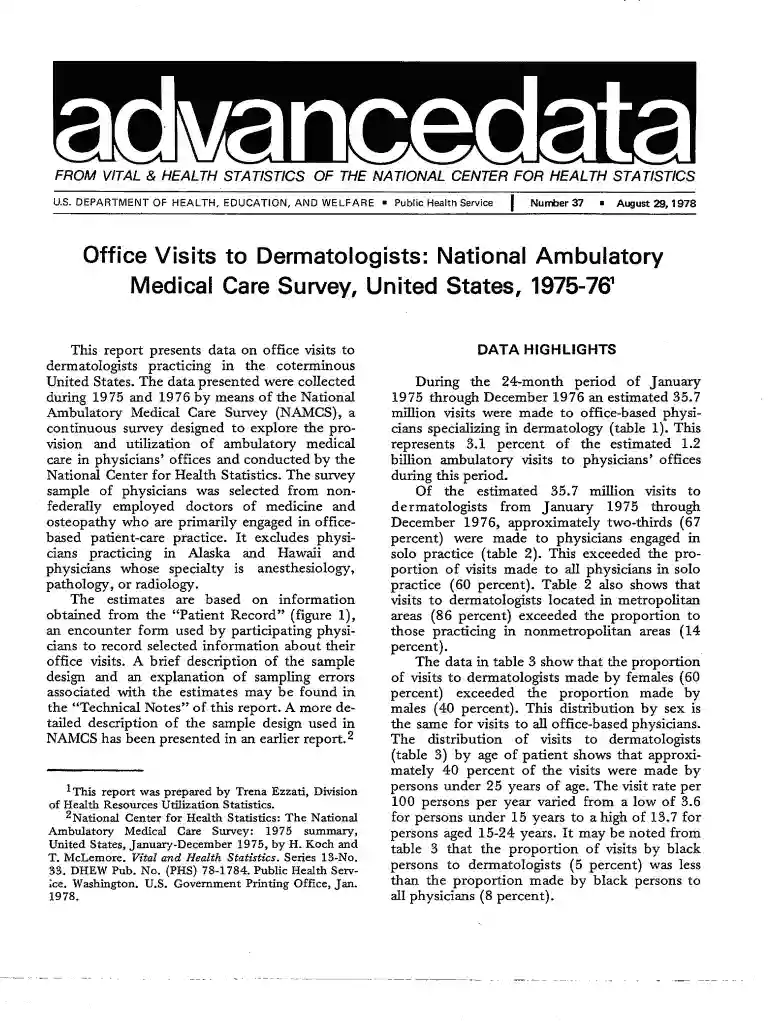
Office Visits to Dermatologists - cdc, based on data from the National Ambulatory Medical Care Survey (NAMCS), provides insights into dermatological consultations in the United States. In 1975-76, approximately 35.7 million visits were recorded, representing 3.1% of total ambulatory visits. This data is crucial for understanding trends in patient demographics, typical conditions treated, and the setting of these consultations.
The data can be leveraged by health policy makers, healthcare providers, and researchers to identify areas needing improvement or additional resources and to better understand patient demographics and common skin conditions presented during office visits.
Access to this data can generally be obtained through the Centers for Disease Control and Prevention (CDC) or reports published from the National Ambulatory Medical Care Survey. Researchers and policy makers often need this data for strategic planning and educational purposes.
Understanding the specific components of the data from the NAMCS report is essential. This includes demographic statistics, common conditions treated, and details about the practice settings.
Familiarity with relevant medical and statistical terms is crucial for interpreting the data accurately. This includes understanding terms like "ambulatory visits" and "metropolitan areas."
Different states might have specific regulations influencing how dermatological services are rendered or reported. These differences can impact the data analysis and service delivery.
While the data itself doesn't directly relate to filing deadlines, understanding the timeline for accessing and submitting related data requests is important for timely analysis.
Accessing detailed datasets may require possession of specific identification or approval documents. Awareness of submission methods ensures efficient data access.
By comprehensively understanding these elements of the Office Visits to Dermatologists - cdc, stakeholders can maximize the utility of this data for enhancing healthcare services, research, and policy development related to dermatology in the U.S.
We've got more versions of the Office Visits to Dermatologists - cdc form. Select the right Office Visits to Dermatologists - cdc version from the list and start editing it straight away!
At DocHub, your data security is our priority. We follow HIPAA, SOC2, GDPR, and other standards, so you can work on your documents with confidence.