






Definition and Meaning of Cold Case Identification
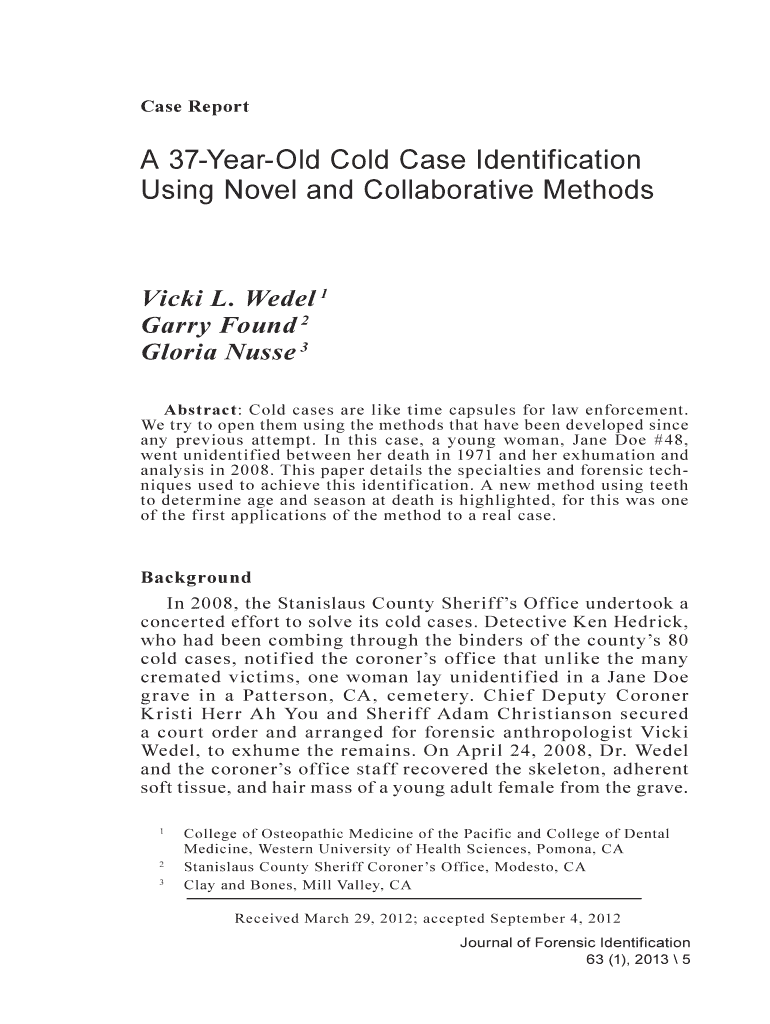
A cold case identification refers to the process of solving a criminal investigation that has remained unsolved for an extended period, typically due to a lack of evidence or leads. In the context of the A 37-Year-Old Cold Case Identification, this involves revisiting a case that dates back 37 years, using modern forensic techniques and interdisciplinary collaboration to uncover new evidence and make an identification. The primary goal is to bring closure to cases that have languished unresolved for decades, offering justice for the victims and their families.
Steps to Complete the Cold Case Identification Process
-
Case Review and Evidence Gathering: Re-examining existing files, evidence, and witness statements to establish a baseline understanding of the case.
-
Forensic Analysis and Testing: Utilizing contemporary forensic methods, such as DNA profiling or chemical analysis, to test old evidence for new leads.
-
Interdisciplinary Collaboration: Engaging experts from various fields, including forensic anthropology, odontology, and pathology, to provide a holistic view of the evidence.
-
Comparative Analysis: Cross-referencing gathered data with national and international databases to identify potential matches for victims or suspects.
-
Facial Reconstruction and Profiling: Creating facial reconstructions based on skeletal remains, if available, to generate leads from the public or surviving community.
-
Public Appeals and Information Sharing: Disseminating updated information to the public through various media channels to solicit additional tips or information.
-
Report Compilation and Legal Review: Formulating a detailed report of findings and presenting it to legal authorities for potential reopening and further action in the case.
Importance of Solving a Cold Case
Solving a cold case has significant implications not only for the justice system but also for the families impacted. Bringing closure to families who have waited decades for answers provides emotional relief and a sense of justice served. It also helps refine investigative techniques and methodologies, contributing to the body of knowledge in forensic science and criminal investigations. Moreover, solving such cases can expose systemic issues, such as mismanaged evidence or procedural gaps, prompting reforms within law enforcement agencies.
Key Elements in Cold Case Investigations
-
Forensic Technology: The use of cutting-edge technology like DNA analysis, forensic genealogy, and digital simulations to uncover new leads.
-
Interdisciplinary Approach: Collaboration across various forensic disciplines to maximize the depth and accuracy of the investigation.
-
Public and Media Engagement: Leveraging public interest and media coverage to gather information and maintain transparency in the investigation process.
-
Database Utilization: Accessing and continuously updating databases that house genetic and dental records, missing persons reports, and criminal profiles to aid in identification.
Legal Use and Considerations
The legal process involved in cold case identification must strictly adhere to jurisdictional laws regarding the handling and analysis of evidence. Careful documentation and chain-of-custody protocols are crucial to ensure findings are admissible in court. Furthermore, any newly obtained evidence must be re-evaluated under current legal standards, which might differ significantly from those during the original investigation period.
Examples of Successful Cold Case Resolutions
In recent years, several decades-old cases have been resolved through advanced forensics and community involvement. For instance, the identification of the Golden State Killer in California was a groundbreaking case solved through forensic genealogy. Another example includes the identification of John Wayne Gacy's unknown victims using modern DNA techniques, which brought closure to affected families. These cases highlight the pivotal role of technology and collaboration in resolving cold case investigations.
Technological and Database Integration in Cold Case Work
Modern cold case investigations rely heavily on technology integration, such as the Combined DNA Index System (CODIS), which stores DNA profiles from convicted offenders, unsolved crime scene evidence, and missing persons. Additionally, forensic advancements like 3D scanning and AI-driven facial reconstruction software can generate new leads by reconstructing likely scenarios or appearances, drawing public assistance in complex cases.
Variations and Alternatives in Cold Case Methodologies
Cold case investigations may adopt diverse methodologies depending on the case specifics and available resources. In some situations, traditional detective work, such as re-interviewing witnesses or leveraging witness protection programs, might be more effective. In other cases, crowd-sourcing through social media or television programs dedicated to true crime can complement official efforts by gathering broader input and perspectives potentially overlooked by initial investigations. Each case requires a tailored approach to maximize the chance of resolution.