







Understanding Definitions of Acids and Bases
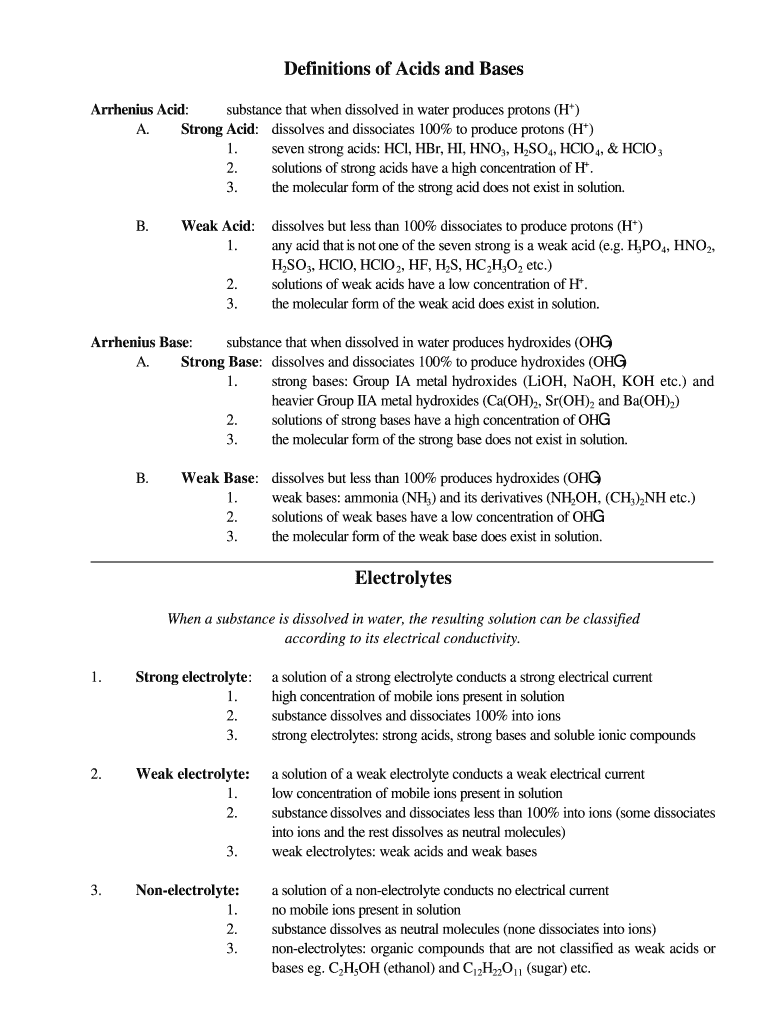
The "Definitions of Acids and Bases" primarily revolves around the foundational concepts within chemistry, showcasing how distinct chemical substances interact in aqueous solutions. Recognizing the diverse interpretive frameworks scientists use is crucial, such as the Arrhenius definition that classifies acids and bases based on their ion production in water.
Strong and Weak Acids and Bases
A pivotal classification within this topic is distinguishing between strong and weak acids and bases. Strong acids and bases fully dissociate in water, releasing ions, thus efficiently conducting electricity. For example, hydrochloric acid (HCl) is a strong acid, whereas acetic acid (CH₃COOH) is considered weak due to its partial dissociation. This classification affects electrolyte categorization, crucial in understanding chemical behavior in solutions.
Examples:
- Strong Acids: Hydrochloric acid (HCl), sulfuric acid (H₂SO₄)
- Weak Acids: Acetic acid (CH₃COOH), citric acid (C₆H₈O₇)
- Strong Bases: Sodium hydroxide (NaOH), potassium hydroxide (KOH)
- Weak Bases: Ammonia (NH₃)
Key Elements of the Definitions
The definitions provide insights into how substances interact chemically. Acids, known for donating protons (H⁺ ions), are contrasted with bases, which accept these protons or release hydroxide ions (OH⁻). Understanding these interactions is vital in various chemical processes, such as neutralization reactions where acids and bases neutralize each other to form water and a salt.
Important Terms Related to Definitions
To fully grasp these definitions, familiarization with certain terms is beneficial:
- Dissociation: Refers to the process where acids or bases split into ions in a solution.
- pH Scale: Measures the acidity or basicity of a solution; a lower pH indicates acidity, while a higher pH indicates basicity.
- Electrolytes: Substances that conduct electricity in solution due to ion formation.
How to Use the Definitions
Understanding these definitions is fundamental in both academic and practical situations. In educational settings, they form the basis for studying more advanced chemistry topics like organic chemistry and biochemistry. In industrial applications, knowing the strength of acids and bases can affect product formulation and safety protocols.
Practical Applications:
- Educational Contexts: Used to elucidate chemical equations and reactions.
- Industrial Usage: Critical in manufacturing processes including pharmaceuticals and cleaning agents.
Legal Use and Safety Guidelines
In lab and industrial environments, guidelines surrounding the handling and usage of acids and bases are crucial for safety and regulatory compliance. These include proper labeling, storage, and disposal methods to prevent harmful chemical reactions or exposures.
Safety Measures:
- Labeling: Ensure clear identification to avoid misuse.
- Storage: Store strong acids and bases separately and in appropriate containers.
- Handling Equipment: Use protective gear like gloves and goggles.
Example Scenarios of Usage
The definitions can be illustrated through various scenarios, each highlighting specific characteristics of acids and bases.
Real-World Scenarios:
- Chemical Manufacturing: Determining the right acid or base for reaction processes.
- Educational Experiments: Demonstrating precise pH changes with indicators.
- Household Cleaning: Differentiating between acidic and basic cleaning agents for specific stains or surfaces.
Software Compatibility and Digital Usage
Modern educational tools and laboratory systems are designed to accommodate comprehensive information on acids and bases. Platforms like TurboTax or QuickBooks, although primarily financial, might necessitate understanding chemical transaction data for specific industry applications.
Digital Tools:
- Education Apps: Interactive simulations help visualize acid-base reactions.
- Laboratory Software: Tracks chemical inventory and reaction logs.
State-by-State Differences in Regulations
While the basic scientific principles are universal, regulations concerning chemical handling, labeling, and disposal might vary by state. Understanding these differences is essential for compliance in educational and industrial settings.
Regulatory Variations:
- Labeling Requirements: Some states may have stricter guidelines.
- Disposal Regulations: Differences in how states require excess or dangerous chemicals to be disposed of environmentally responsibly.
Quick Reference Facts
- Arrhenius Definition: Focuses on ion production in water.
- pH Importance: Critical for determining chemical behavior.
- Electrolyte Classification: Based on electrical conductivity in solution.
- Safety Protocols: Must adhere to state and federal guidelines for handling.
- Educational Role: Fundamental in academic chemistry programs.
Providing a comprehensive understanding of the definitions of acids and bases is essential for both foundational chemistry education and practical application in various industries and regulatory environments.




