






Definition and Meaning of Dynamic Fault-Tolerant Routing
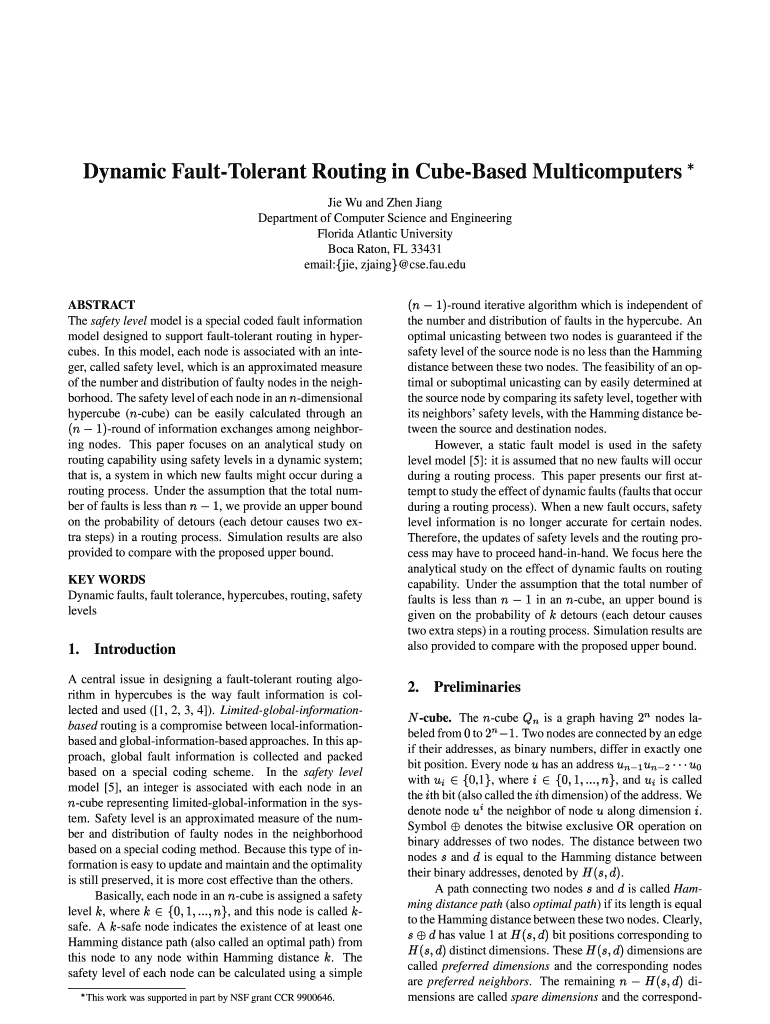
Dynamic fault-tolerant routing in cube-based multicomputers refers to a network routing protocol used in hypercube computer topologies. This system is designed to ensure data packets can effectively circumvent node or path failures without compromising the overall network's efficiency and reliability. It uses a safety level model to allocate an integer to each node, denoting the likelihood and distribution of nearby faulty nodes.
Key Concepts
- Hypercube Networks: A type of network architecture that arranges nodes in the form of a hypercube. This structure is used to connect multiple processors for parallel computing.
- Safety Level: An integer assigned to each node, representing fault tolerance metrics.
- Probabilistic Detours: The approach assesses possible reroutes due to node failures and predicts the probability of detouring from the intended path.
Real-World Application
Dynamic fault-tolerant routing is crucial in large-scale parallel computing environments such as scientific simulations, data centers, and AI computations, where maintaining high-level consistency and minimal downtime is essential.
How to Use the Dynamic Fault-Tolerant Routing Protocol
Implementing the dynamic fault-tolerant routing protocol in a hypercube multicomputer involves several technical steps, which assure the network maintains operational integrity even in the presence of faults.
Implementation Steps
- Node Configuration: Each node must be configured with its positional coordinates within the cube-based architecture.
- Fault Detection and Update: Implement software to continuously monitor node status and update the safety level integer when faults are detected.
- Routing Algorithm Installation: Deploy the routing algorithm across the nodes with predefined rules that allow for dynamic decision-making when faults are encountered.
- Testing and Validation: Run simulations to ensure the routing effectively navigates faults, with an emphasis on optimizing detour probability.
Practical Considerations
Organizations should ensure robust node monitoring systems and regularly update routing algorithms to adapt to new network conditions or hardware upgrades.
Important Terms Related to Routing in Cube-Based Multicomputers
Understanding certain technical terms is fundamental when dealing with dynamic fault-tolerant routing in cube-based systems.
Core Terms
- Hypercube: A multi-dimensional cube having nodes on its vertices, often used in parallel computing networks.
- Node Fault: Any failure or malfunction at a network node preventing it from operating correctly.
- Routing Algorithm: The method by which data is routed through a network.
- Safety Level Model: A model that assesses each node's reliability based on neighboring faults.
- Detour Probability: A likelihood measure of rerouting due to network faults.
Key Elements of the Dynamic Fault-Tolerant Routing
Several elements form the backbone of the dynamic fault-tolerant routing system. These elements work in synergy to ensure network resilience.
Components and Features
- Routing Tables: Maintain dynamic updates of available paths and fault metrics.
- Fault Tolerance Metrics: Monitored by the safety level integer at each node.
- Adaptive Path Selection: The algorithm's ability to choose the shortest viable path under dynamic conditions.
- Real-Time Monitoring: Involves continuous tracking of node health and path availability.
Examples of Using Dynamic Fault-Tolerant Routing
To contextualize its application, consider various scenarios where dynamic fault-tolerant routing proves advantageous.
Use Cases
- Data Centers: When a server within a hypercube-like topology fails, the routing protocol quickly adjusts paths to maintain data flow.
- Supercomputing Tasks: Supports high-processing activities such as weather forecasting or complex simulations by ensuring minimal interruption from node faults.
- AI Research: By providing a reliable network, complex machine learning models can be trained without data loss due to node failures.
Legal Use and Compliance
While the topic primarily focuses on technological aspects, it’s essential to be aware of any potential legal implications when deploying such systems, especially concerning data security and compliance with industry standards.
Compliance Considerations
- Data Protection Regulations: Ensure that node monitoring systems comply with data protection laws and maintain necessary data privacy standards.
- Network Security Protocols: Integrate robust security measures to protect against unauthorized access or potential cyber threats aimed at exploiting network vulnerabilities.
Software Compatibility and Adaptation
Compatibility with various software environments ensures smooth integration and function of dynamic fault-tolerant routing systems.
Compatible Software Environments
- Parallel Computing Platforms: Must support the routing algorithms needed for hypercube configurations.
- Network Management Tools: Software that can visualize and manage network health, such as SNMP-based tools.
- Custom Simulation Software: Required to test and validate routing performance under simulated fault conditions before deployment.
Business Types That Benefit Most From Dynamic Fault-Tolerant Routing
Certain industries and business types see enhanced operational efficiency and resilience through the implementation of these systems.
Ideal Industries
- Technology Firms: Companies with large-scale data centers, such as cloud service providers or organizations engaged in high-performance computing (HPC).
- Research Institutions: Facilities running computationally intensive research rely on uninterrupted network performance.
- Telecommunications: Network providers benefit from fault-tolerant routing to maintain service quality in the face of component failures.
Each of these domains can leverage dynamic fault-tolerant routing to align with their operational and service delivery goals, ensuring robust and seamless performance across computational architecture.