






Definition & Meaning
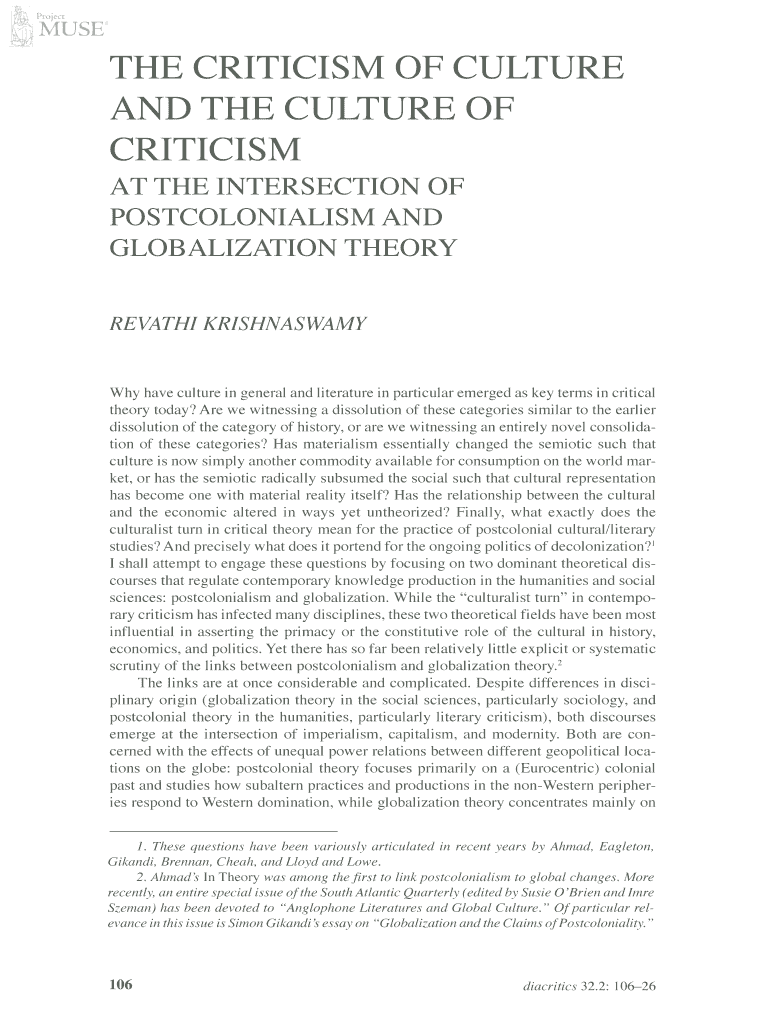
The document titled "The Criticism of Culture and the Culture of Criticism" delves into contemporary critical theory, especially regarding postcolonialism and globalization. It examines culture's commodification, cultural representation's impact on material reality, and the dynamic interactions that affect postcolonial cultural studies. Understanding these terms provides insights into the broader discourse about how cultures are perceived and critiqued in a global context.
Key Elements of the Document
- Cultural Commodification: Evaluates how cultural items are turned into marketable goods within global markets.
- Cultural Representation: Discusses the link between cultural portrayal and practical material conditions.
- Interplay of Theories: How postcolonial theory critiques Western cultural dominance and globalization theory highlights cross-border cultural flow.
Steps to Complete the Use of the Document
- Understanding the Context: Familiarize yourself with the core theories and terms—postcolonialism, globalization, cultural commodification.
- Reading and Annotation: Make detailed notes as you read to capture major themes and arguments.
- Critical Analysis: Reflect on the implications of the cultural critiques presented and consider how they apply to modern global contexts.
- Discussion and Application: Engage in dialogue with peers or apply theories to current cultural phenomena.
Who Typically Uses This Document
- Academics and Researchers: Those studying cultural criticism, postcolonial theory, or globalization.
- Students: Particularly those in cultural studies, literature, or social sciences.
- Critics and Cultural Analysts: Individuals who analyze cultural trends and theories in society.
How to Obtain the Document
- Online Academic Platforms: Accessible through educational resources like JSTOR or university libraries.
- Institutional Repositories: Available through institutions that house scholarly work on critical theory and cultural studies.
Examples of Using the Document
- Case Study Analysis: Applying theories to examine a specific cultural artifact or phenomenon.
- Essay Development: Using insights to craft arguments in essays on cultural criticism.
- Research Papers: Integrating its findings and arguments to support or contest scholarly positions on cultural and postcolonial studies.
Important Terms Related to the Document
- Postcolonial Theory: Examines the lasting impact of colonialism on cultures and societies.
- Globalization Theory: Studies the interconnectedness of societies and cultures across the world.
- Neoliberalism: Economic and political approach that affects cultural practices and critical engagement.
Legal Use and Context
- Academic Integrity: Ensure proper citation when referencing the document in academic or professional work.
- Research Ethics: When utilizing the document for research, adhere to ethical standards of source usage and attribution.
Eligibility Criteria
- Prerequisite Knowledge: Users should have a foundational understanding of critical theory and global cultural dynamics.
- Access Requirements: Availability might be limited to institutions that have subscriptions to scholarly databases.


Software Compatibility
While not directly related to digital documentation like PDF forms, understanding and accessing scholarly documents often requires compatible software such as PDF readers or academic database access tools.
Business Types That Benefit Most
- Educational Institutions: Utilized as part of cultural and critical studies programs.
- Research Facilities: Integral for cultural research initiatives exploring postcolonial and globalization impacts.
Understanding these facets ensures comprehensive engagement with the document, allowing users to fully grasp its contributions to cultural and critical theory discourse.