Definition and Purpose of the P87 Form
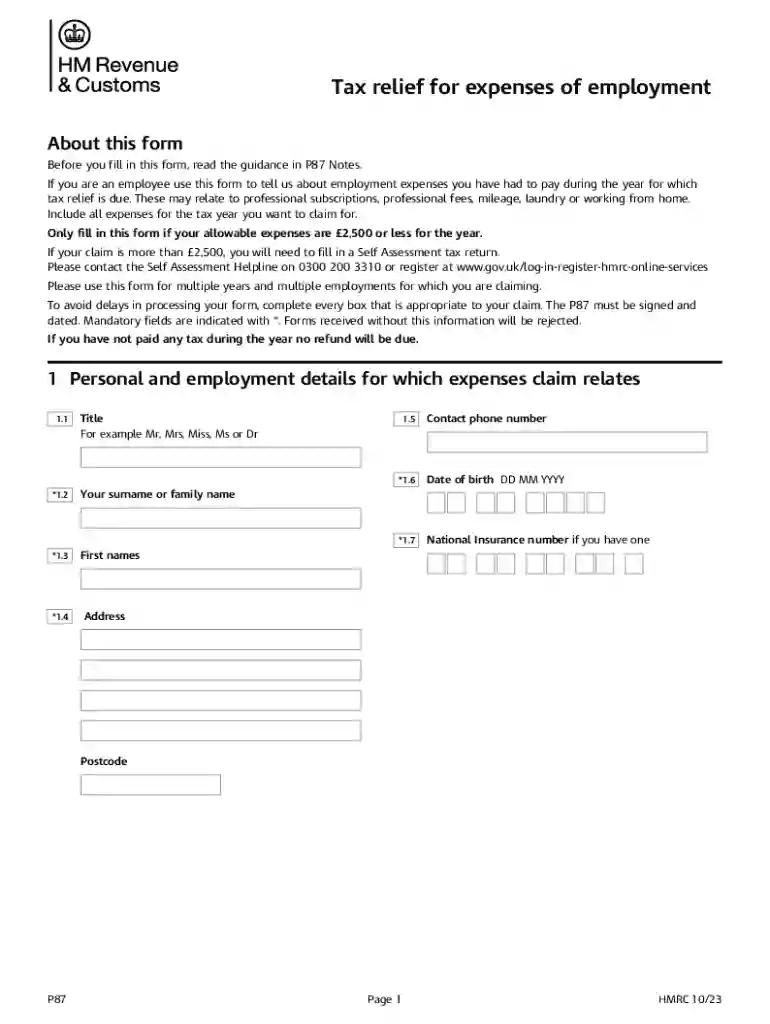
The P87 form is a document used by UK employees to claim tax relief for employment-related expenses incurred as part of their job. It is essential for costs that are not reimbursed by the employer and for amounts up to £2,500. These expenses can include, but are not limited to, professional subscriptions, uniform costs, business travel, and working from home. The purpose of this form is to ensure that employees can recover costs directly related to their employment without directly impacting their disposable income.
Key Elements of the P87 Form
Completing the P87 form requires several key pieces of information. These include:
- Personal Information: Full name, National Insurance number, address, and contact details.
- Employment Details: Employer's name and address, PAYE reference number, and job title.
- Expense Breakdown: Detailed list of expenses, categorized by type, such as travel, training, and tools. Supporting documentation is crucial for accuracy and should include receipts and invoices.
- Claim Total: The aggregate amount of all claimed expenses. The form guides users through calculating this sum, ensuring clarity and correctness.
Eligibility Criteria for Claiming Tax Relief
To qualify for tax relief via the P87 form, certain criteria must be met:

- Employment-Based Expenses: The costs must be essential for performing your job duties and not reimbursed by the employer.
- Expense Type and Limit: Only expenses up to £2,500 are claimable through the P87. For claims over this threshold, a different method may be necessary.
- Taxpayer Status: The individual must be a PAYE taxpayer in the UK.
- Documentation: Claimants must provide evidence of the expenses, reflecting careful record-keeping habits, including logs, receipts, or other official documents.
Step-by-Step Completion of the P87 Form
- Gather Documentation: Compile all necessary receipts and records for expenses.
- Complete Personal Details: Fill out your full name, National Insurance number, and home address.
- Fill in Employment Information: Provide the employer’s PAYE reference and other employment details.
- List Each Expense: Enter each expense individually with its respective category.
- Calculate Total Claimable Expenses: Sum all expenses to ensure the total does not exceed the £2,500 limit.
- Review and Submit: Careful review for completeness, then submit to HMRC by mail or online, ensuring a copy is kept for personal records.
Common Mistakes and How to Avoid Them
Several common mistakes can occur when completing the P87 form:
- Incomplete Information: Missing personal or employment details can delay processing. Double-checking these sections is critical.
- Incorrect Expense Categorization: Misclassifying expenses can lead to queries or refusals; thorough knowledge of eligible expenses is essential.
- Lack of Evidence: Failing to provide documentation results in claims being rejected. Collection and organization of receipts and invoices are crucial.
- Miscalculations: Errors in addition or tax rate determination could result in incorrect claims. Use digital tools or spreadsheets to help with accuracy.
Importance of Accurate Reporting
Accurate reporting on the P87 form is of utmost importance. Errors or omissions can lead to audits or penalties. Accurate submissions ensure not only compliance with tax regulations but also that deserved relief is received. It protects against unnecessary scrutiny from HMRC and ensures that the tax relief process remains smooth and efficient for claimants. Detailed records back up the claims and prevent future issues.
Different Submission Methods
The P87 form can be submitted in several ways:
- Online Submission: HMRC’s online service allows digital completion and submission directly through their website.
- Mail Submission: Print and send the completed form with all supporting documents to the HMRC address.
- In-Person Submission: While less common, some individuals may submit forms directly at local tax offices.
Each method provides different convenience levels depending on individual circumstances, with online submission generally being the most efficient and traceable.
Impact of Incomplete or Incorrect Forms
Incomplete or incorrect forms have various repercussions, such as:
- Delayed Processing: Missing information results in longer wait times for processing.
- Rejection of Claims: Errors can lead to outright rejection, requiring resubmission.
- Potential Penalties: Consistent inaccurate reporting could lead to penalties or detailed investigations from HMRC.
- Loss of Entitled Relief: Errors mean losing potential tax relief, thus impacting personal finances negatively.
Ensuring forms are completed correctly and thoroughly prevents these issues and facilitates smooth processing.