




01. Edit your st19 form online
Type text, add images, blackout confidential details, add comments, highlights and more.

Type text, add images, blackout confidential details, add comments, highlights and more.

Draw your signature, type it, upload its image, or use your mobile device as a signature pad.

Send st 19 form via email, link, or fax. You can also download it, export it or print it out.
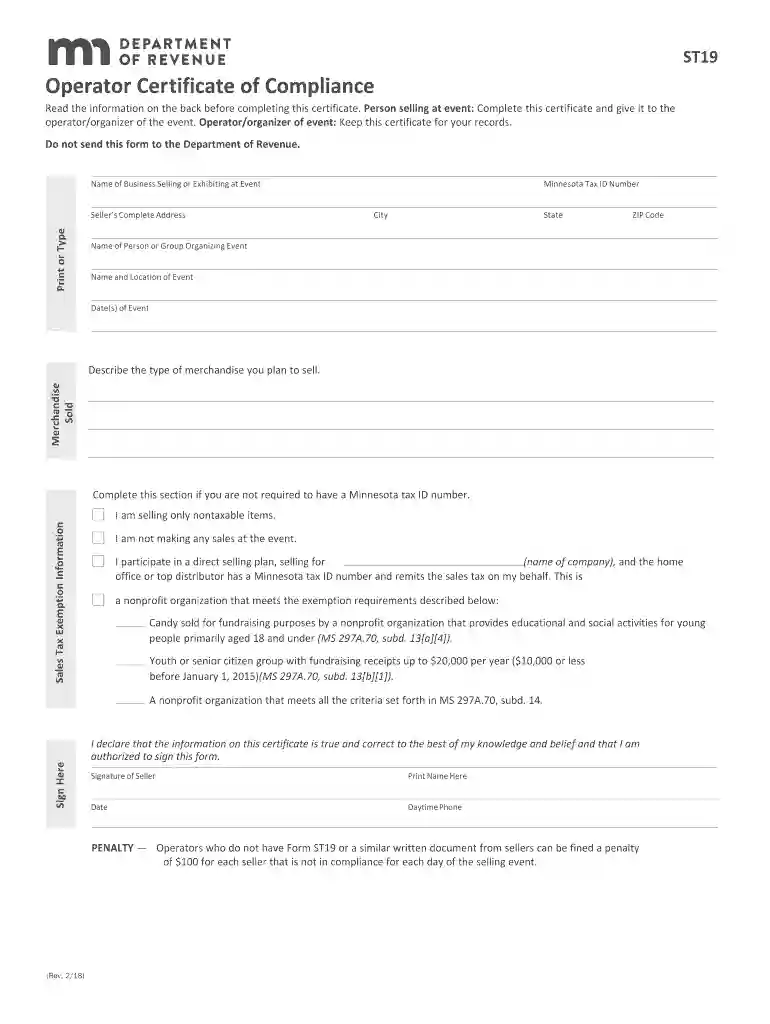
The ST19 form, or Operator Certificate of Compliance, is a crucial document in Minnesota for sellers participating in events and selling merchandise. It serves as a mechanism for businesses to certify their adherence to sales tax regulations. This document simplifies compliance and ensures sellers provide necessary information about their business, verifying that they are operating within the law.
The primary purpose of the ST19 form is to ensure compliance with Minnesota's sales tax laws. It requires sellers to certify that they understand their tax obligations and provide evidence of a valid Minnesota tax ID number. By obtaining this certificate, sellers can confirm their status with the Minnesota Department of Revenue, leading to smoother transactions during events.
The ST19 form consists of several key components that sellers must complete accurately. These include:
Completing the ST19 form involves several steps to ensure accuracy and compliance:
While completing the ST19 form, sellers may encounter common issues that can delay processing:
Failure to comply with the guidelines set forth by the ST19 form can result in significant penalties:
For additional help regarding the ST19 form or compliance questions, sellers can reach out to several resources:
Certain sellers may qualify for exemptions under specific circumstances, such as those selling items classified differently for tax purposes. Detailed understanding of exemptions can enhance compliance and operational efficiency during events.
In some cases, there may be variations or updates to the ST19 form, requiring continual review of Minnesota's tax guidelines. Staying informed about the latest developments is crucial for ongoing compliance.
Understanding and correctly using the ST19 form is essential for anyone engaged in selling at events in Minnesota. Its utility lies in not only complying with tax laws but also promoting responsible business practices within the state. Sellers should approach this process with diligence to benefit from smooth operational experiences at events.
We've got more versions of the st19 form form. Select the right st19 form version from the list and start editing it straight away!
At DocHub, your data security is our priority. We follow HIPAA, SOC2, GDPR, and other standards, so you can work on your documents with confidence.



Form ST-19. COMMONWEALTH OF VIRGINIA. SALES AND USE TAX CERTIFICATE OF EXEMPTION. For use by shipping lines engaged in interstate or foreign commerce and byRead more
In this mode you can select the arrangement that you wish to play. There are 128 preset arrangements (eight each in POP1, POP2, SLOWPOP, LATIN POP, LATIN1,.Read more
Web st19 form is a document that sellers and event operators in minnesota must complete and exchange to comply with sales tax laws. You can also look for formsRead more


